

1 cent – Netherlands East Indies
Add to wishlist
Indonesia
Context
Years: 1855–1912
Country: Indonesia
Issuer: Netherlands East Indies
Ruler: Wilhelmina
Currency:
(1854—1948)
Demonetized: Yes
Total mintage: 667,185,741
Material
References
KM: #
Numista: #7254
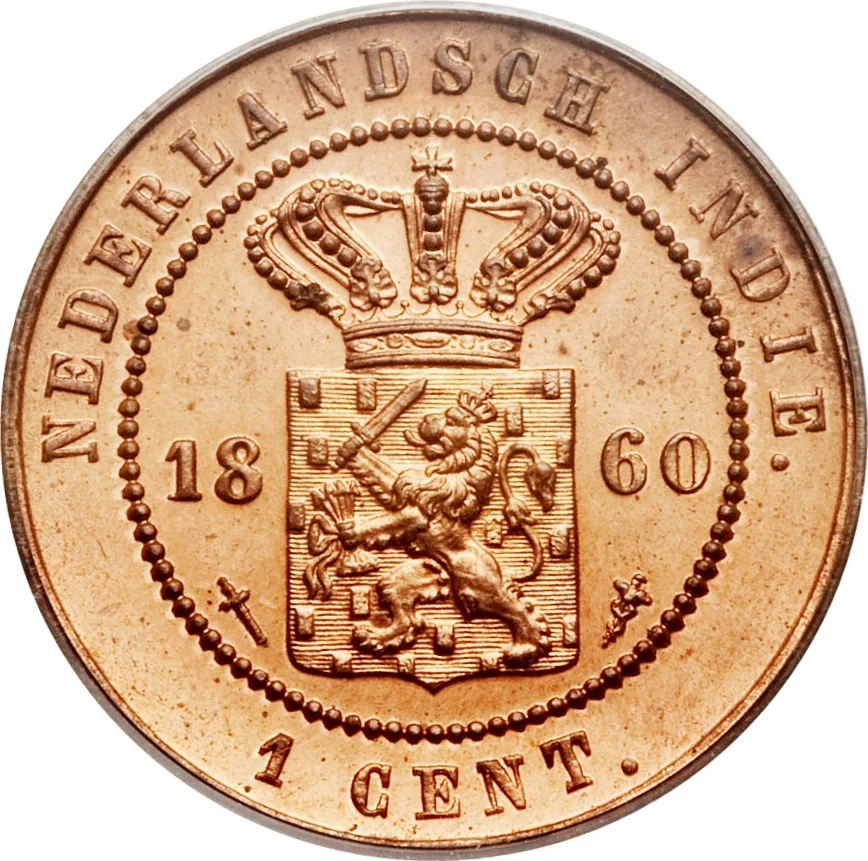
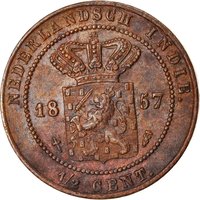
Obverse
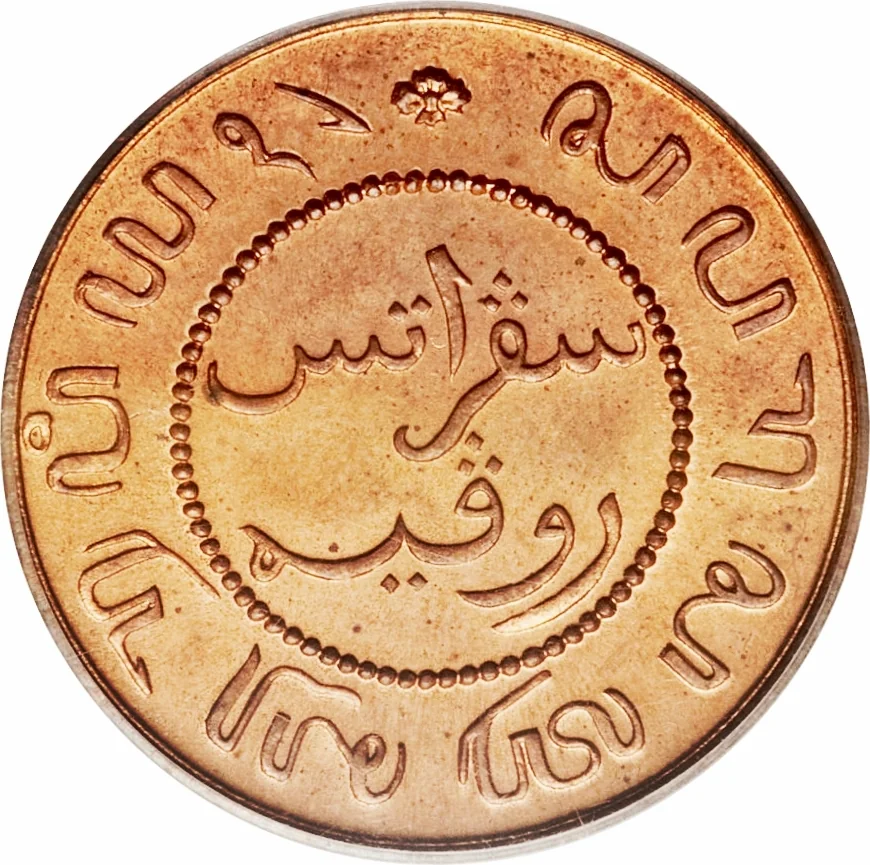
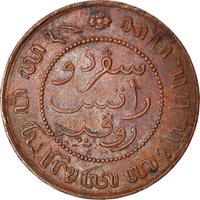
Reverse
Edge
Plain
Categories
| Symbols> Coat of Arms |
Mints
| Name | Mark |
|---|---|
| Royal Dutch Mint | — |
Mintings
| Year | Mint Mark | Mintage | Quality | Collection |
|---|---|---|---|---|
| 1855 | — | 100,000 | ||
| 1855 | — | — | Proof | |
| 1856 | — | — | Proof | |
| 1856 | — | 67,900,000 | ||
| 1857 | — | 162,000,000 | ||
| 1858 | — | 119,430,741 | ||
| 1859 | — | 40,800,000 | ||
| 1860 | — | 14,455,000 | ||
| 1896 | — | 60,400,000 | ||
| 1896 | — | — | Proof | |
| 1897 | — | 69,600,000 | ||
| 1897 | — | — | Proof | |
| 1898 | — | 36,600,000 | ||
| 1899 | — | — | Proof | |
| 1899 | — | 18,400,000 | ||
| 1901 | — | 15,000,000 | ||
| 1901 | — | — | Proof | |
| 1902 | — | 10,000,000 | ||
| 1907 | — | 7,500,000 | ||
| 1907 | — | — | Proof | |
| 1908 | — | 12,500,000 | ||
| 1908 | — | — | Proof | |
| 1909 | — | 7,500,000 | ||
| 1909 | — | — | Proof | |
| 1912 | — | 25,000,000 |
Historical background
In 1855, the currency system of the Netherlands East Indies (NEI) was a complex and often problematic dual system, officially based on the Dutch guilder but dominated in everyday use by the Spanish silver dollar (known locally as the rijksdaalder). The Dutch authorities had introduced the guilder, divisible into 100 cents, as the sole legal tender in 1826. However, the entrenched popularity and wide circulation of the Spanish and later Mexican silver dollars, trusted for their consistent silver content, meant the colony effectively operated with two parallel currencies. This created constant challenges for trade and administration, as the value of the silver dollar fluctuated against the guilder, leading to exchange rate instability and arbitrage.
The situation was further complicated by a chronic shortage of small change, which hampered daily transactions. To address this, the colonial government and private entities issued a proliferation of low-value copper duit coins and paper money in fractional denominations. This small-change currency often suffered from depreciation, especially outside Java, and counterfeiting was rampant. Consequently, public confidence in the official coinage was uneven, and the more reliable silver dollars remained the preferred medium for larger commercial dealings and savings.
Recognizing the inefficiencies, the colonial administration was actively working towards reform. The year 1855 fell within a transitional period leading to a major monetary overhaul. Just a few years later, in 1854-1857, the government would pass laws to finally demonetize the Spanish dollar and formally introduce a new, standardized silver Netherlands Indies guilder, aiming to unify the currency system under direct state control. Thus, the situation in 1855 was one of lingering tradition and disorder, poised on the brink of significant state-driven modernization to better serve the needs of the colonial export economy.
The situation was further complicated by a chronic shortage of small change, which hampered daily transactions. To address this, the colonial government and private entities issued a proliferation of low-value copper duit coins and paper money in fractional denominations. This small-change currency often suffered from depreciation, especially outside Java, and counterfeiting was rampant. Consequently, public confidence in the official coinage was uneven, and the more reliable silver dollars remained the preferred medium for larger commercial dealings and savings.
Recognizing the inefficiencies, the colonial administration was actively working towards reform. The year 1855 fell within a transitional period leading to a major monetary overhaul. Just a few years later, in 1854-1857, the government would pass laws to finally demonetize the Spanish dollar and formally introduce a new, standardized silver Netherlands Indies guilder, aiming to unify the currency system under direct state control. Thus, the situation in 1855 was one of lingering tradition and disorder, poised on the brink of significant state-driven modernization to better serve the needs of the colonial export economy.
🌱 Very Common