

2 piastres – Syria
Add to wishlist
Syria
Context
Year: 1926
Issuer: Syria
Period:
(1925—1930)
Currency:
(since 1919)
Demonetized: Yes
Total mintage: 600,000
Material
Diameter: 18 mm
Weight: 2 g
Shape: Round
Composition: Aluminium bronze
Magnetic: No
Technique: Milled
Alignment: Coin alignment
flip
References
KM: #
Numista: #11259
Value
Exchange value: 0.02 SYP
Obverse
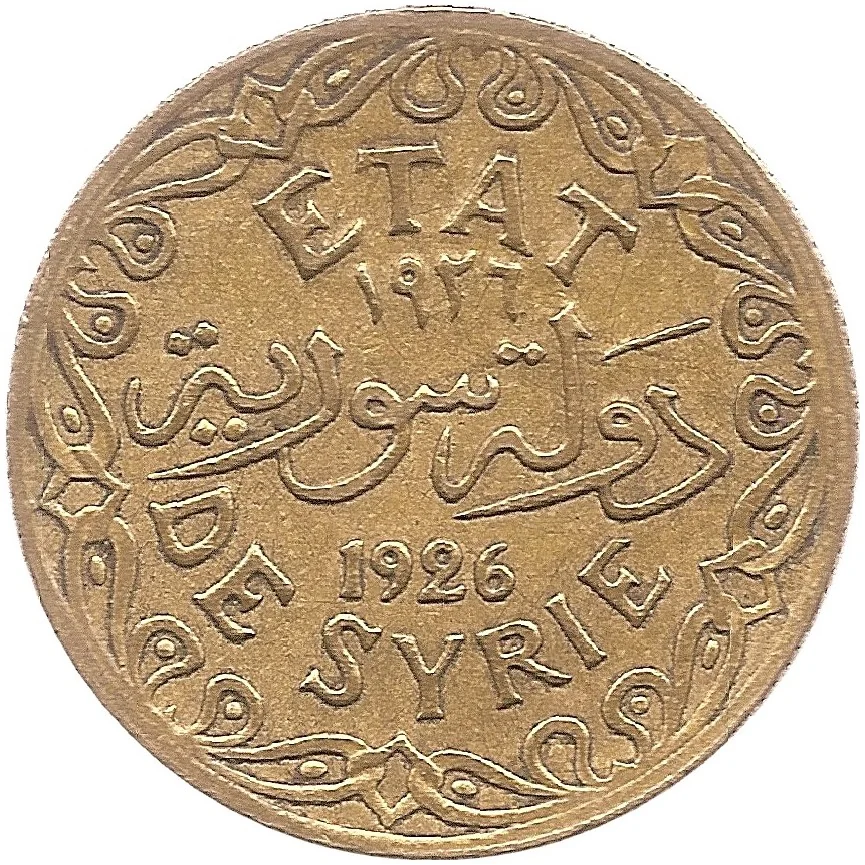
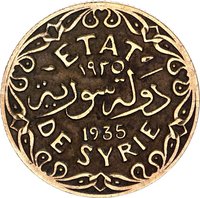
Inscription:
ETAT
١٩٢٦
دولة سورية
1926
DE SYRIE
١٩٢٦
دولة سورية
1926
DE SYRIE
Translation:
STATE OF SYRIA
1926
OF SYRIA
1926
OF SYRIA
Engraver: Henri-Auguste Patey
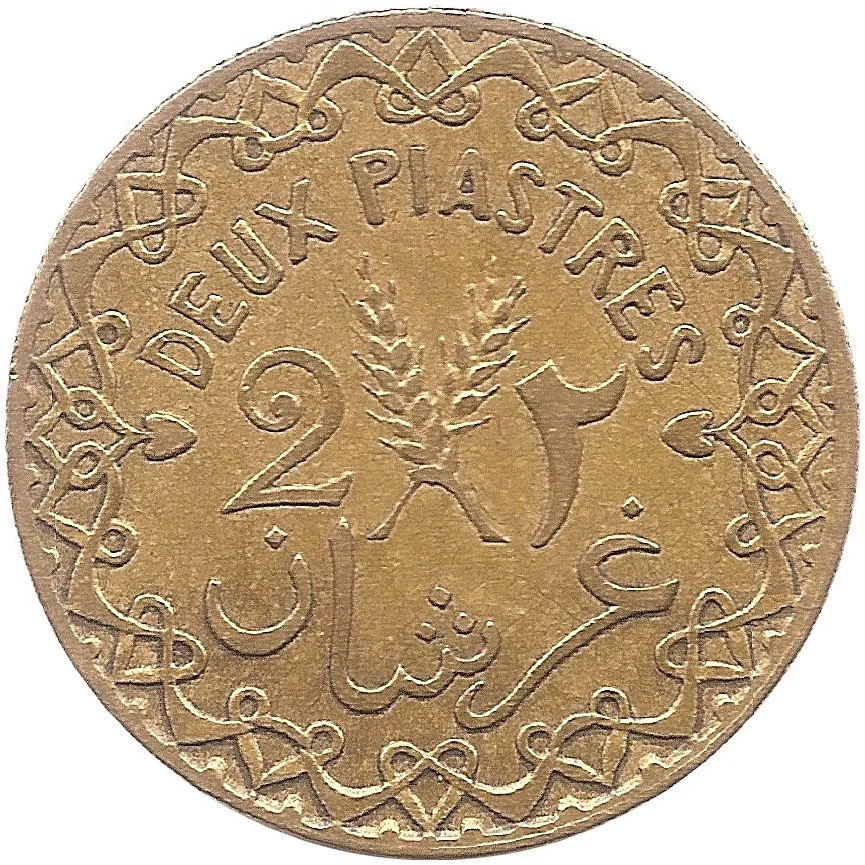
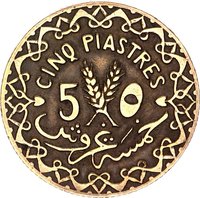
Reverse
Edge
Reeded
Mints
| Name | Mark |
|---|---|
| Monnaie de Paris | — |
Mintings
| Year | Mint Mark | Mintage | Quality | Collection |
|---|---|---|---|---|
| 1926 | — | 600,000 |
Historical background
In 1926, Syria's currency situation was defined by its status as a French Mandate, established after the fall of the Ottoman Empire. The Ottoman lira had collapsed following World War I, leading to a period of monetary instability and a proliferation of foreign currencies, including the Egyptian pound and the French franc. The Banque de Syrie et du Grand-Liban, a French-controlled institution granted the exclusive right of note issue, became the central monetary authority. Its initial banknotes, denominated in "livre syrienne" (Syrian pound), were effectively pegged to the French franc, firmly anchoring Syria's economy to that of the mandatory power.
This new currency faced significant public distrust and competition. Many Syrians, resentful of French colonial control, were hesitant to adopt the mandated currency, preferring instead gold Ottoman liras or other metallic currencies seen as more stable and independent. Furthermore, the monetary landscape was complicated by the simultaneous circulation of distinct banknotes issued for the territories of Lebanon, which shared the same currency board but featured different designs. This period was marked by an ongoing struggle for monetary sovereignty, as the mandatory authority worked to impose a unified, franc-backed paper currency on a skeptical population accustomed to gold.
Consequently, the year 1926 fell within a broader transitional and contentious phase in Syria's monetary history. The French mandate authority was actively working to consolidate its financial control through the Banque de Syrie, but the Syrian pound had not yet achieved full public acceptance or exclusive circulation. The situation reflected the larger political tensions of the mandate, with currency acting as a focal point for debates over national identity, economic dependency, and resistance to foreign administration.
This new currency faced significant public distrust and competition. Many Syrians, resentful of French colonial control, were hesitant to adopt the mandated currency, preferring instead gold Ottoman liras or other metallic currencies seen as more stable and independent. Furthermore, the monetary landscape was complicated by the simultaneous circulation of distinct banknotes issued for the territories of Lebanon, which shared the same currency board but featured different designs. This period was marked by an ongoing struggle for monetary sovereignty, as the mandatory authority worked to impose a unified, franc-backed paper currency on a skeptical population accustomed to gold.
Consequently, the year 1926 fell within a broader transitional and contentious phase in Syria's monetary history. The French mandate authority was actively working to consolidate its financial control through the Banque de Syrie, but the Syrian pound had not yet achieved full public acceptance or exclusive circulation. The situation reflected the larger political tensions of the mandate, with currency acting as a focal point for debates over national identity, economic dependency, and resistance to foreign administration.
🌟 Uncommon