

½ piastre – Syria
Add to wishlist
Syria
Context
Year: 1921
Issuer: Syria
Period:
(1921—1925)
Currency:
(since 1919)
Demonetized: Yes
Total mintage: 4,000,000
Material
Diameter: 21 mm
Weight: 4 g
Thickness: 1.42 mm
Shape: Round
Composition: Copper-nickel
Technique: Milled
Alignment: Coin alignment
flip
References
KM: #
Numista: #4832
Value
Exchange value: 0.005 SYP
Obverse
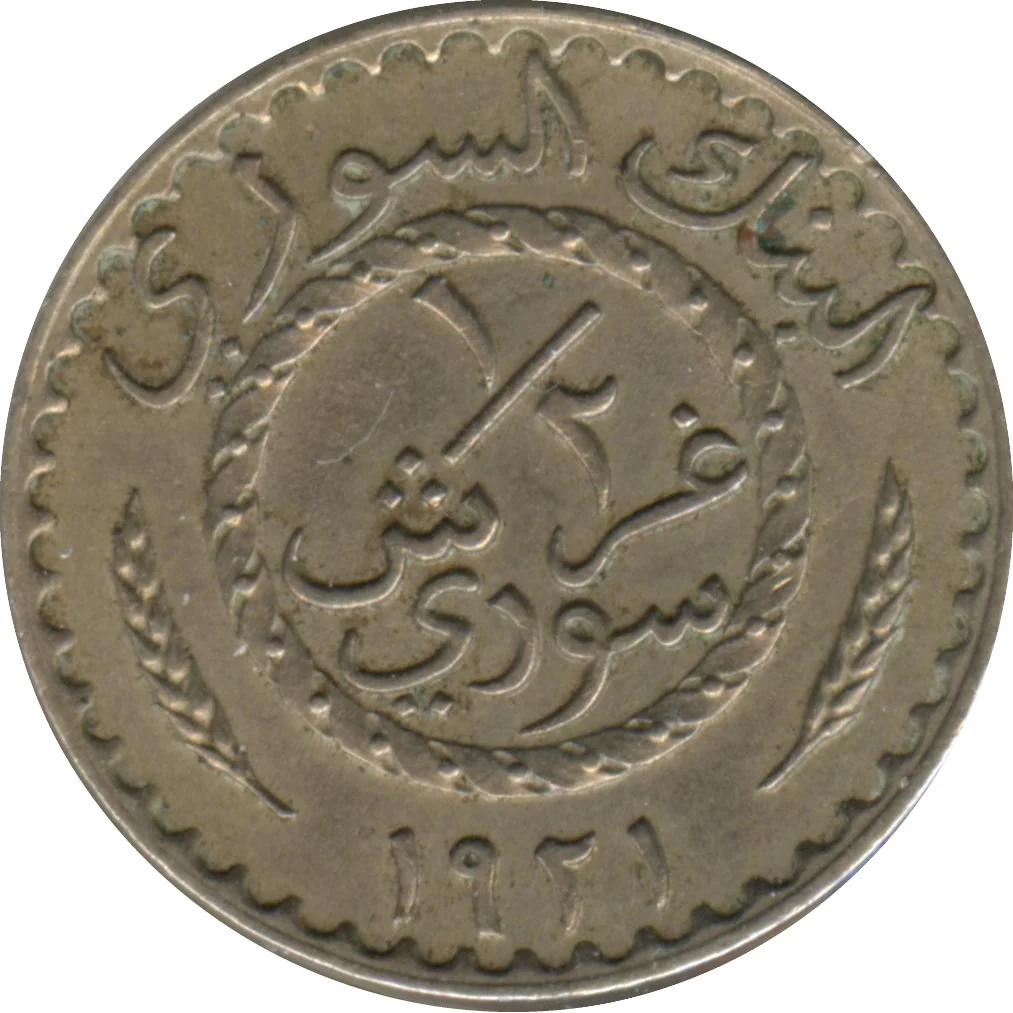
Description:
Arabic date and value in wreath, flanked by oat sprigs.
Inscription:
البنك السوري
١/٢
غرش
سوري
١٩٢١
١/٢
غرش
سوري
١٩٢١
Translation:
Syrian Bank
1/2
Piastre
Syrian
1921
1/2
Piastre
Syrian
1921
Script: Arabic
Language: Arabic
Engraver: Henri-Auguste Patey
Reverse
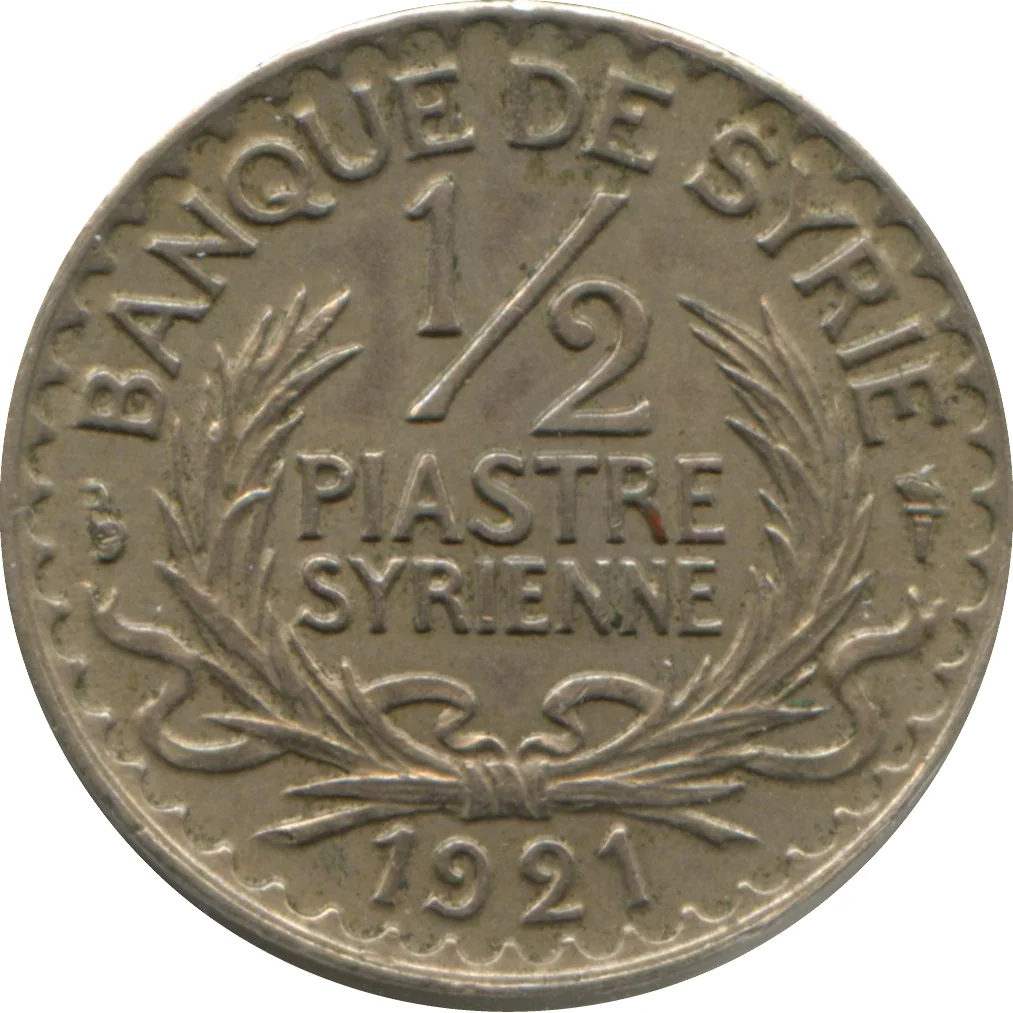
Description:
"Valeur" in French within a wreath.
Inscription:
BANQUE DE SYRIE
1/2
PIASTRE
SYRIENNE
1921
1/2
PIASTRE
SYRIENNE
1921
Translation:
BANK OF SYRIA
1/2
PIASTER
SYRIAN
1921
1/2
PIASTER
SYRIAN
1921
Script: Latin
Language: French
Engraver: Henri-Auguste Patey
Edge
Plain
Mints
| Name | Mark |
|---|---|
| Monnaie de Paris | — |
Mintings
| Year | Mint Mark | Mintage | Quality | Collection |
|---|---|---|---|---|
| 1921 | — | 4,000,000 |
Historical background
In 1921, Syria’s currency situation was defined by political transition and monetary fragmentation. Following the collapse of the Ottoman Empire after World War I, the French Mandate for Syria and Lebanon was formally established by the League of Nations in September 1920, though French military control began earlier. This period saw the circulation of a chaotic mix of currencies, including residual Ottoman gold liras and paper notes, Egyptian pounds (linked to the British sterling), and French francs. The lack of a unified, sovereign currency system reflected the region's instability and the nascent, contested authority of the French administration.
The French authorities moved to impose monetary order as part of their consolidation of power. In 1919, even before the Mandate was official, the French had established the Banque de Syrie, a private bank granted the privilege of issuing currency for Syria and Lebanon. In 1920, this bank began issuing a new currency, the Syrian pound or livre syrienne (also known as the Syrian lira), which was pegged at a fixed value to the French franc. However, in 1921, this currency was still in the early stages of circulation, competing with the plethora of existing currencies and struggling to gain public trust and widespread acceptance.
Thus, the monetary landscape in 1921 was one of duality: a formal, state-driven project to create a Franc-backed currency system coexisted with the practical reality of a heterogeneous and unstable currency market. This transition period was marked by significant economic uncertainty, as the value and acceptance of money varied greatly across regions and communities, undermining trade and economic recovery. The successful imposition of the Syrian pound as the sole legal tender would be a gradual process extending through the mid-1920s, as the French Mandate sought to fully integrate Syria into its economic sphere.
The French authorities moved to impose monetary order as part of their consolidation of power. In 1919, even before the Mandate was official, the French had established the Banque de Syrie, a private bank granted the privilege of issuing currency for Syria and Lebanon. In 1920, this bank began issuing a new currency, the Syrian pound or livre syrienne (also known as the Syrian lira), which was pegged at a fixed value to the French franc. However, in 1921, this currency was still in the early stages of circulation, competing with the plethora of existing currencies and struggling to gain public trust and widespread acceptance.
Thus, the monetary landscape in 1921 was one of duality: a formal, state-driven project to create a Franc-backed currency system coexisted with the practical reality of a heterogeneous and unstable currency market. This transition period was marked by significant economic uncertainty, as the value and acceptance of money varied greatly across regions and communities, undermining trade and economic recovery. The successful imposition of the Syrian pound as the sole legal tender would be a gradual process extending through the mid-1920s, as the French Mandate sought to fully integrate Syria into its economic sphere.
🌱 Common