

25 centesimi – Italy
Add to wishlist
Italy
Context
Years: 1902–1903
Issuer: Italy
Ruler: Vittorio Emanuele III
Currency:
(1861—2001)
Demonetization: 13 November 1908
Total mintage: 13,668,000
Material
References
KM: #
Numista: #7231
Value
Exchange value: 0.25 ITL
Obverse
Description:
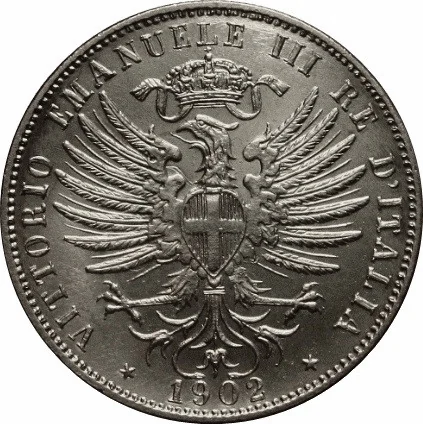
Heraldic eagle with Savoia shield, crowned, date below tail between stars.
Inscription:
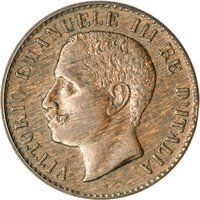
VITTORIO EMANUELE III RE D'ITALIA
1902
1902
Translation:
Victor Emmanuel III King of Italy
1902
1902
Script: Latin
Language: Italian
Engraver: Filippo Speranza
Reverse
Description:
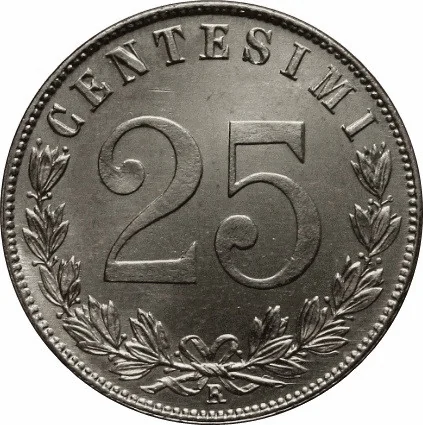
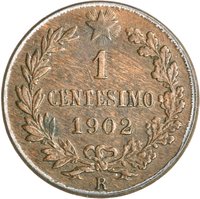
Between the laurel branches and mintmark.
Inscription:
CENTESIMI 25
Script: Latin
Engraver: Filippo Speranza
Edge
Reeded
Mints
| Name | Mark |
|---|---|
| Rome | R |
Historical background
In 1902, Italy's currency situation was defined by its adherence to the Latin Monetary Union (LMU), a pan-European agreement it had helped found in 1865. The country was officially on a bimetallic standard (gold and silver), but in practice, the lira was pegged to gold. This system aimed to stabilize exchange rates and facilitate trade with member nations like France, Belgium, and Switzerland. However, Italy's participation was fraught with difficulty, as persistent government budget deficits and a large public debt undermined international confidence in the lira.
The nation's finances were under significant strain. Years of heavy spending, including ambitious public works and military expansion, had led to chronic inflation and a suspension of gold convertibility for banknotes in 1866. While convertibility had been nominally restored, Italy's central bank, the Banca d'Italia, often struggled to maintain sufficient gold reserves. This resulted in a circulation of paper currency that was not fully backed by gold, creating a divergence between Italy's "paper lira" and the stronger "gold-based" currencies of its LMU partners. Consequently, Italian coinage often flowed out to other Union countries where it was melted down for its metal value, causing domestic shortages.
By the turn of the century, the situation was precarious but showing signs of managed stability. The government, led by figures like Finance Minister Luigi Luzzatti, was pursuing a policy of "quasi-convertibility" and fiscal austerity to align more solidly with LMU rules. The goal was to defend the lira's external value and fully return to the gold standard, a symbol of financial credibility. Thus, 1902 found Italy in a transitional phase, navigating the tensions between its formal international commitments and its fragile domestic fiscal reality, a balancing act that would continue for years.
The nation's finances were under significant strain. Years of heavy spending, including ambitious public works and military expansion, had led to chronic inflation and a suspension of gold convertibility for banknotes in 1866. While convertibility had been nominally restored, Italy's central bank, the Banca d'Italia, often struggled to maintain sufficient gold reserves. This resulted in a circulation of paper currency that was not fully backed by gold, creating a divergence between Italy's "paper lira" and the stronger "gold-based" currencies of its LMU partners. Consequently, Italian coinage often flowed out to other Union countries where it was melted down for its metal value, causing domestic shortages.
By the turn of the century, the situation was precarious but showing signs of managed stability. The government, led by figures like Finance Minister Luigi Luzzatti, was pursuing a policy of "quasi-convertibility" and fiscal austerity to align more solidly with LMU rules. The goal was to defend the lira's external value and fully return to the gold standard, a symbol of financial credibility. Thus, 1902 found Italy in a transitional phase, navigating the tensions between its formal international commitments and its fragile domestic fiscal reality, a balancing act that would continue for years.
🌱 Fairly Common