

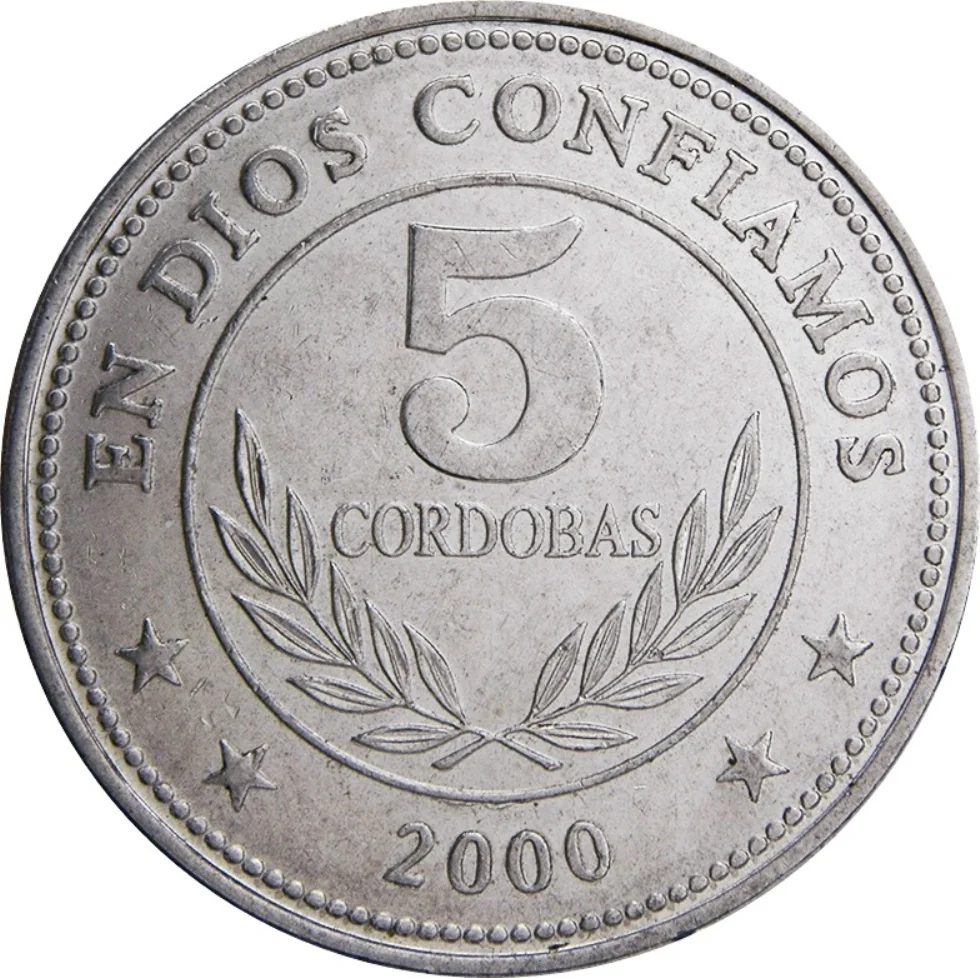
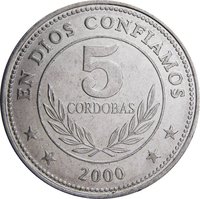
5 Córdobas – Nicaragua
Nicaragua
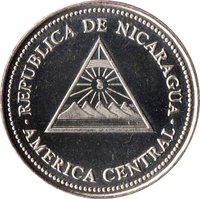
Obverse
Description:
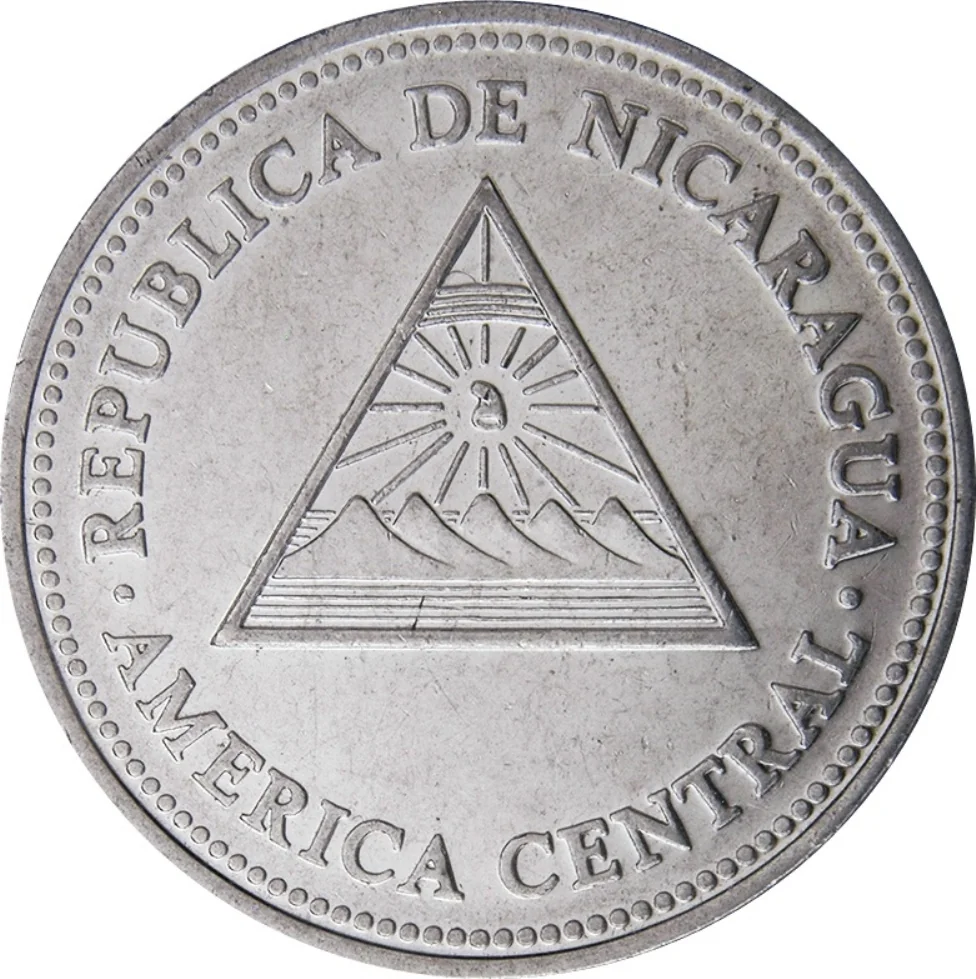
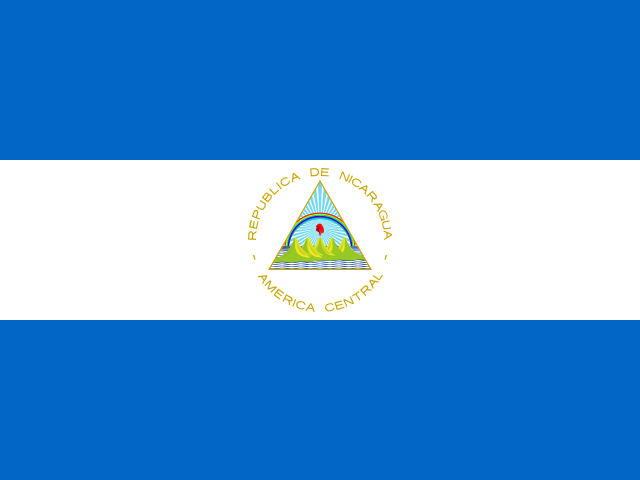
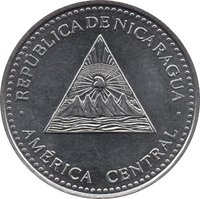
The Nicaraguan coat of arms features a triangle for equality, a rainbow for peace, a Phrygian cap for liberty, and five volcanoes representing Central American unity. The water lines are flat.
Inscription:
REPUBLICA DE NICARAGUA
AMERICA CENTRAL
AMERICA CENTRAL
Translation:
REPUBLIC OF NICARAGUA
CENTRAL AMERICA
CENTRAL AMERICA
Script: Latin
Language: Spanish
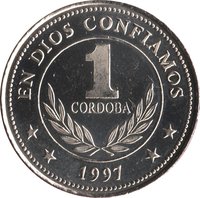
Reverse
Edge
Reeded
Categories
| Symbols> Coat of Arms |
| Symbol> Wreath |
Mints
| Name | Mark |
|---|---|
| Royal Canadian Mint of Winnipeg | — |
| Vereinigte Deutsche Nickelwerke | — |
Mintings
| Year | Mint Mark | Mintage | Quality | Collection |
|---|---|---|---|---|
| 1997 | — | 11,000,000 | ||
| 2000 | — | 25,000,000 |
Historical background
In 1997, Nicaragua's currency situation was defined by the ongoing stabilization of the Córdoba Oro (NIO), following a period of extreme hyperinflation and economic turmoil in the late 1980s and early 1990s. A pivotal reform occurred in 1991 with the introduction of a new "gold córdoba," which was pegged to the US dollar at a fixed rate of 5:1 (5 córdobas = 1 USD) as part of a strict stabilization program under President Violeta Chamorro. By 1997, this fixed exchange rate regime remained firmly in place, providing a crucial anchor for prices and helping to curb the inflationary psychology that had devastated the economy.
The stability of the córdoba was artificially maintained by the Central Bank of Nicaragua, which required tight monetary discipline and significant foreign exchange reserves. This policy succeeded in bringing inflation down from over 13,000% in 1990 to approximately 12.4% in 1996, with it falling further to around 7.2% in 1997. However, this stability came with significant trade-offs. The overvalued fixed exchange rate made Nicaraguan exports less competitive and contributed to a persistent and growing trade deficit. The economy remained heavily dollarized, with many major transactions, bank deposits, and real estate deals conducted in US dollars, limiting the effectiveness of domestic monetary policy.
Overall, the currency situation in 1997 reflected a fragile equilibrium. While the fixed rate was hailed for ending hyperinflation and restoring basic macroeconomic order, it also masked underlying structural weaknesses. The economy was highly dependent on foreign aid and remittances to maintain the peg, and concerns were growing about the sustainability of the policy amidst low productivity and high poverty. Thus, 1997 represented a point of calibrated stability, but one that stored vulnerabilities for future economic challenges.
The stability of the córdoba was artificially maintained by the Central Bank of Nicaragua, which required tight monetary discipline and significant foreign exchange reserves. This policy succeeded in bringing inflation down from over 13,000% in 1990 to approximately 12.4% in 1996, with it falling further to around 7.2% in 1997. However, this stability came with significant trade-offs. The overvalued fixed exchange rate made Nicaraguan exports less competitive and contributed to a persistent and growing trade deficit. The economy remained heavily dollarized, with many major transactions, bank deposits, and real estate deals conducted in US dollars, limiting the effectiveness of domestic monetary policy.
Overall, the currency situation in 1997 reflected a fragile equilibrium. While the fixed rate was hailed for ending hyperinflation and restoring basic macroeconomic order, it also masked underlying structural weaknesses. The economy was highly dependent on foreign aid and remittances to maintain the peg, and concerns were growing about the sustainability of the policy amidst low productivity and high poverty. Thus, 1997 represented a point of calibrated stability, but one that stored vulnerabilities for future economic challenges.
🌱 Very Common