

6 Pence – United Kingdom
United Kingdom
Context
Years: 1937–1946
Issuer: United Kingdom 
Ruler: George VI
Currency:
(1158—1970)
Demonetization: 30 June 1980
Total mintage: 321,665,204
Material
References
KM: #Click to copy to clipboard852
Numista: #1125
Value
Bullion value: $4.05
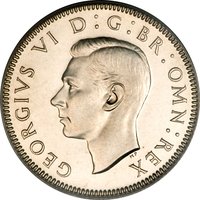
Obverse
Description:
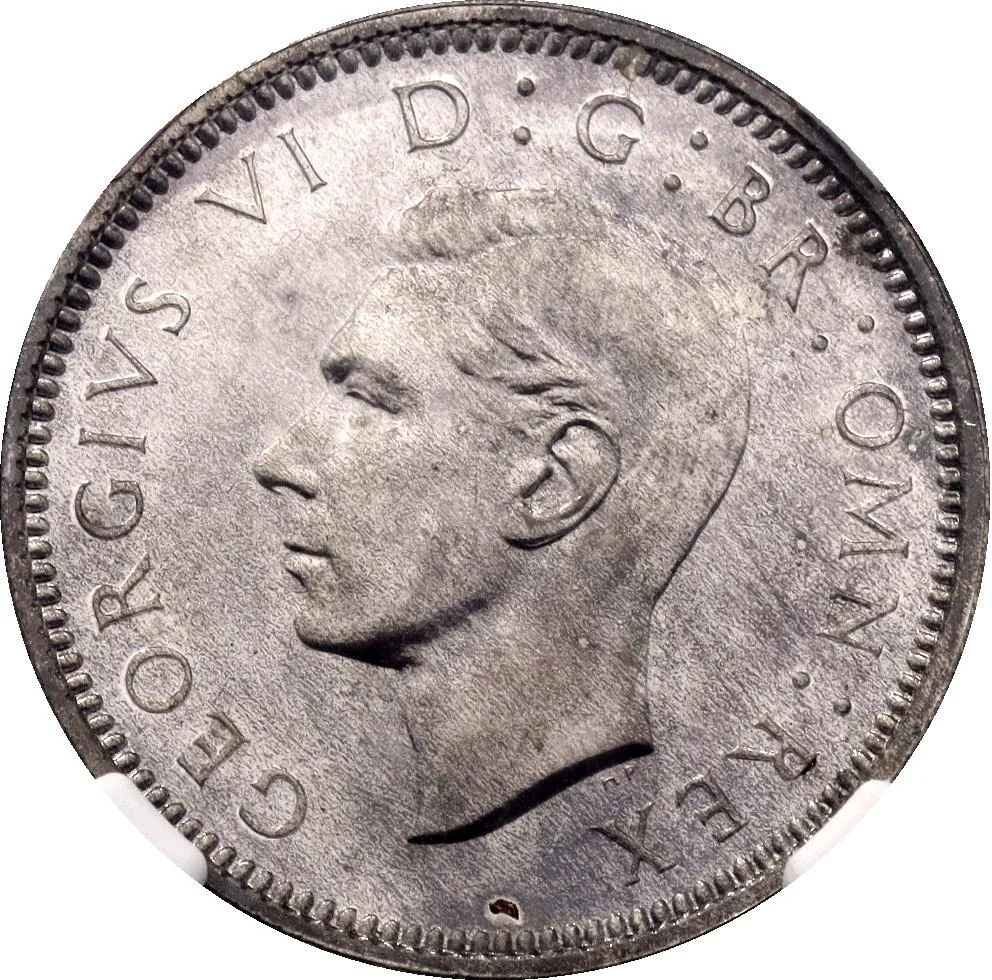
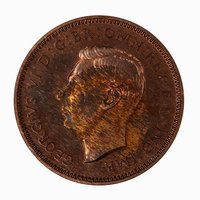
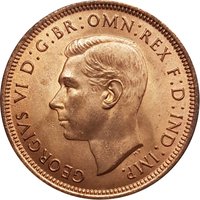
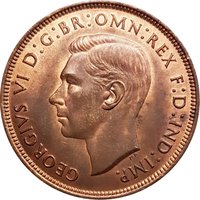
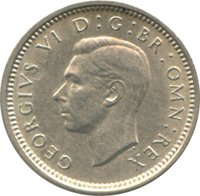
King George VI, uncrowned, left-facing portrait, legend encircling.
Inscription:
GEORGIVS VI D:G:BR:OMN:REX
HP
HP
Translation:
George VI by the Grace of God King of all the Britains
Defender of the Faith Emperor of India
Defender of the Faith Emperor of India
Script: Latin
Language: Latin
Engraver: Thomas Humphrey Paget
Reverse
Description:
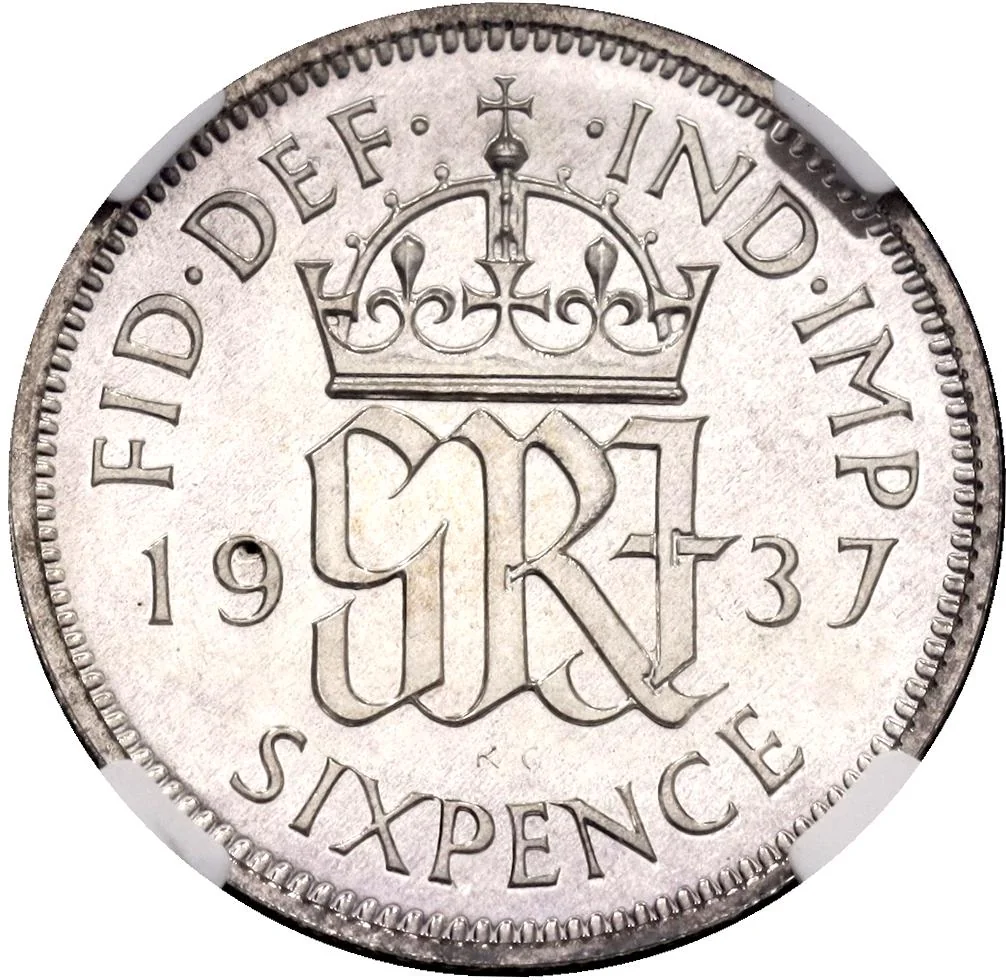
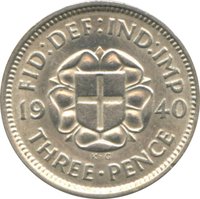
Royal cypher divides date, legend above, value below.
Inscription:
FID·DEF· ·IND·IMP
19 GRI 46
K · G
SIXPENCE
19 GRI 46
K · G
SIXPENCE
Translation:
Faith Defender · Indian Emperor
19 GRI 46
K · G
SIXPENCE
19 GRI 46
K · G
SIXPENCE
Script: Latin
Engraver: George Kruger Gray
Edge
Reeded
Mints
| Name | Mark |
|---|---|
| Royal Mint (Tower Hill) | — |
Mintings
| Year | Mint Mark | Mintage | Quality | Collection |
|---|---|---|---|---|
| 1937 | — | 22,302,500 | ||
| 1937 | — | 4 | Proof | |
| 1938 | — | 13,402,700 | ||
| 1938 | — | — | Proof | |
| 1939 | — | — | Proof | |
| 1939 | — | 28,670,300 | ||
| 1940 | — | 20,875,100 | ||
| 1940 | — | — | Proof | |
| 1941 | — | 23,186,600 | ||
| 1941 | — | — | Proof | |
| 1942 | — | 44,942,700 | ||
| 1942 | — | — | Proof | |
| 1943 | — | 46,927,100 | ||
| 1943 | — | — | Proof | |
| 1944 | — | 37,952,600 | ||
| 1944 | — | — | Proof | |
| 1945 | — | 39,939,200 | ||
| 1945 | — | — | Proof | |
| 1946 | — | — | Proof | |
| 1946 | — | 43,466,400 |
Historical background
In 1937, the United Kingdom's currency was underpinned by the Sterling Area, an informal monetary bloc where member nations pegged their currencies to the British pound and held their reserves in London. This system, which had evolved after Britain left the Gold Standard in 1931, granted the UK significant economic influence and provided a zone of exchange rate stability for its trading partners, particularly within the Empire. The pound itself was a managed currency, with its value influenced by the Treasury and the Bank of England through the Exchange Equalisation Account, established in 1932 to smooth out volatile fluctuations without being tied to a fixed gold price.
Domestically, the economy was in a state of cautious recovery from the Great Depression, but this was overshadowed by growing rearmament expenditures due to rising geopolitical tensions in Europe. Chancellor of the Exchequer Sir John Simon was grappling with the need to fund a rapidly expanding military budget while trying to avoid inflationary pressure on the pound. The currency's external value was relatively stable but vulnerable, as the government's "cheap money" policy of low interest rates, maintained to stimulate business investment, also risked capital outflows if confidence wavered.
Overall, the sterling in 1937 was in a period of precarious equilibrium. It benefited from the stability of the Sterling Area and controlled management, yet it faced underlying strains from the dual pressures of massive rearmament and a delicate balance of payments. The financial authorities were effectively walking a tightrope, prioritising domestic economic stability and defence preparedness over a return to international monetary orthodoxy, a position that would be severely tested in the coming war years.
Domestically, the economy was in a state of cautious recovery from the Great Depression, but this was overshadowed by growing rearmament expenditures due to rising geopolitical tensions in Europe. Chancellor of the Exchequer Sir John Simon was grappling with the need to fund a rapidly expanding military budget while trying to avoid inflationary pressure on the pound. The currency's external value was relatively stable but vulnerable, as the government's "cheap money" policy of low interest rates, maintained to stimulate business investment, also risked capital outflows if confidence wavered.
Overall, the sterling in 1937 was in a period of precarious equilibrium. It benefited from the stability of the Sterling Area and controlled management, yet it faced underlying strains from the dual pressures of massive rearmament and a delicate balance of payments. The financial authorities were effectively walking a tightrope, prioritising domestic economic stability and defence preparedness over a return to international monetary orthodoxy, a position that would be severely tested in the coming war years.

🌱 Very Common