

5 Florin (Kingship) – Aruba
Circulating commemorative coins
Commemoration: 1 Year Anniversary Kingship
Netherlands
Context
Year: 2014
Country: Netherlands 
Issuer: Aruba
Ruler: Willem-Alexander
Currency:
(since 1986)
Total mintage: 2,500
Material
Diameter: 23.45 mm
Weight: 8.4 g
Thickness: 2.7 mm
Shape: Round
Composition: Aluminium bronze
Magnetic: No
Alignment: Coin alignment
flip
References
KM: #Click to copy to clipboard59
Numista: #71893
Value
Exchange value: 5 AWG
Inflation-adjusted value: 6.56 AWG
Obverse
Description:
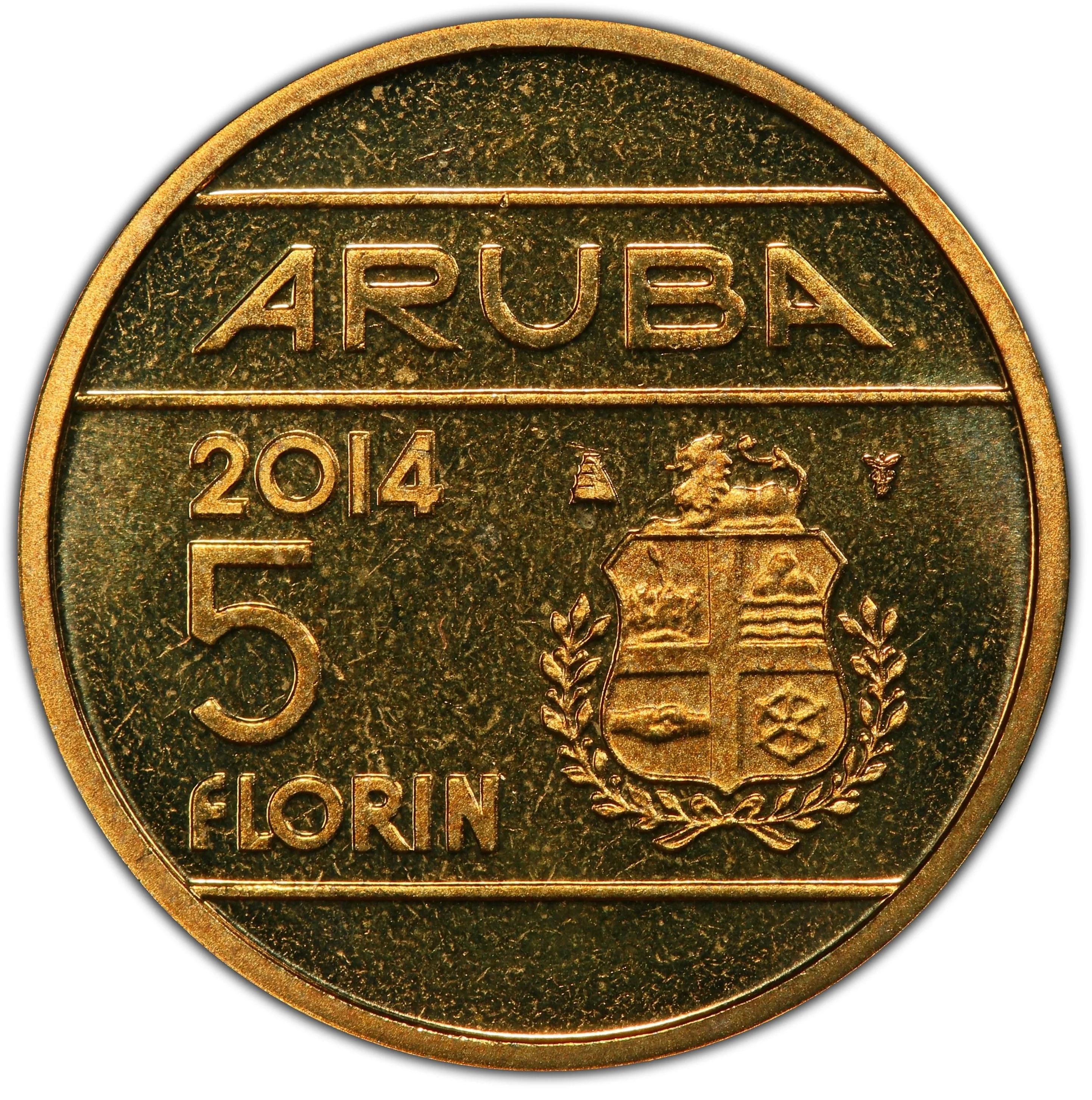
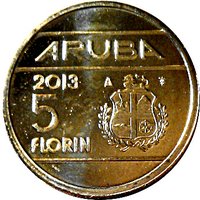
Date and denomination left, Aruba's coat of arms right.
Inscription:
ARUBA
2014
5
FLORIN
2014
5
FLORIN
Translation:
ARUBA
2014
5
FLORIN
2014
5
FLORIN
Script: Latin
Languages: Papiamento, English
Engraver: Evelino Fingal
Reverse
Description:
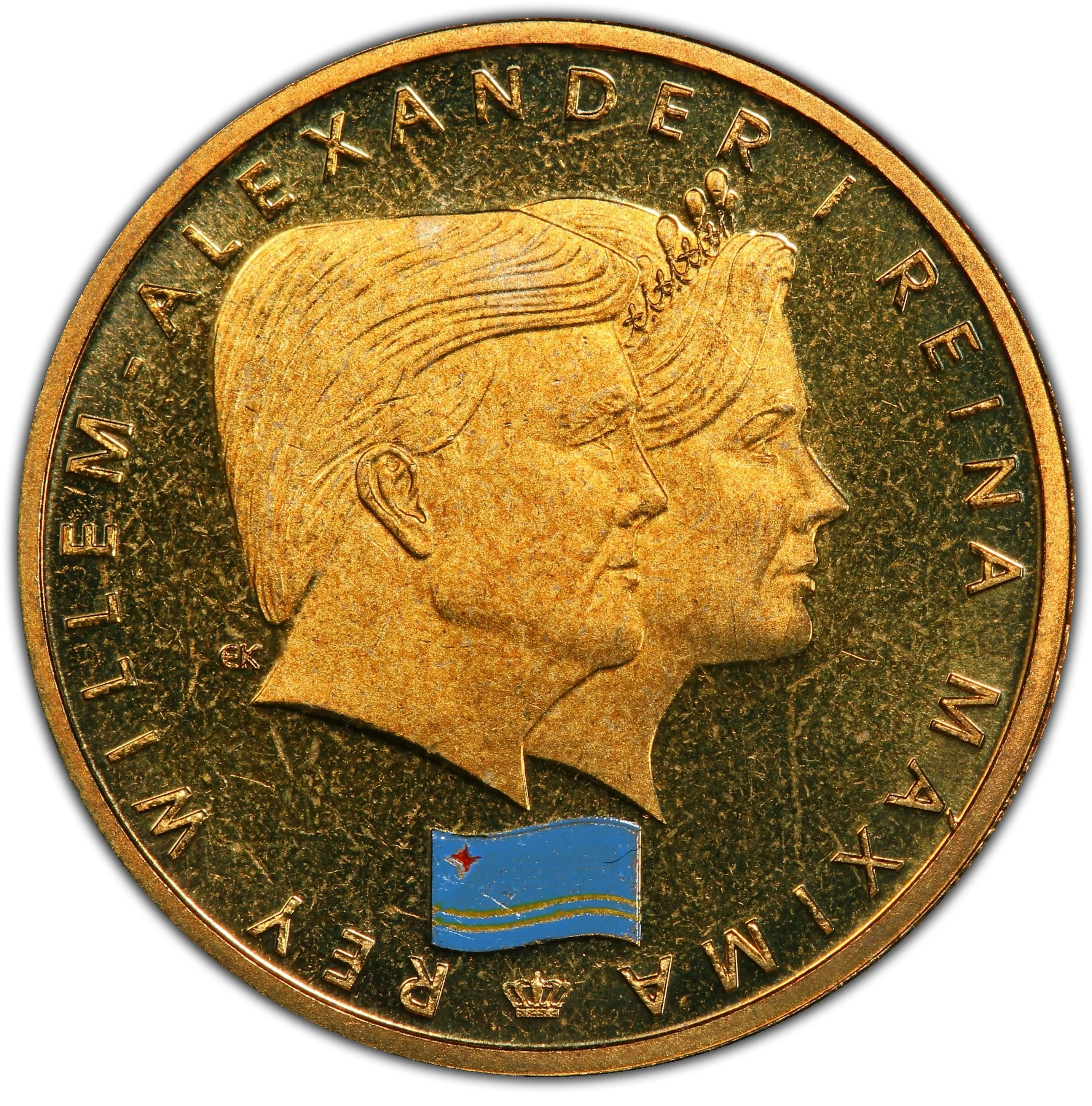
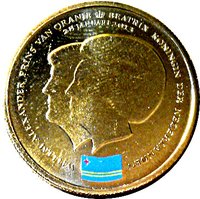
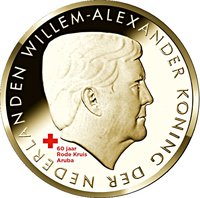
Portrait of King Willem-Alexander and Queen Máxima facing right, with the Aruban flag.
Inscription:
REY WILLEM-ALEXANDER | REINA MÁXIMA
EK
EK
Translation:
King Willem-Alexander | Queen Máxima
I
I
Script: Latin
Engraver: Elles Kloosterman
Edge
Reeded edges with smooth center channel containing inscription
Legend:
GOD ZIJ MET ONS
Translation:
God be with us
Language: Dutch
Categories
| Symbol> Flag |
| Symbols> Coat of Arms |
Mints
| Name | Mark |
|---|---|
| Royal Dutch Mint | — |
Mintings
| Year | Mint Mark | Mintage | Quality | Collection |
|---|---|---|---|---|
| 2014 | — | 2,500 |
Historical background
In 2014, Aruba's currency situation was defined by its longstanding and stable use of the Aruban florin (AWG), which has been pegged to the United States dollar at a fixed rate of 1.79 AWG to 1 USD since 1986. This peg, managed by the Central Bank of Aruba (CBA), provided a crucial anchor for price stability and economic predictability on the island. The system functioned through a currency board-like arrangement, requiring foreign reserve backing for the local currency in circulation, which helped maintain strong international confidence and facilitated the vital tourism and trade sectors, both heavily oriented toward the U.S. economy.
The year 2014 saw this regime face ongoing, but manageable, pressures. The global financial crisis of 2008-2009 and subsequent recessions had impacted Aruba's key tourism industry, leading to budget deficits and a gradual decline in the official foreign exchange reserves that back the currency peg. While reserves remained at adequate levels, the Central Bank of Aruba continued to emphasize the need for fiscal discipline to sustain the peg. The government's efforts to consolidate public finances were viewed as essential to maintaining the credibility of the fixed exchange rate, which was considered non-negotiable for the island's economic stability.
Consequently, monetary policy in 2014 was largely subordinated to maintaining the dollar peg, limiting the Central Bank's ability to use interest rates for domestic stimulus. The focus remained on preserving sufficient foreign reserves and managing liquidity within the banking system. The stable exchange rate continued to benefit the import-dependent economy by controlling inflation and providing certainty for businesses and investors, even as it required careful economic management to address underlying fiscal challenges and ensure the peg's long-term sustainability.
The year 2014 saw this regime face ongoing, but manageable, pressures. The global financial crisis of 2008-2009 and subsequent recessions had impacted Aruba's key tourism industry, leading to budget deficits and a gradual decline in the official foreign exchange reserves that back the currency peg. While reserves remained at adequate levels, the Central Bank of Aruba continued to emphasize the need for fiscal discipline to sustain the peg. The government's efforts to consolidate public finances were viewed as essential to maintaining the credibility of the fixed exchange rate, which was considered non-negotiable for the island's economic stability.
Consequently, monetary policy in 2014 was largely subordinated to maintaining the dollar peg, limiting the Central Bank's ability to use interest rates for domestic stimulus. The focus remained on preserving sufficient foreign reserves and managing liquidity within the banking system. The stable exchange rate continued to benefit the import-dependent economy by controlling inflation and providing certainty for businesses and investors, even as it required careful economic management to address underlying fiscal challenges and ensure the peg's long-term sustainability.

🌟 Limited