


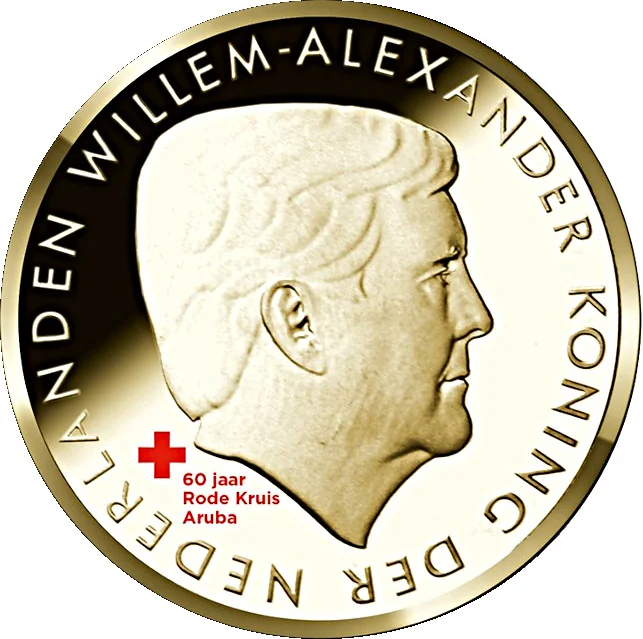
5 florin (Aruban Red Cross) – Aruba
Add to wishlist
Circulating commemorative coins
Commemoration: Commemorative coin on the occasion of the 60th anniversary of the Aruban Red Cross
Netherlands
Context
Material
Diameter: 23.5 mm
Weight: 8.4 g
Thickness: 2.7 mm
Shape: Round
Composition: Aluminium bronze
Magnetic: No
Alignment: Coin alignment

flip

References
KM: #
Numista: #128194
Value
Exchange value: 5 AWG
Inflation-adjusted value: 6.44 AWG
Obverse
Description:
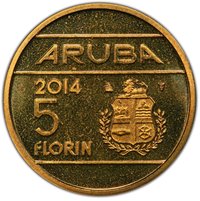
Date and denomination left, Aruba's coat of arms right.
Inscription:
ARUBA
2017
5
FLORIN
2017
5
FLORIN
Translation:
ARUBA
2017
5
FLORIN
2017
5
FLORIN
Script: Latin
Languages: English, Papiamento
Reverse
Edge
Reeded edges with smooth center channel containing inscription
Legend:
GOD ZIJ MET ONS
Translation:
God be with us
Language: Dutch
Categories
| Organization> Red Cross |
| Symbols> Coat of Arms |
Mints
| Name | Mark |
|---|---|
| Royal Dutch Mint | — |
Mintings
| Year | Mint Mark | Mintage | Quality | Collection |
|---|---|---|---|---|
| 2017 | — | — |
Historical background
In 2017, Aruba's currency situation remained defined by its long-standing and stable peg to the United States dollar. Since 1986, the island nation utilized the Aruban florin (AWG), which was fixed at a rate of 1.79 florin to 1 US dollar. This monetary policy, managed by the Centrale Bank van Aruba (CBA), provided crucial stability for an economy almost entirely dependent on tourism, with the vast majority of visitors arriving from the United States. The peg minimized exchange rate risk for investors and businesses, kept inflation low and predictable, and simplified transactions within the dominant tourism sector.
However, this stability came with significant constraints. The fixed exchange rate meant Aruba relinquished independent monetary policy, as the CBA was obligated to maintain sufficient foreign reserves to defend the peg. This limited its ability to use interest rates or currency devaluation as tools to stimulate the economy during downturns. Furthermore, the strong link to the US dollar sometimes made Aruban goods and services more expensive for visitors from other currency zones, potentially affecting competitiveness. The system also required strict fiscal discipline from the government to maintain confidence in the currency board arrangement.
The year 2017 saw these dynamics play out against a backdrop of ongoing economic challenges. Following a period of fiscal consolidation, the government was working to reduce high public debt levels, which were essential for maintaining the credibility of the dollar peg. Economic growth was modest but positive, primarily driven by the resilient tourism sector. The currency situation itself was not a point of crisis in 2017, but rather a foundational and carefully managed framework within which all other economic policies had to operate, underscoring the trade-off between stability and policy flexibility.
However, this stability came with significant constraints. The fixed exchange rate meant Aruba relinquished independent monetary policy, as the CBA was obligated to maintain sufficient foreign reserves to defend the peg. This limited its ability to use interest rates or currency devaluation as tools to stimulate the economy during downturns. Furthermore, the strong link to the US dollar sometimes made Aruban goods and services more expensive for visitors from other currency zones, potentially affecting competitiveness. The system also required strict fiscal discipline from the government to maintain confidence in the currency board arrangement.
The year 2017 saw these dynamics play out against a backdrop of ongoing economic challenges. Following a period of fiscal consolidation, the government was working to reduce high public debt levels, which were essential for maintaining the credibility of the dollar peg. Economic growth was modest but positive, primarily driven by the resilient tourism sector. The currency situation itself was not a point of crisis in 2017, but rather a foundational and carefully managed framework within which all other economic policies had to operate, underscoring the trade-off between stability and policy flexibility.
⭐ Somewhat Rare