

50 Centimes – French Cameroon
Cameroon
Context
Year: 1943
Country: Cameroon 
Issuer: French Cameroon
Period:
(1940—1945)
Currency:
(1922—1945)
Demonetized: Yes
Total mintage: 4,000,000
Material
References
KM: #Click to copy to clipboard6
Numista: #11249
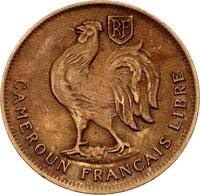
Obverse
Description:
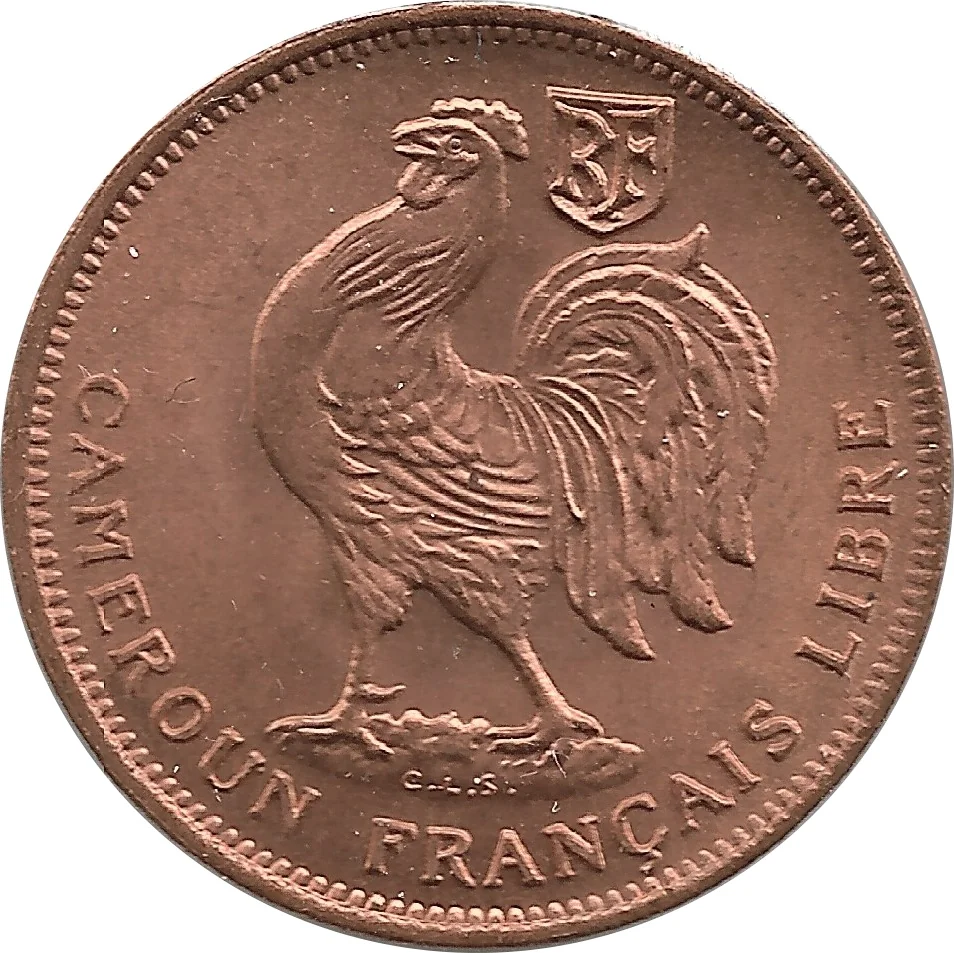
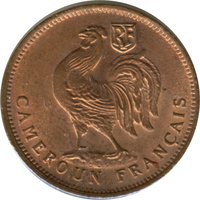
Rooster left, shield monogrammed top right.
Inscription:
RF
C.L.S.
CAMEROUN FRANÇAIS LIBRE
C.L.S.
CAMEROUN FRANÇAIS LIBRE
Translation:
Free French Cameroons
Script: Latin
Language: French
Engraver: Coert Laurens Steynberg
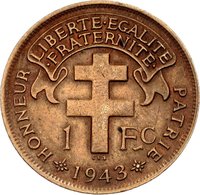
Reverse
Description:
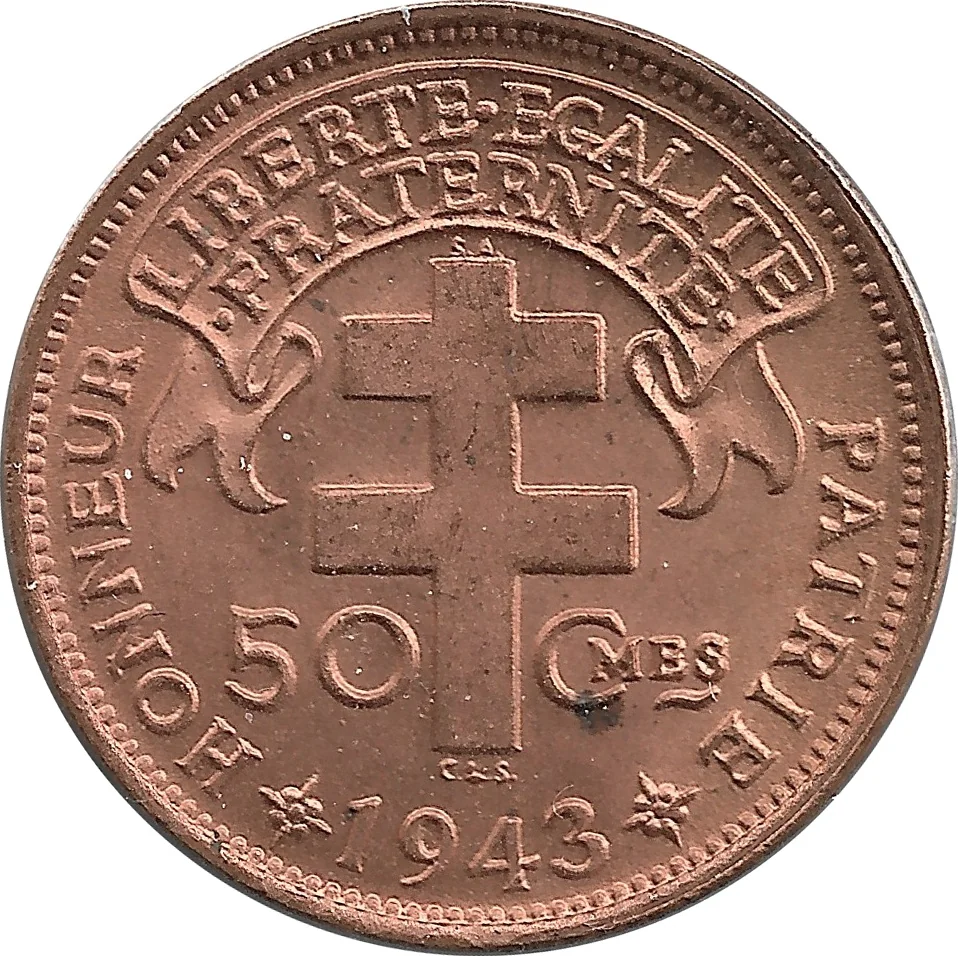
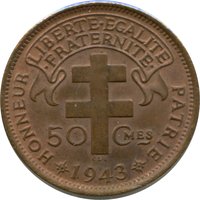
Cross of Lorraine above denomination, date below.
Inscription:
HONNEUR LIBERTÉ · ÉGALITÉ PATRIE
·FRATERNITÉ·
50 CMES
C.L.S.
1943
·FRATERNITÉ·
50 CMES
C.L.S.
1943
Translation:
Honour Liberty · Equality Fatherland
·Fraternity·
50 Centimes
C.L.S.
1943
·Fraternity·
50 Centimes
C.L.S.
1943
Script: Latin
Language: French
Engraver: Coert Laurens Steynberg
Edge
Plain
Mints
| Name | Mark |
|---|---|
| Pretoria | SA |
Mintings
| Year | Mint Mark | Mintage | Quality | Collection |
|---|---|---|---|---|
| 1943 | SA | 4,000,000 |
Historical background
In 1943, French Cameroon, as a League of Nations Mandate territory administered by France, was fully integrated into the economic sphere of Free France during the Second World War. The colony had historically used the French franc, but the war and the division of France created a complex monetary situation. Following the fall of France in 1940, the colonial administration in Brazzaville, under General de Gaulle, pledged allegiance to the Free French forces, cutting ties with the Vichy-controlled Banque de France. This meant that the currency in circulation was nominally the same franc, but its issuance and backing were now under the authority of the provisional Free French government.
The practical currency in use was primarily a mix of pre-war banknotes and new emergency issues. A critical development was the creation of the CFA franc in December 1945; however, in 1943, its immediate precursor was already taking shape. To finance the Free French war effort and stabilize the local economy, the authorities relied on currency issued by the Caisse Centrale de la France Libre (Central Fund of Free France), established in 1941. This institution, the forerunner to the Caisse Centrale de la Coopération Économique, provided the necessary liquidity and began laying the institutional groundwork for the post-war CFA franc system.
Economically, the period was marked by hardship and inflationary pressures. The colony was mobilized to supply vital raw materials (like rubber, timber, and agricultural products) to the Allied war effort, but global trade disruptions caused shortages of imported goods. This, combined with increased money supply to fund military and administrative expenses, created inflationary conditions. Thus, the currency situation in 1943 was one of transitional authority, defined by its break from Vichy and its alignment with the Free French monetary structures that would formally crystallize into the CFA franc two years later, solidifying the region's lasting monetary link to France.
The practical currency in use was primarily a mix of pre-war banknotes and new emergency issues. A critical development was the creation of the CFA franc in December 1945; however, in 1943, its immediate precursor was already taking shape. To finance the Free French war effort and stabilize the local economy, the authorities relied on currency issued by the Caisse Centrale de la France Libre (Central Fund of Free France), established in 1941. This institution, the forerunner to the Caisse Centrale de la Coopération Économique, provided the necessary liquidity and began laying the institutional groundwork for the post-war CFA franc system.
Economically, the period was marked by hardship and inflationary pressures. The colony was mobilized to supply vital raw materials (like rubber, timber, and agricultural products) to the Allied war effort, but global trade disruptions caused shortages of imported goods. This, combined with increased money supply to fund military and administrative expenses, created inflationary conditions. Thus, the currency situation in 1943 was one of transitional authority, defined by its break from Vichy and its alignment with the Free French monetary structures that would formally crystallize into the CFA franc two years later, solidifying the region's lasting monetary link to France.
🌱 Fairly Common