

5 Korun / Korún – Czechoslovakia
Context
Years: 1991–1992
Issuer: Czechoslovakia 
Period:
(1990—1992)
Currency:
(1953—1992)
Demonetization: 30 November 1993
Total mintage: 10,050,250
Material
Diameter: 26 mm
Weight: 7 g
Thickness: 1.9 mm
Shape: Round
Composition: Copper-nickel
Technique: Milled
Alignment: Medal alignment
flip
References
KM: #Click to copy to clipboard152
Numista: #7177
Value
Exchange value: 5 CSK
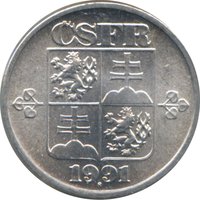
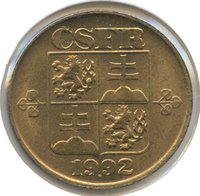
Obverse
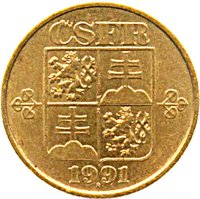
Description:
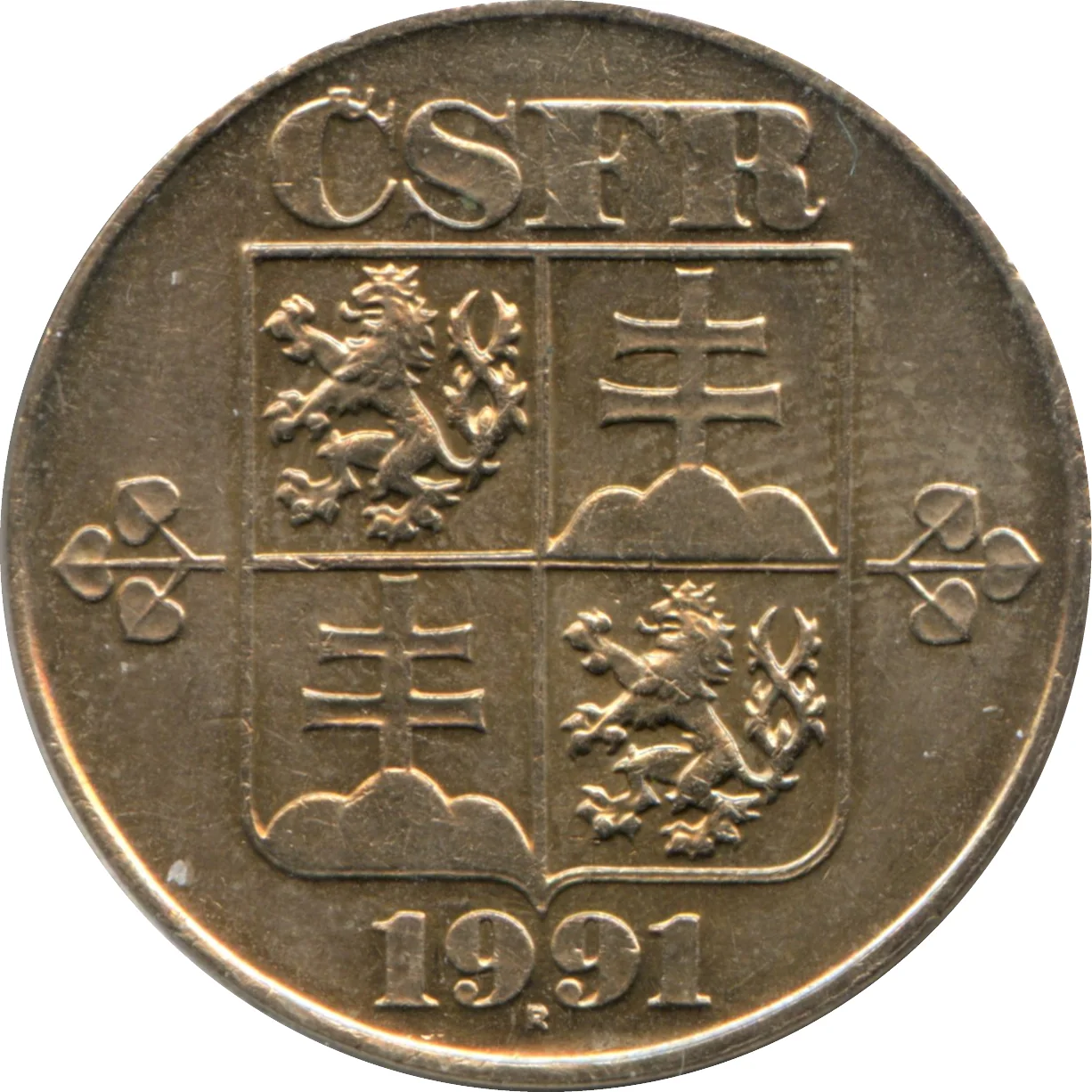
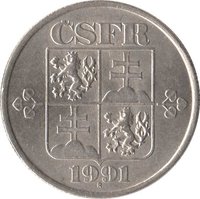
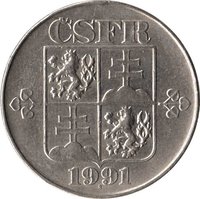
CSFR shield with linden leaves, date and signature beneath.
Inscription:
ČSFR
1991
R
1991
R
Translation:
Czech and Slovak Federal Republic
1991
R
1991
R
Script: Latin
Engraver: Miroslav Ronai
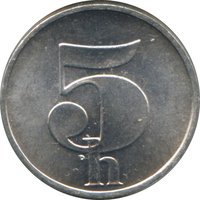
Reverse
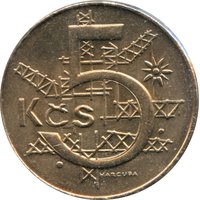
Description:
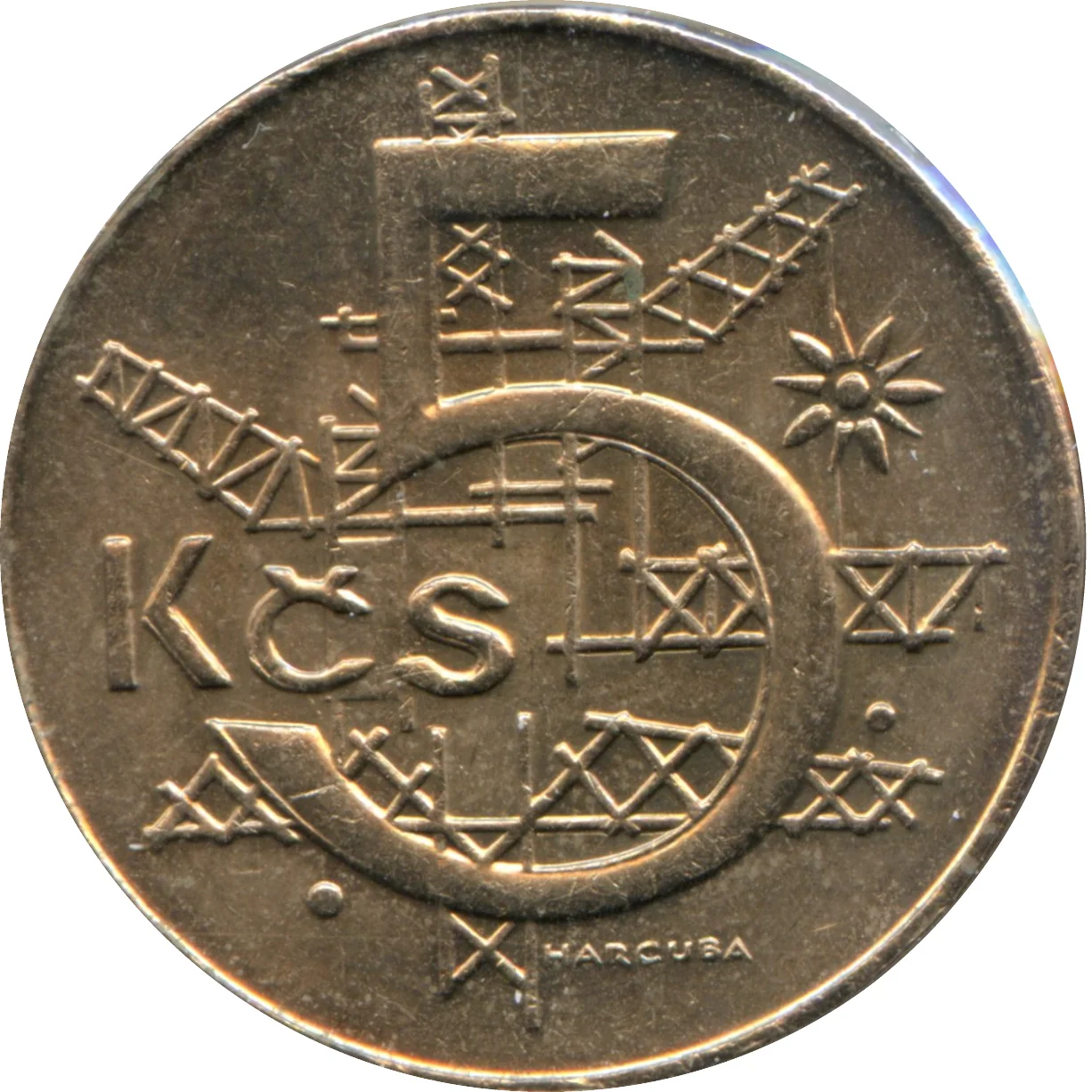
Floral crane pattern, signed.
Inscription:
Kčs 5
HARCUBA
HARCUBA
Translation:
Czechoslovak Socialist Republic 5 Korunas Harcuba
Script: Latin
Language: Czech
Engraver: Jiří Harcuba
Edge
Smooth with waves imprinted
Categories
| Symbols> Coat of Arms |
Mints
| Name | Mark |
|---|---|
| Kremnica | — |
| Royal Mint | — |
Mintings
| Year | Mint Mark | Mintage | Quality | Collection |
|---|---|---|---|---|
| 1991 | — | 10,000,750 | ||
| 1992 | — | 49,500 |
Historical background
In early 1991, Czechoslovakia was navigating the turbulent first phase of its post-communist economic transition. The federal government, led by Finance Minister Václav Klaus, had just launched a radical "shock therapy" program in January, which involved sweeping price liberalization and the beginning of large-scale privatization. A critical component of this transition was the need for a stable and credible national currency to replace the heavily manipulated Czechoslovak koruna (Kčs) of the communist era, which bore little relation to market value. The immediate challenge was to prevent a collapse in confidence and a spiral of hyperinflation, which was a real risk following the removal of state price controls.
The currency situation was defined by two major reforms. First, in January 1991, a crucial internal devaluation was implemented, making the koruna convertible for domestic businesses and residents at a unified, significantly devalued rate. This move abolished the complex system of multiple exchange rates and was a painful but necessary step to align the currency with economic reality and facilitate international trade. Second, and most significantly, the government introduced a strict fixed exchange rate regime, pegging the koruna at approximately 28 Kčs to the US dollar. This anchor was intended to provide stability, crush inflationary expectations, and serve as a nominal symbol of the government's commitment to disciplined monetary policy.
This rigid peg, managed by the State Bank of Czechoslovakia, was largely successful in its primary goal of stabilizing prices and establishing monetary credibility during the most volatile early years. However, it came at a cost, requiring very high interest rates and tight fiscal policy to maintain, which contributed to a sharp recession and a rise in unemployment. Furthermore, the currency policy existed within the growing political tensions between the Czech and Slovak republics, as differing economic perspectives and impacts of the transition fueled debates that would ultimately culminate in the peaceful dissolution of the federation and the creation of separate Czech and Slovak currencies in 1993.
The currency situation was defined by two major reforms. First, in January 1991, a crucial internal devaluation was implemented, making the koruna convertible for domestic businesses and residents at a unified, significantly devalued rate. This move abolished the complex system of multiple exchange rates and was a painful but necessary step to align the currency with economic reality and facilitate international trade. Second, and most significantly, the government introduced a strict fixed exchange rate regime, pegging the koruna at approximately 28 Kčs to the US dollar. This anchor was intended to provide stability, crush inflationary expectations, and serve as a nominal symbol of the government's commitment to disciplined monetary policy.
This rigid peg, managed by the State Bank of Czechoslovakia, was largely successful in its primary goal of stabilizing prices and establishing monetary credibility during the most volatile early years. However, it came at a cost, requiring very high interest rates and tight fiscal policy to maintain, which contributed to a sharp recession and a rise in unemployment. Furthermore, the currency policy existed within the growing political tensions between the Czech and Slovak republics, as differing economic perspectives and impacts of the transition fueled debates that would ultimately culminate in the peaceful dissolution of the federation and the creation of separate Czech and Slovak currencies in 1993.
🌱 Very Common