

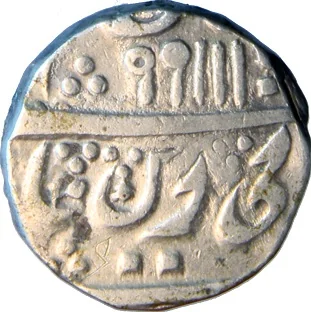
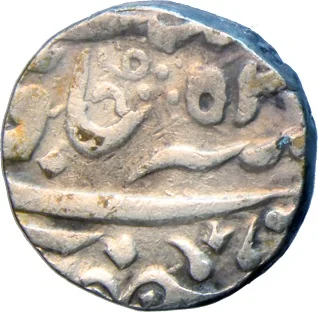
1 Rupee – Maratha Empire
India
Context

Material
References
KM: #Click to copy to clipboard330
Numista: #71690
Value
Bullion value: $30.60
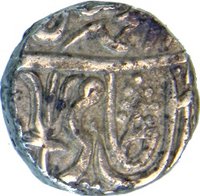
Obverse
Description:
Naudri 99, Shah Alam II, AH 1119
Inscription:
99111
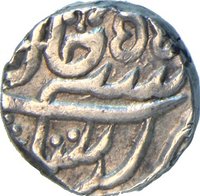
Reverse
Description:
RY [year]: [text]
Edge
Plain
Mintings
| Year | Mint Mark | Mintage | Quality | Collection |
|---|---|---|---|---|
| 1819 | — | — | ||
| — | — | — | ||
| 1806 | — | — | ||
| 1806 | — | — | ||
| 1808 | — | — | ||
| 1809 | — | — |
Historical background
By 1806, the currency situation within the Maratha Confederacy was one of profound fragmentation and decline, mirroring the empire's political disintegration following defeat in the Second Anglo-Maratha War (1803-1805). The Treaty of Bassein (1802) and subsequent treaties had reduced the major Maratha rulers—the Peshwa in Pune, the Scindias in Gwalior, the Holkars in Indore, and the Bhonsles in Nagpur—to British subsidiaries, each controlling their own territories but stripped of independent foreign policy. Consequently, there was no unified imperial monetary system. Each princely state, major jagirdars (landholders), and even important cities minted their own coins, leading to a chaotic proliferation of rupees, paise, and other denominations of varying weight, purity, and acceptability.
The most prevalent coins were the silver rupee and its copper fractions, but their standards differed. The Peshwa's territory largely used the Ankushi rupee (minted in Pune), while Scindia's domains used the Sanad rupee. Older Maratha rupees like the Hali Sicca, and Mughal-era coins like the Chandori rupee, also remained in circulation, creating a complex landscape for trade. This monetary anarchy was exacerbated by the British East India Company's growing economic dominance, which was actively standardizing its own Company Rupee in its directly controlled territories of Bombay, Bengal, and the newly acquired districts around Delhi and Agra. The Company's currency, backed by a centralized administration, began to circulate within Maratha regions, creating a dual system that further undermined local mints.
This period marked a critical transition from indigenous to colonial monetary control. The Maratha rulers, financially crippled by war indemnities and the British subsidiary alliance system which stationed Company troops at their expense, lacked the resources and sovereignty to reform or standardize their currency. Their mints, often farmed out to revenue contractors, produced debased coins to raise short-term funds, eroding public trust. Thus, by 1806, the Maratha currency system was not only internally fragmented but was being steadily and inexorably supplanted by the more uniform and politically-backed British rupee, a clear economic precursor to the complete political absorption that would follow in 1818.
The most prevalent coins were the silver rupee and its copper fractions, but their standards differed. The Peshwa's territory largely used the Ankushi rupee (minted in Pune), while Scindia's domains used the Sanad rupee. Older Maratha rupees like the Hali Sicca, and Mughal-era coins like the Chandori rupee, also remained in circulation, creating a complex landscape for trade. This monetary anarchy was exacerbated by the British East India Company's growing economic dominance, which was actively standardizing its own Company Rupee in its directly controlled territories of Bombay, Bengal, and the newly acquired districts around Delhi and Agra. The Company's currency, backed by a centralized administration, began to circulate within Maratha regions, creating a dual system that further undermined local mints.
This period marked a critical transition from indigenous to colonial monetary control. The Maratha rulers, financially crippled by war indemnities and the British subsidiary alliance system which stationed Company troops at their expense, lacked the resources and sovereignty to reform or standardize their currency. Their mints, often farmed out to revenue contractors, produced debased coins to raise short-term funds, eroding public trust. Thus, by 1806, the Maratha currency system was not only internally fragmented but was being steadily and inexorably supplanted by the more uniform and politically-backed British rupee, a clear economic precursor to the complete political absorption that would follow in 1818.
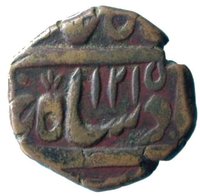
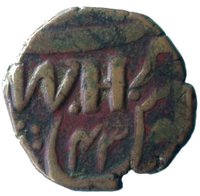
💎 Extremely Rare