

50 Rubles (Napoleon Bonaparte) – Russian Federation
Non-circulating coins
Commemoration: The 200th Anniversary of his Death
Russia
Context
Year: 2000
Country: Russia 
Issuer: Russian Federation
Period:
(since 1991)
Currency:
(since 1998)
Total mintage: 500
Material

References
Value
Exchange value: 50 RUB
Bullion value: $1311.51
Inflation-adjusted value: 624.26 RUB
Obverse
Description:
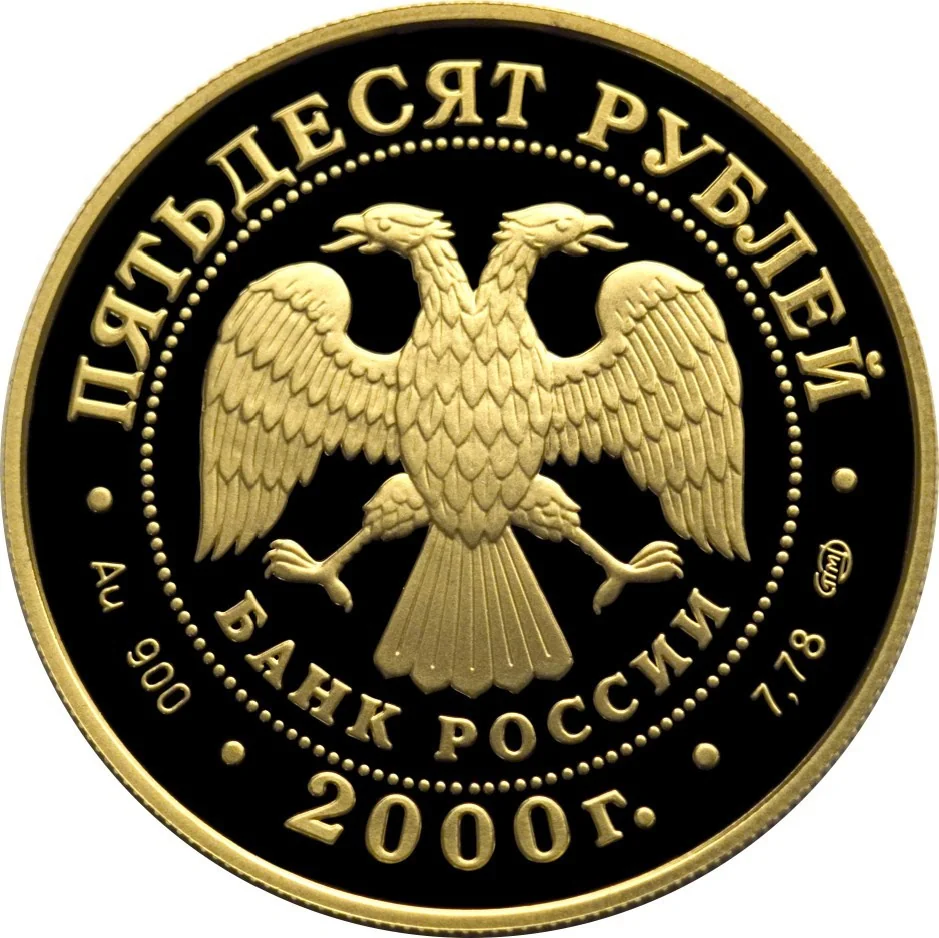
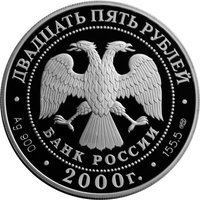
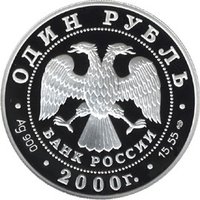
Center: The Bank of Russia emblem (I. Bilibin's two-headed eagle) above a semicircular "БАНК РОССИИ" inscription, encircled by dots. The rim inscriptions: top - "ПЯТЬДЕСЯТ РУБЛЕЙ", bottom - "2000". Left of the eagle: metal and alloy mark. Right: fine metal content and mint mark.
Inscription:
ПЯТЬДЕСЯТ РУБЛЕЙ
БАНК РОССИИ
• Au 900 • 2000 г. • 7,78 СПМД •
БАНК РОССИИ
• Au 900 • 2000 г. • 7,78 СПМД •
Translation:
FIFTY RUBLES
BANK OF RUSSIA
• Au 900 • 2000 yr. • 7.78 SPMD •
BANK OF RUSSIA
• Au 900 • 2000 yr. • 7.78 SPMD •
Language: Russian
Designer and engraver: Alexander Vasilyevich Baklanov
Reverse
Description:
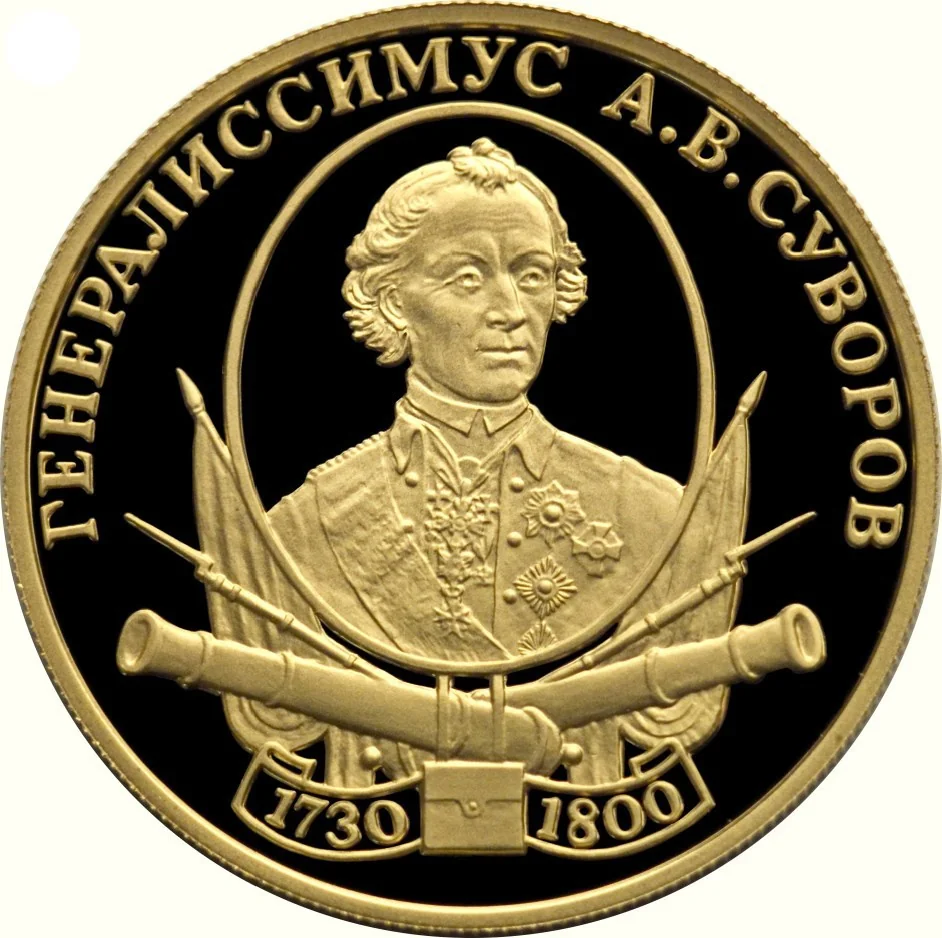
Oval half-length portrait of Suorov in ceremonial uniform, above the inscription "ГЕНЕРАЛИССИМУС А.В. СУВОРОВ", below cannons, sables, standards, and the dates 1730–1800 on a ribbon.
Inscription:
ГЕНЕРАЛИССИМУС А.В. СУВОРОВ
1730 1800
1730 1800
Translation:
GENERALISSIMUS A.V. SUVOROV
1730 1800
1730 1800
Script: Cyrillic
Language: Russian
Engraver: Andrey Sergevich Kunats
Edge
200 corrugations
Mints
| Name | Mark |
|---|---|
| Saint Petersburg | (СПМД) |
Mintings
| Year | Mint Mark | Mintage | Quality | Collection |
|---|---|---|---|---|
| 2000 | СПМД | 500 | Proof |
Historical background
The year 2000 marked a pivotal turning point for the Russian ruble, emerging from the profound crisis of the 1998 default and devaluation. The financial collapse had destroyed public confidence in the currency and the banking system, leading to hyperinflation and a dramatic fall in living standards. By 2000, however, the situation was stabilizing dramatically, primarily due to a surge in global oil prices. This influx of hard currency reserves allowed the Central Bank of Russia (CBR), under new leadership, to assert greater control and implement a policy of a managed floating exchange rate, aiming to rebuild stability and predictability.
The key monetary policy shift was the CBR's move to target the ruble's real effective exchange rate against a bi-currency basket (initially weighted toward the US dollar and euro), rather than defending a specific nominal band. This more flexible approach allowed the currency to gradually appreciate in line with rising export revenues, helping to curb inflation which had begun to decelerate. The government, now led by the newly elected President Vladimir Putin, supported this with a policy of fiscal discipline, running budget surpluses and beginning to repay IMF debts ahead of schedule, which further bolstered macroeconomic credibility.
Consequently, the period saw the ruble transition from an object of panic to a symbol of recovering state sovereignty and economic management. While challenges remained, including a still-fragile banking sector and dependence on commodity exports, the currency stability achieved by the end of 2000 provided a crucial foundation for the subsequent years of economic growth. It represented a clear break from the turbulence of the 1990s and was a cornerstone of the new administration's promise of restored order and national strength.
The key monetary policy shift was the CBR's move to target the ruble's real effective exchange rate against a bi-currency basket (initially weighted toward the US dollar and euro), rather than defending a specific nominal band. This more flexible approach allowed the currency to gradually appreciate in line with rising export revenues, helping to curb inflation which had begun to decelerate. The government, now led by the newly elected President Vladimir Putin, supported this with a policy of fiscal discipline, running budget surpluses and beginning to repay IMF debts ahead of schedule, which further bolstered macroeconomic credibility.
Consequently, the period saw the ruble transition from an object of panic to a symbol of recovering state sovereignty and economic management. While challenges remained, including a still-fragile banking sector and dependence on commodity exports, the currency stability achieved by the end of 2000 provided a crucial foundation for the subsequent years of economic growth. It represented a clear break from the turbulence of the 1990s and was a cornerstone of the new administration's promise of restored order and national strength.

✨ Legendary