

1⁄24 Riksdaler – Sweden
Sweden
Context
Years: 1810–1816
Issuer: Sweden 
Ruler: Charles XIII
Currency:
(1798—1830)
Demonetized: Yes
Total mintage: 2,362,752
Material
References
KM: #Click to copy to clipboard580
Numista: #71423
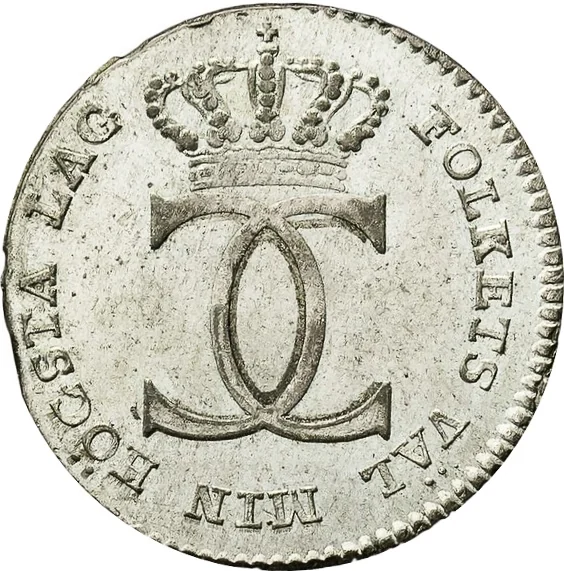
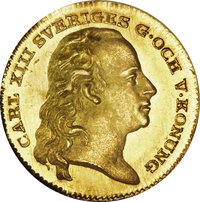
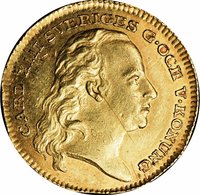
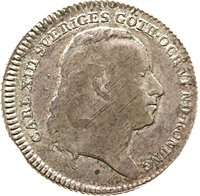
Obverse
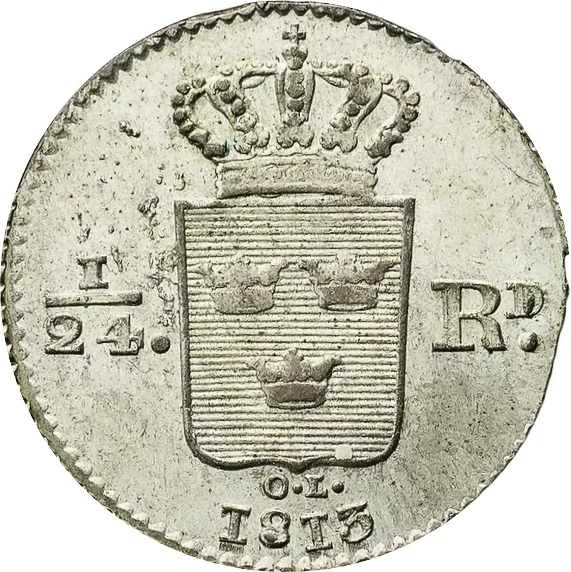
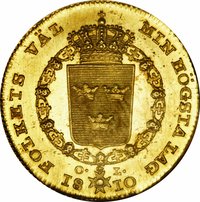
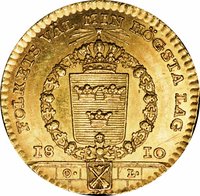
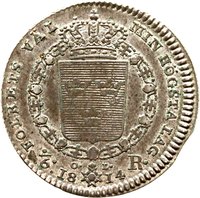
Reverse
Description:
Shield with Sweden's three crowns divides value. Date and mintmark below.
Inscription:
1/24. RD.
O.L.
1811
O.L.
1811
Script: Latin
Edge
Plain
Categories
| Symbols> Coat of Arms |
Mintings
| Year | Mint Mark | Mintage | Quality | Collection |
|---|---|---|---|---|
| 1810 | OL | 742,320 | ||
| 1811 | OL | 378,336 | ||
| 1812 | OL | 536,688 | ||
| 1813 | OL | 444,000 | ||
| 1814 | OL | 101,280 | ||
| 1816 | OL | 160,128 |
Historical background
In 1810, Sweden’s currency situation was dire, characterized by severe inflation and a deeply depreciated paper currency known as the riksdaler riksmynt. This crisis was a direct consequence of the Napoleonic Wars and Sweden's own military conflicts, particularly the Finnish War (1808-1809) against Russia, which resulted in the loss of Finland. To finance these wars, the state had resorted to massive borrowing from the Riksbank, which simply printed more banknotes without sufficient metallic backing. This led to a classic scenario of too much money chasing too few goods, causing prices to skyrocket and public confidence in the paper money to collapse.
The value of the paper riksdaler had fallen to roughly one-third of its face value in silver. This created a chaotic dual-system where transactions were often calculated in both silver riksdaler specie (the theoretical standard) and the depreciated paper notes, causing confusion and economic hardship. The situation was exacerbated by a general European economic downturn and the Continental System, which disrupted trade. For ordinary Swedes, the inflation meant a drastic increase in the cost of living and a devaluation of savings, while the state found its debts swollen and its ability to fund operations crippled.
Recognizing the need for radical reform, the government and the newly established Riksdag of the Estates took decisive action in 1810. They appointed a committee led by the influential MP and economist Lars von Engeström, which proposed a bold stabilization plan. This resulted in the Currency Act of 1810, which created a new monetary unit, the riksdaler riksgälds, to replace the old discredited notes. Crucially, the state pledged to redeem these new notes in silver at a future date, restoring the principle of convertibility. While the immediate pain of deflation followed, this act laid the essential foundation for monetary stability, which would be fully realized with the establishment of the Scandinavian Monetary Union decades later.
The value of the paper riksdaler had fallen to roughly one-third of its face value in silver. This created a chaotic dual-system where transactions were often calculated in both silver riksdaler specie (the theoretical standard) and the depreciated paper notes, causing confusion and economic hardship. The situation was exacerbated by a general European economic downturn and the Continental System, which disrupted trade. For ordinary Swedes, the inflation meant a drastic increase in the cost of living and a devaluation of savings, while the state found its debts swollen and its ability to fund operations crippled.
Recognizing the need for radical reform, the government and the newly established Riksdag of the Estates took decisive action in 1810. They appointed a committee led by the influential MP and economist Lars von Engeström, which proposed a bold stabilization plan. This resulted in the Currency Act of 1810, which created a new monetary unit, the riksdaler riksgälds, to replace the old discredited notes. Crucially, the state pledged to redeem these new notes in silver at a future date, restoring the principle of convertibility. While the immediate pain of deflation followed, this act laid the essential foundation for monetary stability, which would be fully realized with the establishment of the Scandinavian Monetary Union decades later.
💎 Very Rare