

Obverse
Description:
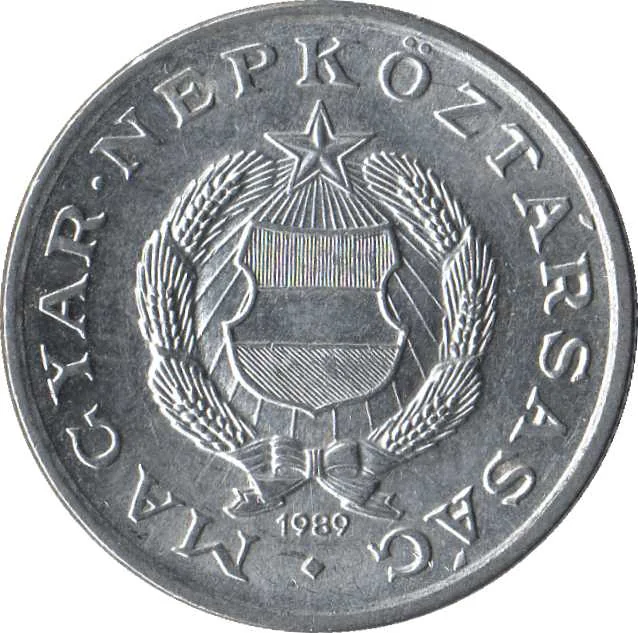
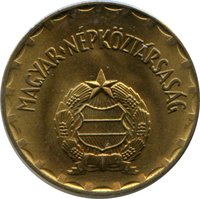
Hungarian People's Republic coat of arms (1957–1990): a shield encircled by a wreath, topped with a star.
Inscription:
MAGYAR · NÉPKÖZTÁRSASÁG ·
1989
1989
Translation:
HUNGARIAN PEOPLE'S REPUBLIC
1989
1989
Script: Latin
Language: Hungarian
Designer: Iván István
Reverse
Description:
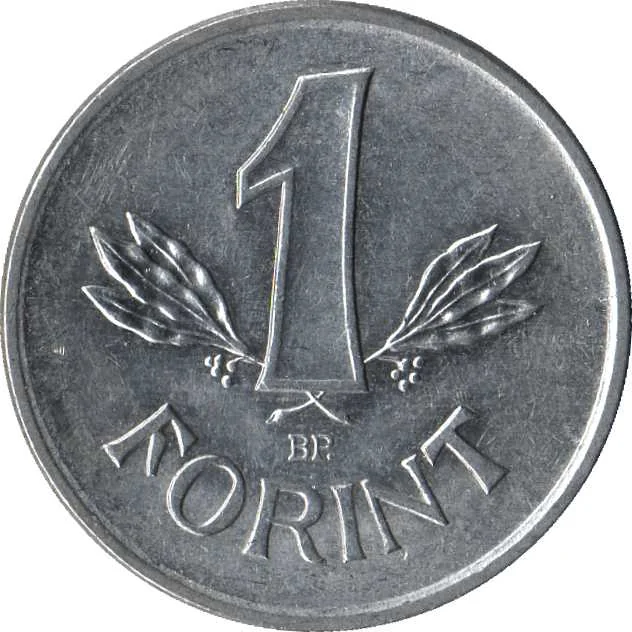
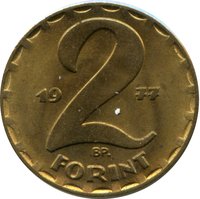
Value between leaves, mintmark center.
Inscription:
1
BP.
FORINT
BP.
FORINT
Script: Latin
Designer: Iván István
Edge
Reeded
Categories
| Symbol> Wreath |
| Symbols> Coat of Arms |
Mints
| Name | Mark |
|---|---|
| Hungarian mint | BP. |
Mintings
| Year | Mint Mark | Mintage | Quality | Collection |
|---|---|---|---|---|
| 1967 | BP. | 60,000,000 | ||
| 1968 | BP. | 53,230,000 | ||
| 1969 | BP. | 27,664,000 | ||
| 1970 | BP. | 11,290,000 | ||
| 1971 | BP. | 100,000 | BU | |
| 1971 | BP. | — | ||
| 1972 | BP. | — | ||
| 1972 | BP. | 110,000 | BU | |
| 1973 | BP. | 1,990,000 | ||
| 1974 | BP. | 4,990,000 | ||
| 1975 | BP. | 10,000,000 | ||
| 1976 | BP. | 15,000,000 | ||
| 1977 | BP. | 10,050,000 | ||
| 1978 | BP. | 50,000 | BU | |
| 1978 | BP. | — | ||
| 1979 | BP. | 10,070,000 | ||
| 1980 | BP. | 20,040,000 | ||
| 1981 | BP. | 25,040,000 | ||
| 1982 | BP. | 10,000,000 | ||
| 1983 | BP. | 20,140,000 | ||
| 1984 | BP. | 6,010,000 | ||
| 1985 | BP. | 30,000 | BU | |
| 1985 | BP. | — | ||
| 1986 | BP. | 30,000 | BU | |
| 1986 | BP. | — | ||
| 1987 | BP. | 13,000,000 | ||
| 1988 | BP. | 20,080,000 | ||
| 1989 | BP. | 115,920,000 |
Historical background
In 1967, Hungary was operating under the complex and restrictive monetary system common to centrally planned economies within the Soviet bloc. The official currency, the forint, existed in a state of artificial isolation, with its exchange rate set administratively by the state and bearing little relation to market forces or purchasing power parity. Crucially, a strict dual-currency regime was in effect: a non-convertible "domestic forint" for everyday transactions within Hungary, and separate, valuable "foreign exchange forints" or hard currency certificates that were needed to access imported goods from the West in special shops like Intershops. This created a pervasive black market for foreign currencies, particularly the US dollar and Deutsche Mark, where the real value of the forint was significantly lower than the official state rate.
This economic environment was set against the backdrop of the New Economic Mechanism (NEM), a major reform program launched in 1968. The preparations throughout 1967 were therefore pivotal, as the state aimed to introduce limited market elements and improve economic efficiency while maintaining overall party control. The currency situation was a central problem to be addressed, as the rigid exchange controls and dual system were seen as major obstacles to increased foreign trade and technological modernization. However, the planned reforms did not envision true convertibility; instead, they sought to create a more realistic and unified official exchange rate and to cautiously expand the sectors where enterprises could engage in direct foreign trade.
Thus, the currency situation in 1967 was one of transition and contradiction. It was characterized by the entrenched inefficiencies of a command economy—with its artificially valued currency, pervasive shortages, and incentive-destroying dual system—while simultaneously preparing for a cautious and partial liberalization. The state was grappling with the need to integrate more with the global economy to spur growth, while being fundamentally unwilling to relinquish the political control that full currency convertibility and an open market would inevitably undermine. The outcome would be a reformed, yet still heavily managed and non-convertible, forint within a hybrid system.
This economic environment was set against the backdrop of the New Economic Mechanism (NEM), a major reform program launched in 1968. The preparations throughout 1967 were therefore pivotal, as the state aimed to introduce limited market elements and improve economic efficiency while maintaining overall party control. The currency situation was a central problem to be addressed, as the rigid exchange controls and dual system were seen as major obstacles to increased foreign trade and technological modernization. However, the planned reforms did not envision true convertibility; instead, they sought to create a more realistic and unified official exchange rate and to cautiously expand the sectors where enterprises could engage in direct foreign trade.
Thus, the currency situation in 1967 was one of transition and contradiction. It was characterized by the entrenched inefficiencies of a command economy—with its artificially valued currency, pervasive shortages, and incentive-destroying dual system—while simultaneously preparing for a cautious and partial liberalization. The state was grappling with the need to integrate more with the global economy to spur growth, while being fundamentally unwilling to relinquish the political control that full currency convertibility and an open market would inevitably undermine. The outcome would be a reformed, yet still heavily managed and non-convertible, forint within a hybrid system.
Series: 1967 Hungary circulation coins
🌱 Very Common