

5 centimes – Belgium
Add to wishlist
Belgium
Context
Years: 1939–1940
Issuer: Belgium
Ruler: Leopold III
Currency:
(1832—2001)
Demonetization: 1 January 1957
Total mintage: 4,970,000
Material
Diameter: 19 mm
Weight: 2.5 g
Thickness: 1.23 mm
Shape: Round with a round hole
Magnetic: No
Technique: Milled
Alignment: Coin alignment
flip
References
KM: #
Numista: #7100
Value
Exchange value: 0.05 BEF
Obverse
Description:
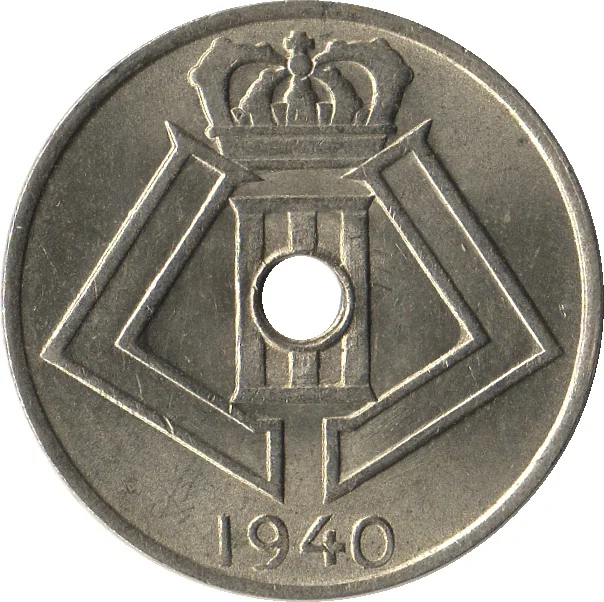
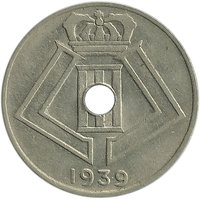
Léopold III monogram, date beneath.
Inscription:
1940
Script: Latin
Engraver: Oscar Jespers
Reverse
Description:
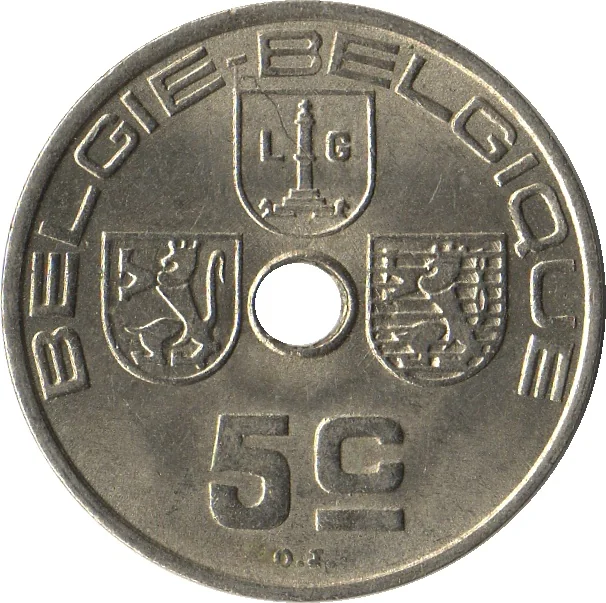
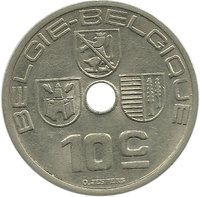
Ghent, Liège, and Arlon coats of arms with bilingual legends. Value and designer below.
Inscription:
BELGIE-BELGIQUE
5c
O.J.
5c
O.J.
Translation:
Belgium
5 centimes
5 centimes
Script: Latin
Engraver: Oscar Jespers
Edge
Plain
Categories
| Symbols> Coat of Arms |
| Symbols> Monogram |
Mints
| Name | Mark |
|---|---|
| Royal Mint of Belgium | — |
Mintings
| Year | Mint Mark | Mintage | Quality | Collection |
|---|---|---|---|---|
| 1939 | — | 3,000,000 | ||
| 1940 | — | 1,970,000 |
Historical background
In 1939, Belgium's currency situation was defined by its membership in the "Gold Bloc," a group of European nations that had struggled to maintain the gold standard after Britain and the United States abandoned it in the early 1930s. The Belgian franc, pegged to gold at its pre-Depression parity, was widely considered overvalued. This overvaluation stifled exports during a period of global economic tension, as Belgian goods were expensive on the international market compared to those from countries with devalued currencies. The National Bank of Belgium held substantial gold reserves to defend this peg, but the policy came at a high cost, contributing to deflation and economic stagnation throughout the decade.
The political and economic pressure to devalue had been mounting for years, culminating in the dramatic devaluation of 35% in March 1935 under Prime Minister Paul van Zeeland. This decisive break from the rigid Gold Bloc policy was part of a broader "New Deal"-style recovery program. The devaluation was successful in providing a crucial economic stimulus; it boosted exports, helped reverse deflation, and spurred industrial production. By 1939, the Belgian franc operated under a managed gold standard with its new, more realistic parity, and the economy was in a stronger, though still fragile, recovery phase.
As Europe stood on the brink of war in September 1939, Belgium's primary monetary concern shifted from economic recovery to wartime financial preparedness. The government and the National Bank focused on safeguarding the nation's substantial gold reserves and ensuring monetary stability in the face of impending crisis. Measures were taken to control capital flows and prepare for the economic disruptions of conflict, understanding that the relative stability achieved after the 1935 devaluation would be severely tested by the geopolitical shocks to come.
The political and economic pressure to devalue had been mounting for years, culminating in the dramatic devaluation of 35% in March 1935 under Prime Minister Paul van Zeeland. This decisive break from the rigid Gold Bloc policy was part of a broader "New Deal"-style recovery program. The devaluation was successful in providing a crucial economic stimulus; it boosted exports, helped reverse deflation, and spurred industrial production. By 1939, the Belgian franc operated under a managed gold standard with its new, more realistic parity, and the economy was in a stronger, though still fragile, recovery phase.
As Europe stood on the brink of war in September 1939, Belgium's primary monetary concern shifted from economic recovery to wartime financial preparedness. The government and the National Bank focused on safeguarding the nation's substantial gold reserves and ensuring monetary stability in the face of impending crisis. Measures were taken to control capital flows and prepare for the economic disruptions of conflict, understanding that the relative stability achieved after the 1935 devaluation would be severely tested by the geopolitical shocks to come.
Series: 1939 Belgium circulation coins
🌱 Very Common