

3 pence – United Kingdom
Add to wishlist
United Kingdom
Context
Years: 1954–1970
Issuer: United Kingdom
Ruler: Elizabeth II
Currency:
(1158—1970)
Demonetization: 31 August 1971
Total mintage: 682,219,200
Material
Diameter: 21.74 mm
Weight: 6.8 g
Thickness: 2.6 mm
Shape: Dodecagonal
Magnetic: No
Technique: Milled
Alignment: Medal alignment
flip
References
KM: #
Numista: #71
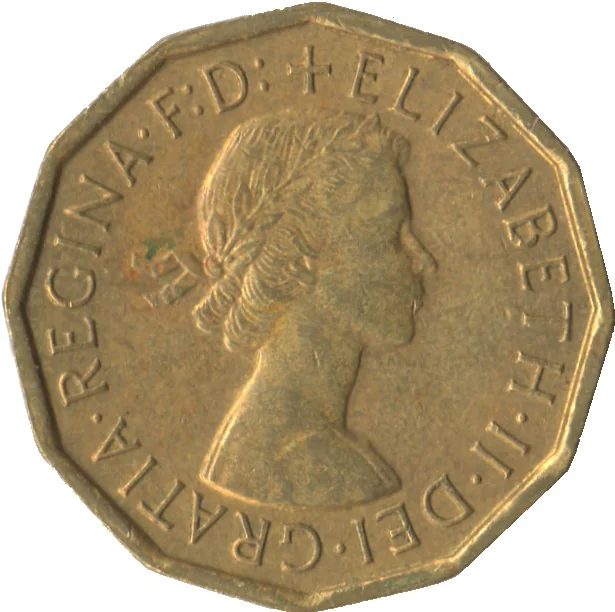
Obverse
Description:
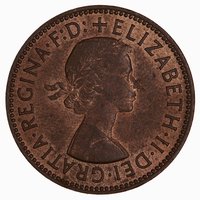
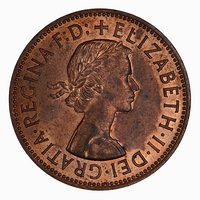
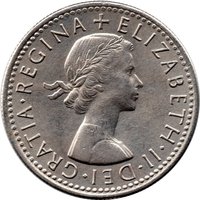
Young Queen Elizabeth II facing right, surrounded by legend.
Inscription:
+ ELIZABETH·II·DEI·GRATIA·REGINA·F:D:
Translation:
Elizabeth II by the Grace of God Queen Defender of the Faith
Script: Latin
Language: Latin
Designer: Mary Gillick
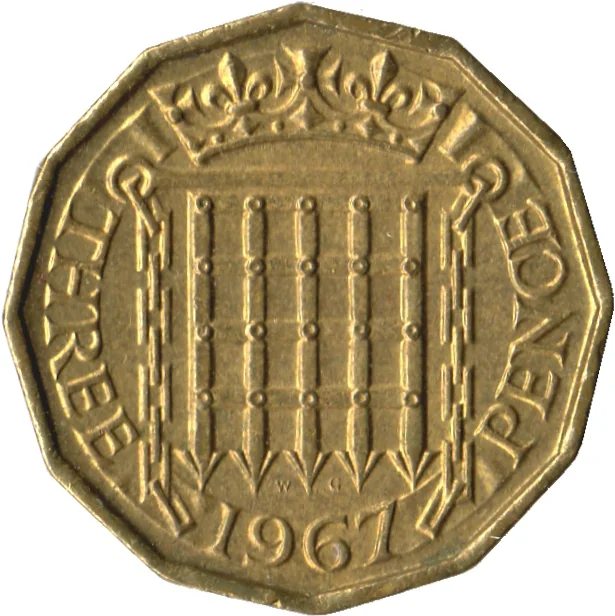
Reverse
Description:
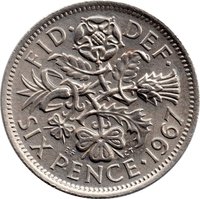
Crowned Tudor portcullis with chains, flanking value; date below.
Inscription:
W G
THREE 1967 PENCE
THREE 1967 PENCE
Script: Latin
Designer: William Maving Gardner
Edge
Plain
Mints
| Name | Mark |
|---|---|
| Royal Mint (Tower Hill) | — |
Mintings
| Year | Mint Mark | Mintage | Quality | Collection |
|---|---|---|---|---|
| 1954 | — | 41,720,000 | ||
| 1955 | — | 41,075,200 | ||
| 1956 | — | 36,801,600 | ||
| 1957 | — | 24,294,400 | ||
| 1958 | — | 20,504,000 | ||
| 1959 | — | 28,499,200 | ||
| 1960 | — | 83,078,400 | ||
| 1961 | — | 41,102,400 | ||
| 1962 | — | 51,545,600 | ||
| 1963 | — | 35,280,000 | ||
| 1964 | — | 44,867,200 | ||
| 1965 | — | 27,160,000 | ||
| 1966 | — | 53,760,000 | ||
| 1967 | — | 151,780,800 | ||
| 1970 | — | 750,400 | Proof |
Historical background
In 1954, the United Kingdom's currency situation was defined by the lingering constraints of the post-war Sterling Area and the managed framework of the Bretton Woods system. The pound sterling was pegged at a fixed rate of $2.80, a parity maintained through strict exchange controls and the pooling of dollar reserves within the Sterling Area. This system, while promoting trade within the Commonwealth, placed a significant burden on the UK as the banker for the bloc, requiring it to defend the pound's value and manage widespread sterling balances held by member countries—a source of persistent vulnerability.
Domestically, the economy was in a period of recovery and gradual liberalisation under a Conservative government. The harsh austerity of the late 1940s was easing, but the currency remained underpinned by a regime of rationing (which ended fully in 1954) and import restrictions to safeguard the balance of payments. The "Robot" plan of 1952—a failed proposal to float the pound and make sterling balances non-convertible—highlighted ongoing internal debates about the sustainability of the fixed rate and the costs of defending the reserve currency role.
Overall, 1954 represented a point of cautious transition. The currency was stable on the surface, supported by improving trade figures and a rise in gold and dollar reserves. However, this stability was administrative and fragile, reliant on controls rather than market confidence. The underlying tensions between domestic economic aspirations, the demands of the Sterling Area, and the pound's role as an international currency would continue to define British monetary policy and precipitate crises in the decades to follow.
Domestically, the economy was in a period of recovery and gradual liberalisation under a Conservative government. The harsh austerity of the late 1940s was easing, but the currency remained underpinned by a regime of rationing (which ended fully in 1954) and import restrictions to safeguard the balance of payments. The "Robot" plan of 1952—a failed proposal to float the pound and make sterling balances non-convertible—highlighted ongoing internal debates about the sustainability of the fixed rate and the costs of defending the reserve currency role.
Overall, 1954 represented a point of cautious transition. The currency was stable on the surface, supported by improving trade figures and a rise in gold and dollar reserves. However, this stability was administrative and fragile, reliant on controls rather than market confidence. The underlying tensions between domestic economic aspirations, the demands of the Sterling Area, and the pound's role as an international currency would continue to define British monetary policy and precipitate crises in the decades to follow.
🌱 Very Common