

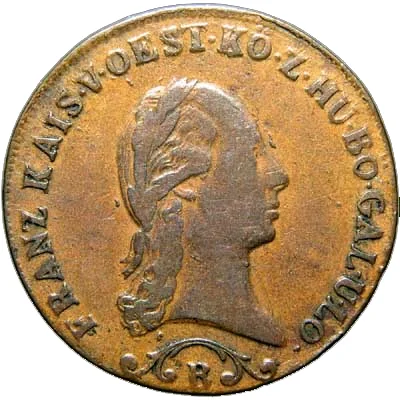
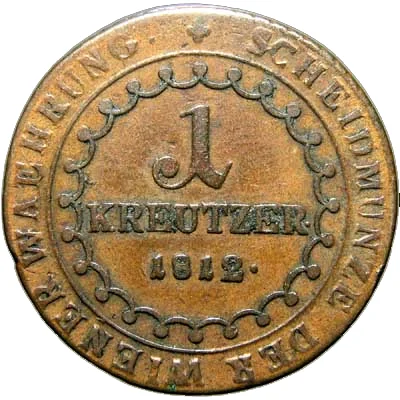
1 Kreuzer – Austrian Empire
Austria
Context
Year: 1812
Country: Austria 
Issuer: Austrian Empire
Ruler: Francis I of Austria
Currency:
(1754—1857)
Demonetized: Yes
Total mintage: 92,163,000
Material
References
KM: #Click to copy to clipboard2112
Numista: #7097
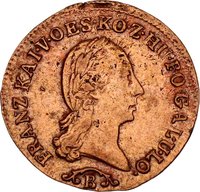
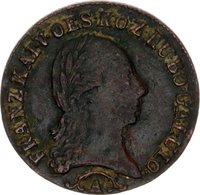
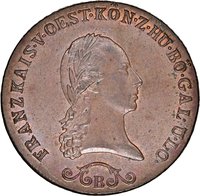
Obverse
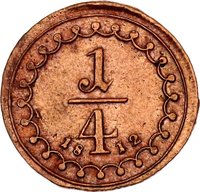
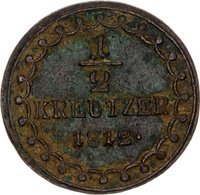
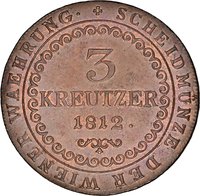
Reverse
Description:
A filigreed ring inscribed "1 KREUTZER 1812."
Inscription:
SCHEIDMUNZE DER WIENER WAEHRUNG
1
KREUTZER
1812.
1
KREUTZER
1812.
Script: Latin
Edge
Chain ornament
Mints
| Name | Mark |
|---|---|
| Münze Österreich | A |
| Kremnica | B |
| Prague | C |
| Alba Iulia | E |
| Baia Mare | G |
| Oravița / Oravicabánya / Orawitz | O |
| Smolník / Szomolnok / Schmöllnitz | S |
Mintings
Historical background
In 1812, the currency situation of the Austrian Empire was one of profound instability and devaluation, a direct legacy of the state's desperate financial measures during the Napoleonic Wars. To fund its military campaigns, the Habsburg monarchy had increasingly relied on the printing press, issuing vast quantities of paper money known as Bancozettel from the state-owned Wiener Stadtbanco. What began as a limited emergency measure in the late 18th century had spiraled into uncontrolled inflation, as the volume of paper notes in circulation far outstripped the silver reserves meant to back them. By 1811, the situation had become so dire that the state was forced to implement a drastic currency reform, the Finanzpatent, which declared state bankruptcy by mandating that old paper notes be exchanged for new ones, the Einlösungsscheine, at a rate of 5:1.
The year 1812 thus found Austria operating under this new, but still fragile, paper currency system. The Einlösungsscheine were theoretically convertible into silver, but in practice, convertibility was severely restricted, and public trust remained low. The state continued to face enormous expenses, particularly due to its forced alliance with Napoleon and the costly preparation for the French invasion of Russia, which required the mobilization of an Austrian auxiliary corps. This ongoing fiscal pressure meant the temptation to print more paper money persisted, threatening to reignite the cycle of depreciation. Consequently, a significant disparity existed between the official face value of the paper currency and its real value in silver coinage, leading to a dual-system economy where precious metal coins were hoarded and traded at a high premium.
This monetary chaos had severe economic and social consequences. Prices were volatile and trade was hampered, as merchants and the public struggled with uncertain exchange rates and the depreciating paper. The burden fell heaviest on fixed-income earners, civil servants, and soldiers, whose salaries lost purchasing power, while debtors benefited at the expense of creditors. In essence, the currency situation of 1812 reflected a state still grappling with the financial wreckage of continuous warfare, its monetary system a patchwork of unstable paper that undermined economic recovery and exposed the deep fiscal vulnerabilities of the Habsburg empire.
The year 1812 thus found Austria operating under this new, but still fragile, paper currency system. The Einlösungsscheine were theoretically convertible into silver, but in practice, convertibility was severely restricted, and public trust remained low. The state continued to face enormous expenses, particularly due to its forced alliance with Napoleon and the costly preparation for the French invasion of Russia, which required the mobilization of an Austrian auxiliary corps. This ongoing fiscal pressure meant the temptation to print more paper money persisted, threatening to reignite the cycle of depreciation. Consequently, a significant disparity existed between the official face value of the paper currency and its real value in silver coinage, leading to a dual-system economy where precious metal coins were hoarded and traded at a high premium.
This monetary chaos had severe economic and social consequences. Prices were volatile and trade was hampered, as merchants and the public struggled with uncertain exchange rates and the depreciating paper. The burden fell heaviest on fixed-income earners, civil servants, and soldiers, whose salaries lost purchasing power, while debtors benefited at the expense of creditors. In essence, the currency situation of 1812 reflected a state still grappling with the financial wreckage of continuous warfare, its monetary system a patchwork of unstable paper that undermined economic recovery and exposed the deep fiscal vulnerabilities of the Habsburg empire.
🌱 Common