

1 crown (Reign of Franz Joseph I) – Austrian Empire
Add to wishlist
Circulating commemorative coins
Commemoration: 60th Anniversary of the Reign of Franz Joseph I
Austria
Context
Year: 1908
Country: Austria
Issuer: Austrian Empire
Ruler: Francis Joseph I
Currency:
(1892—1918)
Demonetized: Yes
Total mintage: 4,784,992
Material
References
KM: #
Numista: #7095
Value
Bullion value: $10.41
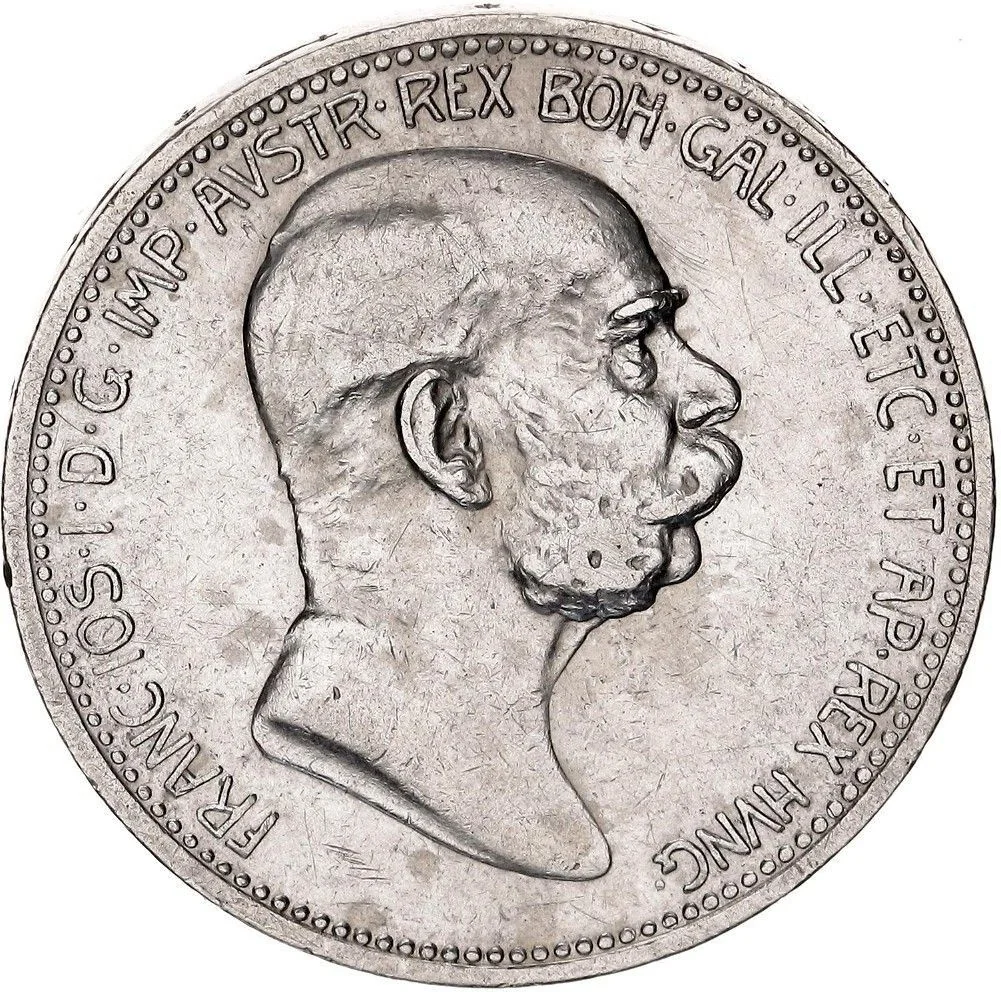
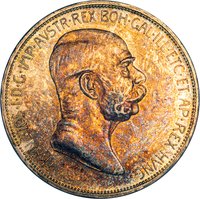
Obverse
Description:
Franz Joseph I bust facing right.
Inscription:
FRANC·IOS·I·D·G·IMP·AVSTR·REX·BOH·GAL·ILL·ETC·ET AP·REX·HVNG
Translation:
FRANCIS I, BY THE GRACE OF GOD, EMPEROR OF AUSTRIA, KING OF BOHEMIA, GALICIA, ILLYRIA, ETC., AND APOSTOLIC KING OF HUNGARY
Script: Latin
Language: Latin
Engraver: Rudolf Marschall/Rudolf Neuberger
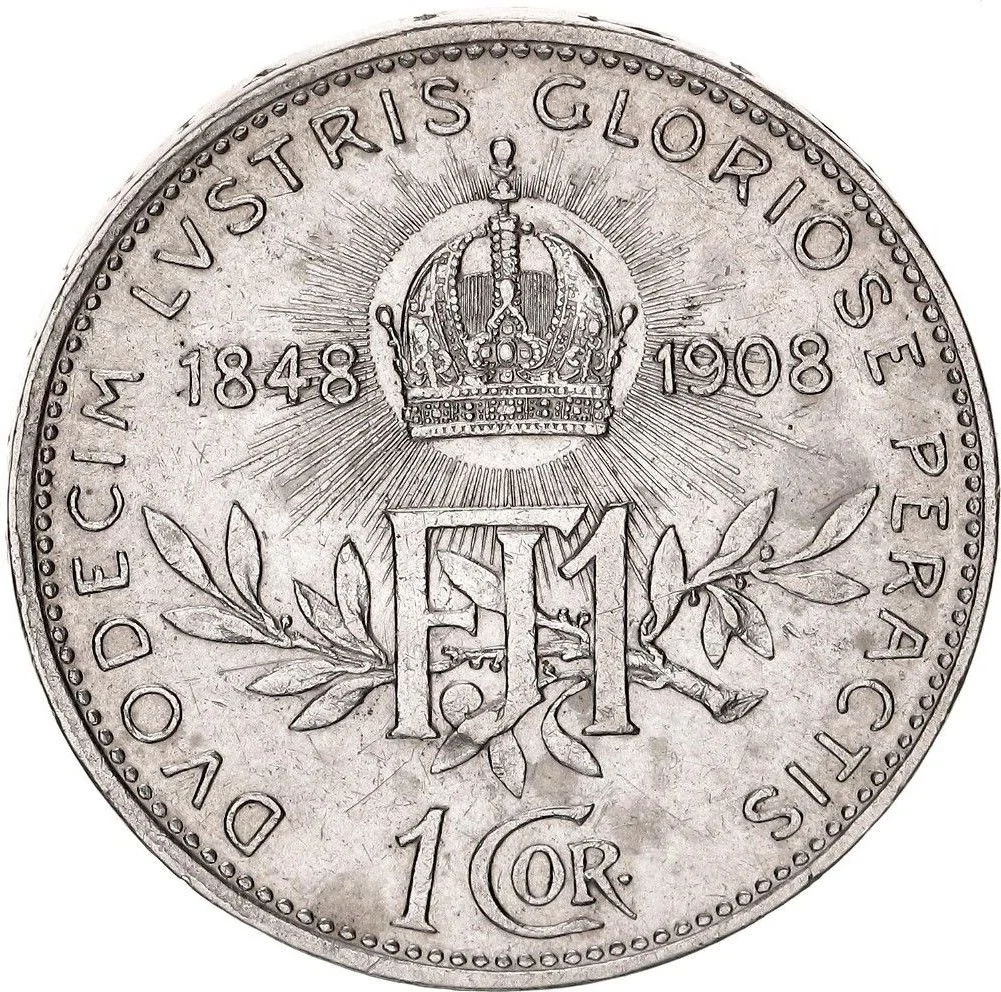
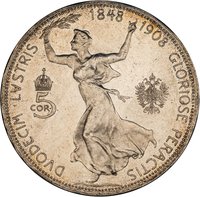
Reverse
Description:
Imperial crown dividing Franz Josef's reign dates, monogram above laurel. Value below.
Inscription:
DVODECIM LVSTRIS GLORIOSE PERACTIS
1848 1908
FJ1
1 COR.
1848 1908
FJ1
1 COR.
Translation:
Having gloriously completed twelve lustral periods
1848 1908
FJ1
1 COR.
1848 1908
FJ1
1 COR.
Script: Latin
Language: Latin
Engraver: Andreas Neudeck
Edge
Mints
| Name | Mark |
|---|---|
| Münze Österreich | — |
Mintings
| Year | Mint Mark | Mintage | Quality | Collection |
|---|---|---|---|---|
| 1908 | — | 4,784,992 |
Historical background
In 1908, the currency situation of the Austrian Empire was defined by the stability of the Austro-Hungarian gulden (or florin), which was backed by a bimetallic (gold and silver) standard established by the 1892 currency reform. This reform, fully implemented by 1900, had successfully replaced the old paper gulden and created the gold-convertible Krone (crown), though the gulden remained in common parlance. The central bank, the Austro-Hungarian Bank, maintained strict convertibility, ensuring the currency's credibility in international markets and fostering a period of economic growth and foreign investment in the decade leading up to 1908.
However, this system operated within the complex political framework of the Dual Monarchy. While the empire had a unified currency and central bank, fiscal and economic policies were largely separate between the Austrian (Cisleithanian) and Hungarian (Transleithanian) halves. This created underlying tensions, as both entities had to agree on the renewal of the central bank's charter and the sharing of seigniorage profits. The year 1908 itself was politically charged, most notably due to the Bosnian Crisis—the annexation of Bosnia and Herzegovina—which increased geopolitical risk and state expenditure, indirectly putting pressure on the fiscal unity that underpinned the currency.
Consequently, while the currency itself was technically sound and stable in 1908, its future was intertwined with the empire's political fortunes. The system relied on a fragile compromise between Vienna and Budapest, and any significant political rupture threatened the monetary union. The costs of military preparedness and the lack of a fully integrated economic space were long-term vulnerabilities. Thus, the krone stood as a symbol of the empire's modernizing economy but also reflected its deep-seated structural contradictions, which would ultimately outlast the currency itself following the empire's collapse in World War I.
However, this system operated within the complex political framework of the Dual Monarchy. While the empire had a unified currency and central bank, fiscal and economic policies were largely separate between the Austrian (Cisleithanian) and Hungarian (Transleithanian) halves. This created underlying tensions, as both entities had to agree on the renewal of the central bank's charter and the sharing of seigniorage profits. The year 1908 itself was politically charged, most notably due to the Bosnian Crisis—the annexation of Bosnia and Herzegovina—which increased geopolitical risk and state expenditure, indirectly putting pressure on the fiscal unity that underpinned the currency.
Consequently, while the currency itself was technically sound and stable in 1908, its future was intertwined with the empire's political fortunes. The system relied on a fragile compromise between Vienna and Budapest, and any significant political rupture threatened the monetary union. The costs of military preparedness and the lack of a fully integrated economic space were long-term vulnerabilities. Thus, the krone stood as a symbol of the empire's modernizing economy but also reflected its deep-seated structural contradictions, which would ultimately outlast the currency itself following the empire's collapse in World War I.
🌱 Common