

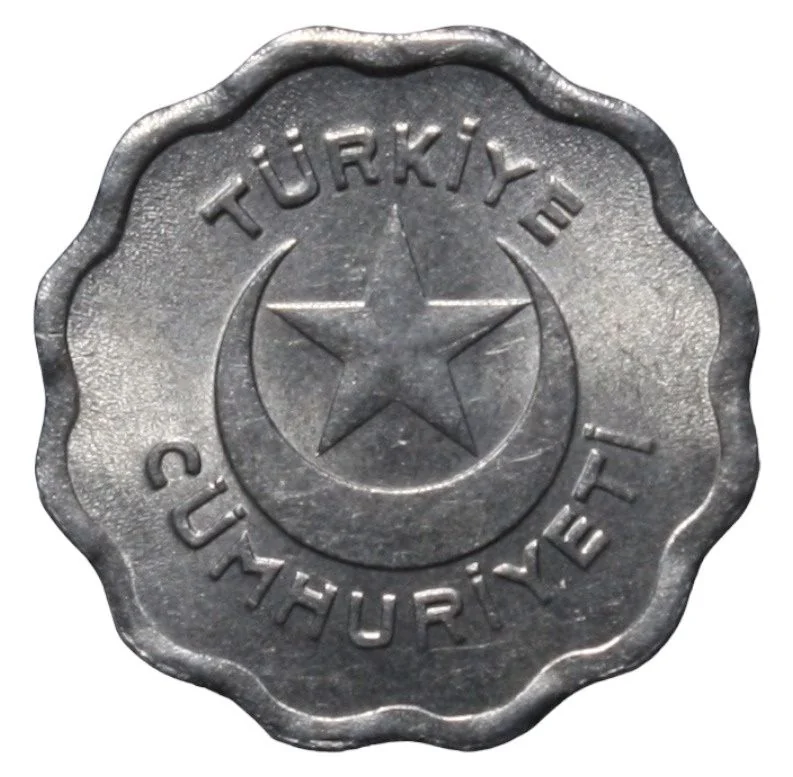
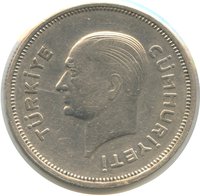
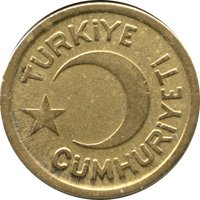
Obverse
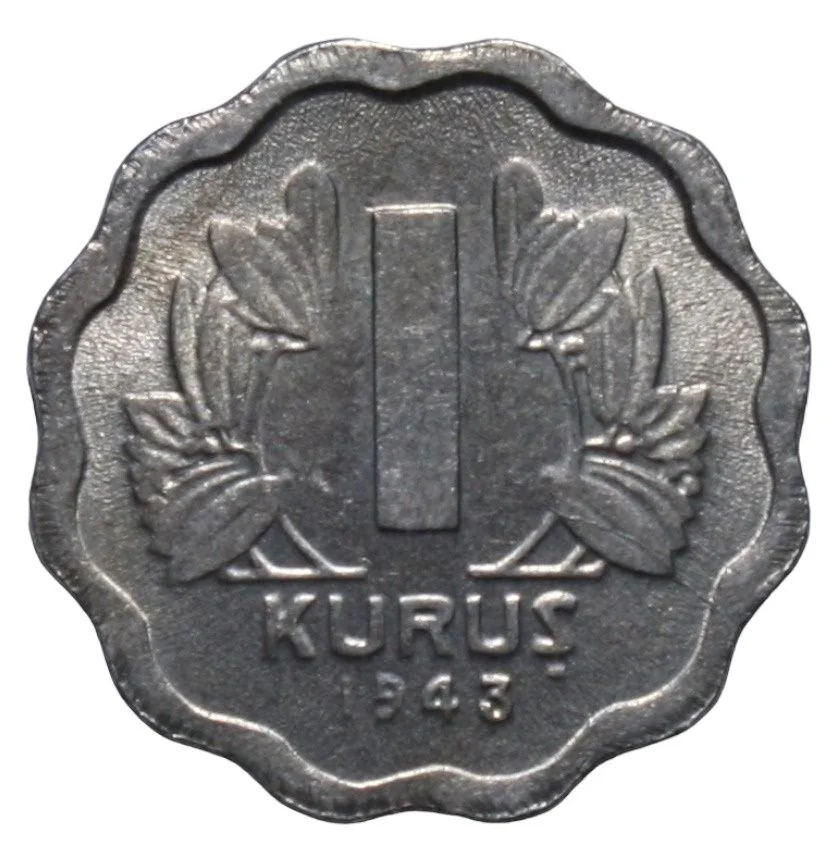
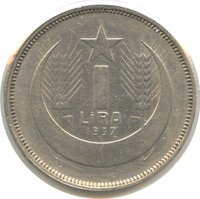
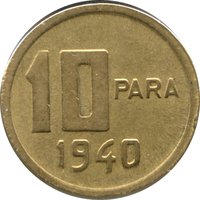
Reverse
Edge
Plain
Mintings
| Year | Mint Mark | Mintage | Quality | Collection |
|---|---|---|---|---|
| 1938 | — | 16,400,000 | ||
| 1939 | — | 21,600,000 | ||
| 1940 | — | 4,500,000 | ||
| 1941 | — | 6,700,000 | ||
| 1942 | — | 10,800,000 | ||
| 1943 | — | 4,000,000 | ||
| 1944 | — | 6,000,000 |
Historical background
In 1938, the Republic of Turkey was operating under a currency system established by its founder, Mustafa Kemal Atatürk, who passed away that November. The Turkish lira, first introduced in the late Ottoman period, had been reorganized under the Central Bank of the Republic of Turkey (TCMB), established in 1930. The country adhered to a fixed exchange rate regime, with the lira pegged to a gold standard and, by extension, to major currencies like the British pound and French franc. This period was characterized by a deliberate policy of monetary stability and insulation from global financial shocks, reflecting the étatist (state-directed) economic principles of the single-party era.
The economy was heavily focused on state-led industrialization and infrastructure projects, with foreign exchange controls strictly managed to conserve reserves for importing essential capital goods. While this protected the currency from speculative pressures, it also created a complex system of trade regulations and limited convertibility. The lira's value was officially strong but did not always reflect market realities, leading to a nascent black market for foreign currency, particularly for transactions outside state-sanctioned channels. Inflation was not a significant concern in this tightly controlled environment, as the government prioritized fiscal discipline to maintain the peg and fund its development plans.
Overall, the currency situation in 1938 was one of artificial stability, a cornerstone of the early Republic's quest for economic sovereignty and modernization. However, this rigid system also sowed the seeds for future challenges, as it relied heavily on continuous state control and struggled to adapt to dynamic economic conditions. The death of Atatürk marked the end of an era, but his monetary legacy of a state-managed, fixed-rate lira would define Turkish economic policy for decades to come, even as global pressures eventually necessitated change.
The economy was heavily focused on state-led industrialization and infrastructure projects, with foreign exchange controls strictly managed to conserve reserves for importing essential capital goods. While this protected the currency from speculative pressures, it also created a complex system of trade regulations and limited convertibility. The lira's value was officially strong but did not always reflect market realities, leading to a nascent black market for foreign currency, particularly for transactions outside state-sanctioned channels. Inflation was not a significant concern in this tightly controlled environment, as the government prioritized fiscal discipline to maintain the peg and fund its development plans.
Overall, the currency situation in 1938 was one of artificial stability, a cornerstone of the early Republic's quest for economic sovereignty and modernization. However, this rigid system also sowed the seeds for future challenges, as it relied heavily on continuous state control and struggled to adapt to dynamic economic conditions. The death of Atatürk marked the end of an era, but his monetary legacy of a state-managed, fixed-rate lira would define Turkish economic policy for decades to come, even as global pressures eventually necessitated change.
🌱 Common