

1000 réis (Tobias Barreto de Meneses) – Brazil
Add to wishlist
Standard circulation coins
Commemoration: Centenary of the birth of Tobias Barreto de Meneses
Brazil
Context
Year: 1939
Issuer: Brazil
Period:
(1889—1967)
Currency:
(1799—1942)
Demonetized: Yes
Total mintage: 9,586,000
Material
Diameter: 24.5 mm
Weight: 7 g
Thickness: 2.1 mm
Shape: Round
Composition: Aluminium bronze
Magnetic: No
Technique: Milled
Alignment: Coin alignment
flip
References
KM: #
Numista: #7059
Obverse
Description:
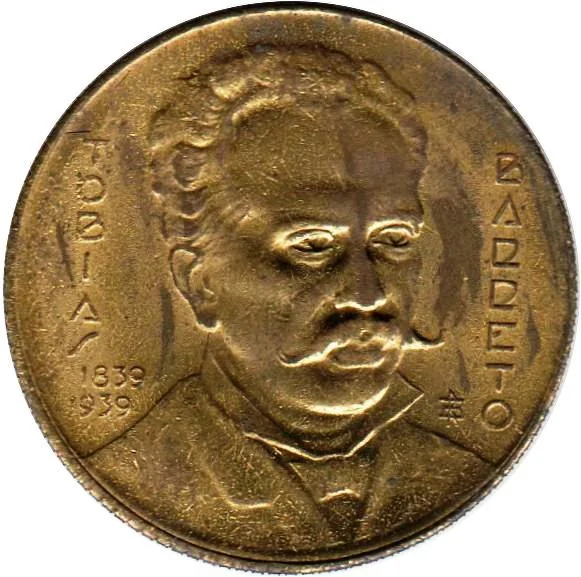
Tobias Barreto (1839–1889) was a Brazilian poet, critic, and jurist.
Inscription:
TOBIAS BARRETO
1839 1939
1839 1939
Script: Latin
Reverse
Description:
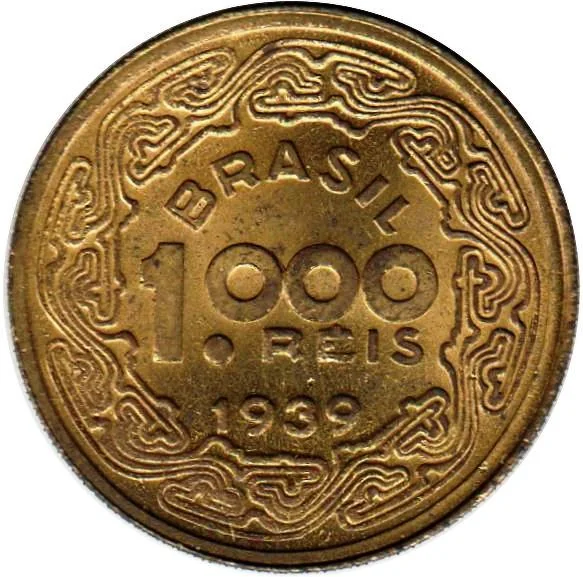
Ornamental ring inscription.
Inscription:
BRASIL
1.000
RÉIS
1939
1.000
RÉIS
1939
Translation:
Brazil
1,000
Réis
1939
1,000
Réis
1939
Script: Latin
Language: Portuguese
Edge
Reeded
Categories
| Art> Literature |
Mints
| Name | Mark |
|---|---|
| Casa da Moeda do Brasil | — |
Mintings
| Year | Mint Mark | Mintage | Quality | Collection |
|---|---|---|---|---|
| 1939 | — | 9,586,000 |
Historical background
In 1939, Brazil's currency situation was characterized by a complex system of exchange controls and multiple exchange rates, a legacy of the Great Depression and the Estado Novo regime of Getúlio Vargas. The country had abandoned the gold standard in the early 1930s, and the official currency, the mil-réis, was no longer freely convertible. The government, through the Banco do Brasil, maintained strict control over foreign exchange to manage balance of payments, prioritize essential imports, and service the nation's substantial foreign debt. This control was crucial for an economy heavily dependent on coffee exports, which faced volatile international prices.
The system operated with several fixed exchange rates set by the government for different types of transactions. For example, there was a preferential rate for financing official debt payments and importing essential goods like fuel and machinery, while luxury imports or non-essential transactions faced a much less favorable rate. This multi-tiered system aimed to conserve scarce dollar and sterling reserves, which were further strained by the outbreak of World War II in September 1939. The war immediately disrupted Atlantic trade, creating new uncertainties for Brazil's export revenues and access to manufactured imports.
Consequently, the primary monetary challenges in 1939 were managing inflationary pressures from constrained imports and maintaining the stability of the mil-réis in a controlled, artificial environment. The government's focus was on economic nationalism and import-substitution industrialization, using currency policy as a key tool to direct the economy. The situation laid the groundwork for the more pronounced inflationary difficulties of the 1940s and would eventually lead to the 1942 currency reform that introduced the cruzeiro, replacing the mil-réis at a rate of 1 cruzeiro to 1,000 mil-réis.
The system operated with several fixed exchange rates set by the government for different types of transactions. For example, there was a preferential rate for financing official debt payments and importing essential goods like fuel and machinery, while luxury imports or non-essential transactions faced a much less favorable rate. This multi-tiered system aimed to conserve scarce dollar and sterling reserves, which were further strained by the outbreak of World War II in September 1939. The war immediately disrupted Atlantic trade, creating new uncertainties for Brazil's export revenues and access to manufactured imports.
Consequently, the primary monetary challenges in 1939 were managing inflationary pressures from constrained imports and maintaining the stability of the mil-réis in a controlled, artificial environment. The government's focus was on economic nationalism and import-substitution industrialization, using currency policy as a key tool to direct the economy. The situation laid the groundwork for the more pronounced inflationary difficulties of the 1940s and would eventually lead to the 1942 currency reform that introduced the cruzeiro, replacing the mil-réis at a rate of 1 cruzeiro to 1,000 mil-réis.
🌱 Very Common