

1 speciedaler – Denmark
Add to wishlist
Denmark
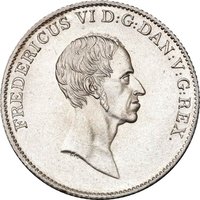
Obverse
Description:
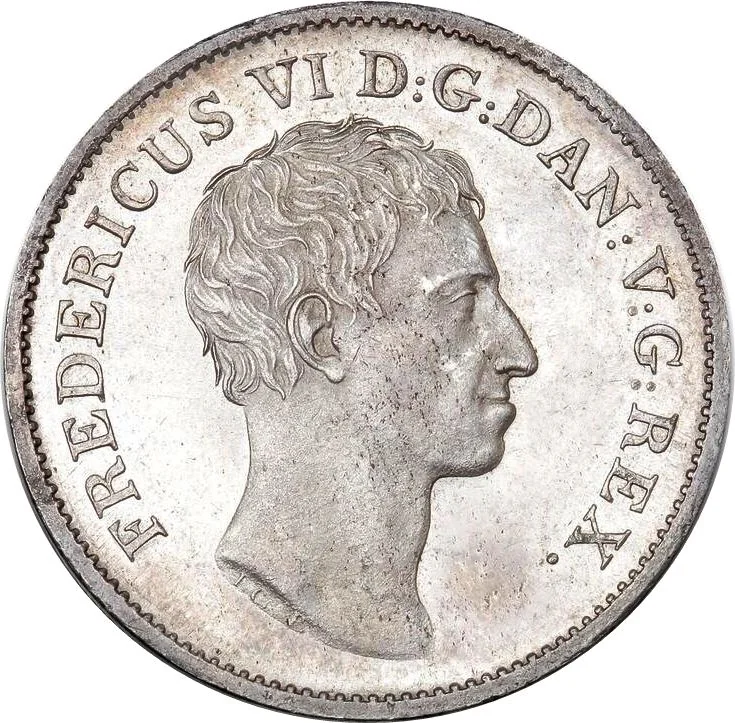
King Frederik VI facing right. Legend around rim.
Inscription:
FREDERICUS VI D:G:DANIÆ:V:G:REX.
ICF
ICF
Translation:
Frederick VI, by the Grace of God, King of Denmark, the Vandal-Goths.
Script: Latin
Language: Latin
Engraver: Johannes Conradsen
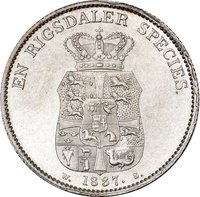
Reverse
Description:
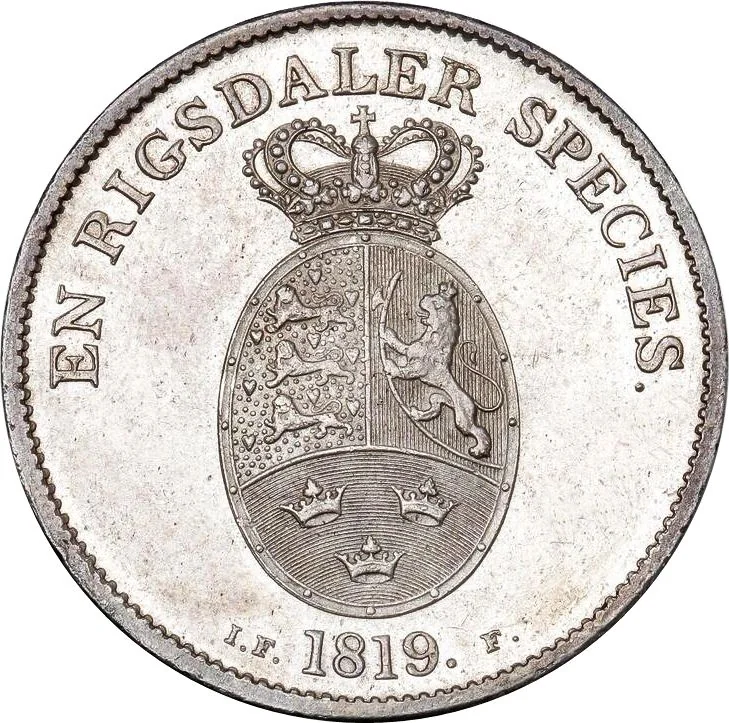
Shield with Danish, Norwegian, and Swedish arms. Value above, date and mintmaster initials below.
Inscription:
EN RIGSDALER SPECIES.
IF. 1819. F.
IF. 1819. F.
Translation:
One Rigsdaler Species.
J.F. 1819. F.
J.F. 1819. F.
Script: Latin
Engraver: Johannes Conradsen
Edge
Mints
| Name | Mark |
|---|---|
| Altona, Schleswig-Holstein | — |
Mintings
| Year | Mint Mark | Mintage | Quality | Collection |
|---|---|---|---|---|
| 1819 | — | — |
Historical background
In 1819, Denmark found itself in a precarious monetary situation, a direct legacy of the state bankruptcy declared in 1813 and the costly aftermath of the Napoleonic Wars. To manage the enormous debt accrued from war, the British naval blockade, and the loss of Norway in 1814, the state had introduced a new, complex currency system. This system, based on the Rigsbankdaler, was not backed by silver but by a national mortgage, creating a fiat currency that struggled with public distrust and severe depreciation. The result was a period of significant inflation and economic instability, where the value of paper money fluctuated wildly, harming trade and public confidence.
The core of the problem was a dual-currency system that created confusion and opportunity for arbitrage. Alongside the paper Rigsbankdaler, there existed the older Kurantdaler, and both circulated while being pegged to the silver Rigsdaler. However, the fixed exchange rates set by the government did not reflect market reality, leading to a wide gap between the official and black-market rates for silver. This disparity crippled foreign commerce and encouraged speculation, as merchants and the public grappled with the uncertain value of their money in everyday transactions.
Consequently, by 1819, pressure for fundamental monetary reform was building. The economic distress and the clear failure of the fiat system pushed the Danish state toward a return to a stable, metallic standard. This mounting crisis set the stage for the significant currency reforms that would follow in the 1830s, most notably the establishment of the Rigsdaler as a silver-based currency, which aimed to restore both fiscal discipline and public trust in the nation's money after a turbulent decade.
The core of the problem was a dual-currency system that created confusion and opportunity for arbitrage. Alongside the paper Rigsbankdaler, there existed the older Kurantdaler, and both circulated while being pegged to the silver Rigsdaler. However, the fixed exchange rates set by the government did not reflect market reality, leading to a wide gap between the official and black-market rates for silver. This disparity crippled foreign commerce and encouraged speculation, as merchants and the public grappled with the uncertain value of their money in everyday transactions.
Consequently, by 1819, pressure for fundamental monetary reform was building. The economic distress and the clear failure of the fiat system pushed the Danish state toward a return to a stable, metallic standard. This mounting crisis set the stage for the significant currency reforms that would follow in the 1830s, most notably the establishment of the Rigsdaler as a silver-based currency, which aimed to restore both fiscal discipline and public trust in the nation's money after a turbulent decade.
✨ Legendary