

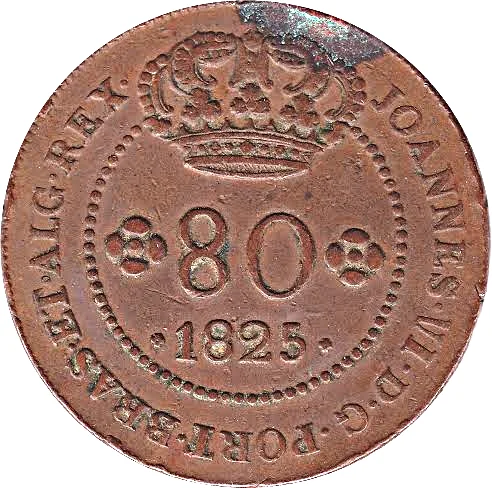
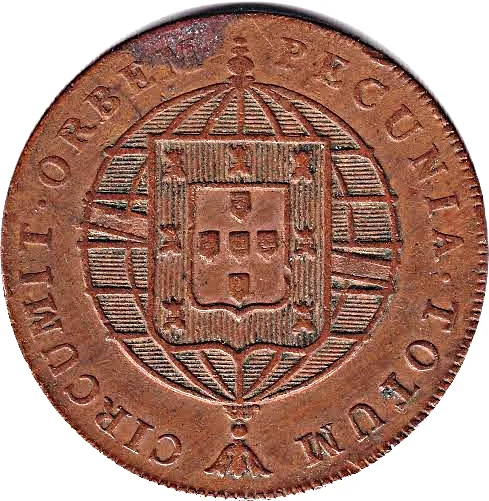
80 réis – São Tomé and Príncipe
Add to wishlist
Sao Tome and Principe
Context
Year: 1825
Country: Sao Tome and Principe
Issuer: São Tomé and Príncipe
Ruler: João VI
Currency:
(1799—1910)
Demonetized: Yes
Material
Diameter: 35 mm
Weight: 15.5 g
Shape: Round
Composition: Copper
Standard: Silver half ounce
Magnetic: No
Technique: Milled
Alignment: Medal alignment
flip
References
KM: #
Numista: #70420
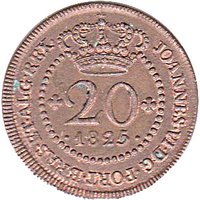
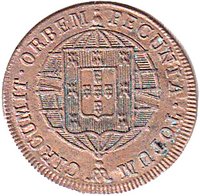
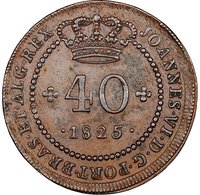
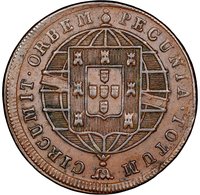
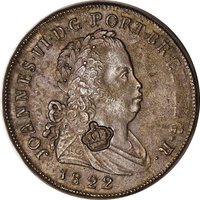
Obverse
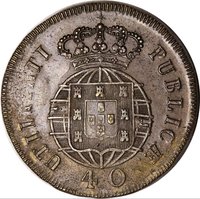
Reverse
Edge
Categories
| Symbol> Armillary sphere |
| Symbol> Crown |
| Symbols> Coat of Arms |
Mints
| Name | Mark |
|---|---|
| Imprensa Nacional - Casa da Moeda | — |
Mintings
| Year | Mint Mark | Mintage | Quality | Collection |
|---|---|---|---|---|
| 1825 | — | — |
Historical background
In 1825, São Tomé and Príncipe existed as a neglected Portuguese colony, its economy still fundamentally structured around the slave trade and plantation agriculture, primarily sugar. The official currency was the Portuguese real, but in practice, the monetary situation was chaotic and insufficient. Hard currency was chronically scarce on the islands, leading to widespread use of barter for local transactions. Furthermore, a variety of foreign coins, particularly Spanish and Brazilian, circulated unofficially due to the archipelago's role in the broader Atlantic trade networks.
This currency scarcity was a direct symptom of the colony's administrative and economic stagnation. Portugal, itself in political turmoil after the Liberal Wars, provided little economic oversight or monetary injection into São Tomé. The plantation economy was inefficient and in decline, failing to generate significant export wealth that would bring in fresh coinage. Consequently, the local economy operated on a limited and ad-hoc monetary base, stifling internal commerce and tying daily survival to the exchange of goods and labor rather than formal currency.
Therefore, the background for 1825 is not one of a formal, functioning currency system but of a monetary vacuum. The Portuguese real was the nominal unit of account, but the tangible medium of exchange was a patchwork of whatever coins arrived on trading ships, supplemented extensively by non-monetary trade. This situation would persist until the later 19th-century cocoa boom, which finally attracted greater economic attention and a more structured, though still problematic, monetary regime to the islands.
This currency scarcity was a direct symptom of the colony's administrative and economic stagnation. Portugal, itself in political turmoil after the Liberal Wars, provided little economic oversight or monetary injection into São Tomé. The plantation economy was inefficient and in decline, failing to generate significant export wealth that would bring in fresh coinage. Consequently, the local economy operated on a limited and ad-hoc monetary base, stifling internal commerce and tying daily survival to the exchange of goods and labor rather than formal currency.
Therefore, the background for 1825 is not one of a formal, functioning currency system but of a monetary vacuum. The Portuguese real was the nominal unit of account, but the tangible medium of exchange was a patchwork of whatever coins arrived on trading ships, supplemented extensively by non-monetary trade. This situation would persist until the later 19th-century cocoa boom, which finally attracted greater economic attention and a more structured, though still problematic, monetary regime to the islands.
💎 Very Rare