

1 shilling – South Africa
Add to wishlist
South Africa
Context
Years: 1926–1930
Issuer: South Africa
Ruler: George V
Currency:
(1825—1961)
Demonetization: 31 March 1961
Total mintage: 2,963,135
Material
References
KM: #
Numista: #70369
Value
Bullion value: $11.37
Obverse
Description:
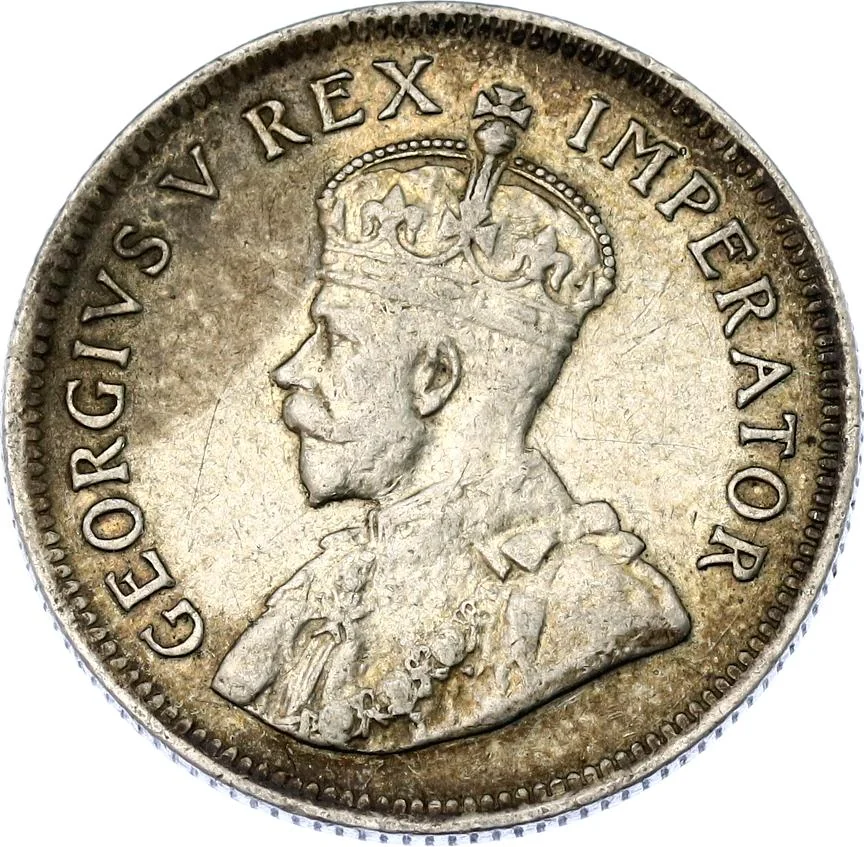
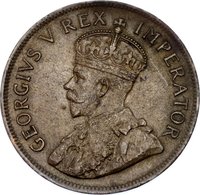
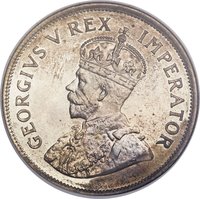
King George V crowned bust left, legend around, engraver's initials on truncation.
Inscription:
GEORGIVS V REX IMPERATOR
B.M.
B.M.
Translation:
George V, King and Emperor.
By the Grace of God.
By the Grace of God.
Script: Latin
Language: Latin
Engraver: Edgar Bertram MacKennal
Reverse
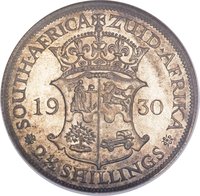
Description:
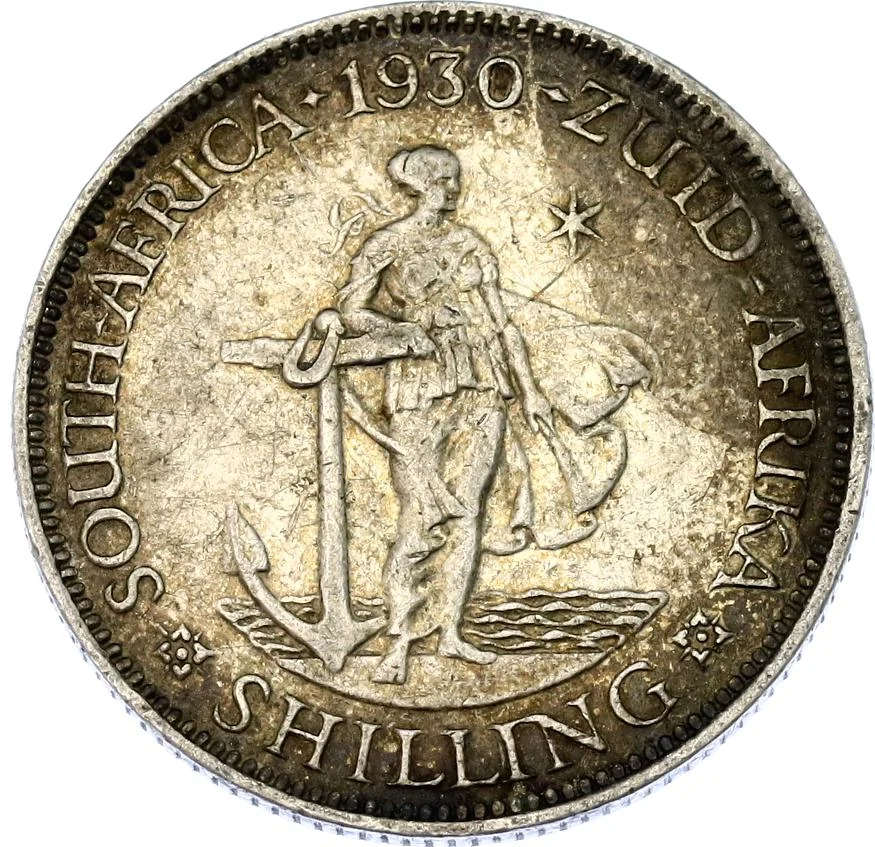
Female figure with anchor inside circle, surrounded by legend. Date above, denomination below, engraver's initials at lower right.
Inscription:
SOUTH·AFRICA· 1929 ·ZUID·AFRIKA
KG
SHILLING
KG
SHILLING
Script: Latin
Engraver: George Kruger Gray
Edge
Reeded
Mints
| Name | Mark |
|---|---|
| Pretoria | — |
Mintings
| Year | Mint Mark | Mintage | Quality | Collection |
|---|---|---|---|---|
| 1926 | — | 238,017 | ||
| 1926 | — | 16 | Proof | |
| 1927 | — | 488,455 | ||
| 1928 | — | 889,270 | ||
| 1929 | — | 925,662 | ||
| 1930 | — | 421,701 | ||
| 1930 | — | 14 | Proof |
Historical background
In 1926, South Africa’s currency situation was defined by a pivotal transition from the gold standard to a new, domestically controlled monetary system. Following the economic disruptions of World War I and the early 1920s, the country faced the dilemma of whether to return to the classical gold standard at the pre-war parity, as Britain had done in 1925. This move had caused deflation and economic strain in Britain, and South African authorities, led by the South African Reserve Bank (established in 1921), sought to avoid similar consequences. The key concern was that a high valuation for the pound sterling would depress the profitability of the gold mining industry, the cornerstone of the national economy.
Consequently, the government, under Prime Minister J.B.M. Hertzog, passed the Currency and Banking Act of 1926. This legislation formally took South Africa off the pure gold standard and introduced the "pound sterling exchange standard." The South African pound remained pegged to the British pound sterling, but the link to gold was now indirect. The Reserve Bank held its reserves primarily in sterling balances in London rather than solely in gold, providing greater flexibility. This system was designed to stabilise the currency and facilitate trade with the dominant British Empire while insulating the domestic economy from the deflationary pressures of a direct gold link.
The 1926 arrangement was therefore a pragmatic compromise. It secured monetary stability and vital trade relations by anchoring the currency to sterling, while deliberately avoiding a deflationary return to the pre-war gold parity that would have harmed the gold mining sector. This policy underscored South Africa’s growing economic sovereignty within the Imperial framework and set the stage for the monetary system that would remain in place until the country decimalised and introduced the Rand in 1961.
Consequently, the government, under Prime Minister J.B.M. Hertzog, passed the Currency and Banking Act of 1926. This legislation formally took South Africa off the pure gold standard and introduced the "pound sterling exchange standard." The South African pound remained pegged to the British pound sterling, but the link to gold was now indirect. The Reserve Bank held its reserves primarily in sterling balances in London rather than solely in gold, providing greater flexibility. This system was designed to stabilise the currency and facilitate trade with the dominant British Empire while insulating the domestic economy from the deflationary pressures of a direct gold link.
The 1926 arrangement was therefore a pragmatic compromise. It secured monetary stability and vital trade relations by anchoring the currency to sterling, while deliberately avoiding a deflationary return to the pre-war gold parity that would have harmed the gold mining sector. This policy underscored South Africa’s growing economic sovereignty within the Imperial framework and set the stage for the monetary system that would remain in place until the country decimalised and introduced the Rand in 1961.

🌱 Fairly Common