

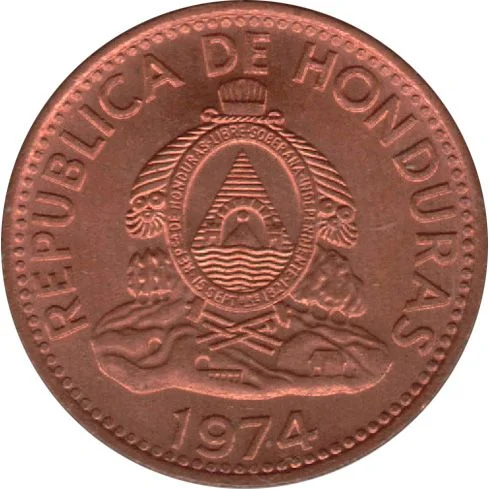
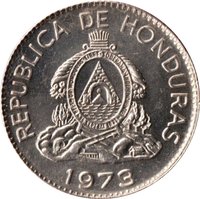
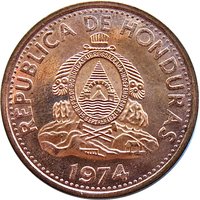
Obverse
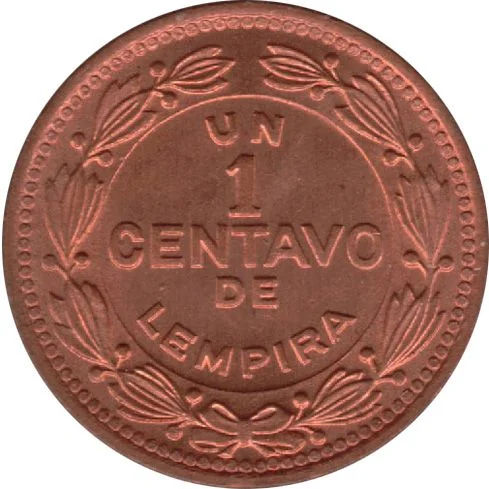
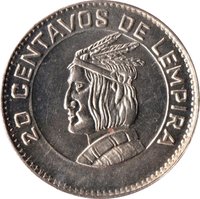
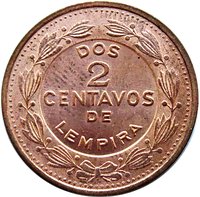
Reverse
Edge
Plain
Categories
| Symbols> Coat of Arms |
| Symbol> Wreath |
Mintings
| Year | Mint Mark | Mintage | Quality | Collection |
|---|---|---|---|---|
| 1974 | — | — | ||
| 1985 | — | 25,000,000 | ||
| 1992 | 1992-1999 | 60,000,000 |
Historical background
In 1974, Honduras operated under a fixed exchange rate regime, with the Honduran Lempira (HNL) pegged to the United States Dollar at the long-standing rate of 2 Lempiras = 1 USD. This stability was a legacy of the 1949 Monetary Law and was managed by the Central Bank of Honduras (BCH), which held sufficient international reserves to defend the peg. The economy was primarily agrarian, heavily dependent on exports of bananas, coffee, and later, increasing shipments of beef and timber. While the fixed rate provided predictability for foreign investment in these export sectors and controlled inflation, it also made the currency vulnerable to external trade shocks and limited monetary policy flexibility.
The year fell within a period of significant regional economic strain. The 1974 coffee boom provided a temporary boost, but this was sharply counteracted by the devastation of Hurricane Fifi in September 1974, one of the worst natural disasters in the nation's history. The hurricane crippled the agricultural export base, destroyed infrastructure, and caused immense human and capital loss, creating a massive balance-of-payments crisis. The government, under President Oswaldo López Arellano, was forced to seek emergency international loans and aid, putting pressure on foreign reserves and testing the stability of the fixed peg.
Despite the catastrophic shock of Hurricane Fifi, the Lempira's peg to the dollar held firm throughout 1974, a testament to conservative fiscal management and immediate international financial assistance. However, the underlying vulnerabilities were exposed. The disaster accelerated a shift in economic policy, increasing the role of the state in reconstruction and laying the groundwork for greater external borrowing. While the currency itself remained stable in the immediate aftermath, the economic dislocation of 1974 set the stage for future debt accumulation and structural weaknesses that would challenge the Honduran economy and its exchange rate regime in the coming decades.
The year fell within a period of significant regional economic strain. The 1974 coffee boom provided a temporary boost, but this was sharply counteracted by the devastation of Hurricane Fifi in September 1974, one of the worst natural disasters in the nation's history. The hurricane crippled the agricultural export base, destroyed infrastructure, and caused immense human and capital loss, creating a massive balance-of-payments crisis. The government, under President Oswaldo López Arellano, was forced to seek emergency international loans and aid, putting pressure on foreign reserves and testing the stability of the fixed peg.
Despite the catastrophic shock of Hurricane Fifi, the Lempira's peg to the dollar held firm throughout 1974, a testament to conservative fiscal management and immediate international financial assistance. However, the underlying vulnerabilities were exposed. The disaster accelerated a shift in economic policy, increasing the role of the state in reconstruction and laying the groundwork for greater external borrowing. While the currency itself remained stable in the immediate aftermath, the economic dislocation of 1974 set the stage for future debt accumulation and structural weaknesses that would challenge the Honduran economy and its exchange rate regime in the coming decades.
🌱 Very Common