

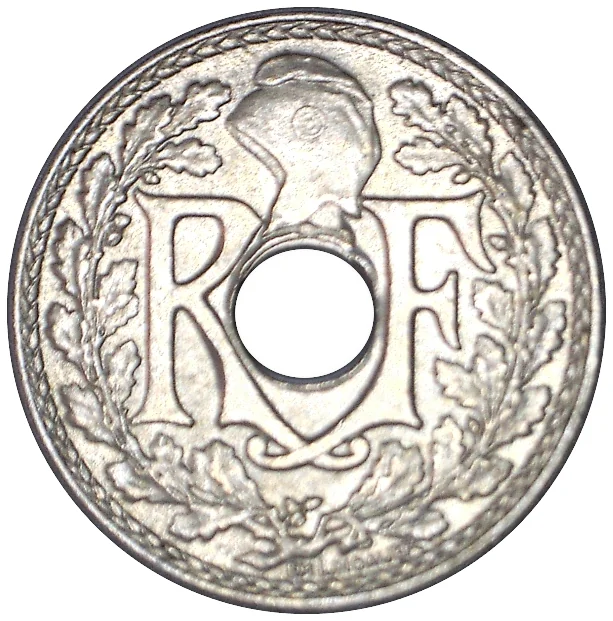
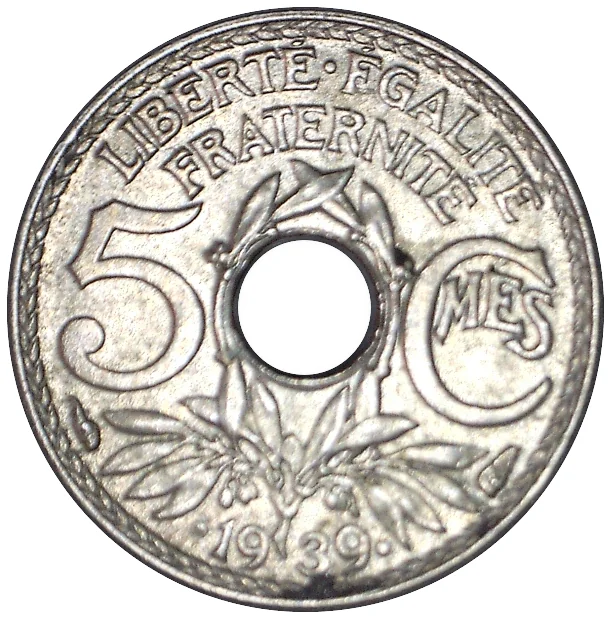
5 centimes – France
Add to wishlist
France
Context
Years: 1938–1939
Issuer: France
Period:
(1870—1940)
Currency:
(1795—1959)
Demonetization: 24 November 1940
Total mintage: 79,002,247
Material
Diameter: 17 mm
Weight: 1.5 g
Thickness: 1.1 mm
Shape: Round with a round hole
Technique: Milled
Alignment: Coin alignment
flip
References
KM: #
Numista: #703
Obverse
Description:
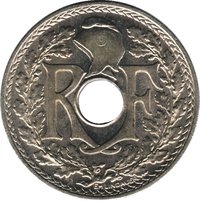
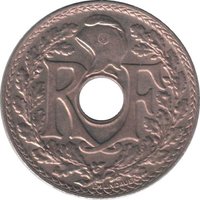
The hole, framed by oak branches, the letters RF, and a Phrygian cap, comes in small or large sizes.
Inscription:
RF
EM LINDAUER
EM LINDAUER
Script: Latin
Engraver: Edmond-Émile Lindauer
Reverse
Description:
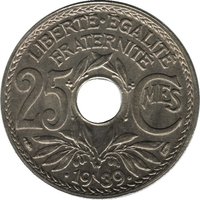
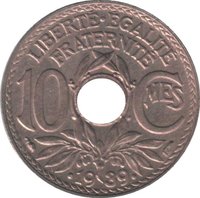
Value divided by center hole, French motto above and date below, flanked by dots.
Inscription:
LIBERTE·EGALITE
FRATERNITE
5 CMES
·19 39·
FRATERNITE
5 CMES
·19 39·
Translation:
LIBERTY EQUALITY
FRATERNITY
5 CENTIMES
·19 39·
FRATERNITY
5 CENTIMES
·19 39·
Script: Latin
Language: French
Engraver: Edmond-Émile Lindauer
Edge
Plain
Categories
| Symbol> Phrygian cap |
Mints
| Name | Mark |
|---|---|
| Monnaie de Paris | — |
| Royal Mint of Madrid | ★ |
Mintings
| Year | Mint Mark | Mintage | Quality | Collection |
|---|---|---|---|---|
| 1938 | — | 26,330,247 | ||
| 1938 | ★ | — | ||
| 1939 | — | 52,672,000 |
Historical background
In 1938, France was grappling with a severe and persistent currency crisis rooted in the economic policies of the Popular Front government of 1936-37. The decision to devalue the franc (as part of the "Franc Poincaré") and implement the Matignon Accords, which granted significant wage increases and social benefits, had led to a classic cycle of inflation, capital flight, and a collapsing trade balance. Wealthy individuals and businesses, fearing further devaluation and left-wing policies, moved their capital abroad, draining the nation's gold and foreign currency reserves. This created a profound lack of confidence in the franc, both domestically and internationally.
The situation was exacerbated by the looming shadow of rearmament and the threat of war with Nazi Germany. The government of Édouard Daladier, which succeeded the Popular Front, faced the impossible trilemma of needing to fund massive military spending, maintain the franc's value, and avoid imposing harsh austerity on a population still recovering from the Great Depression. Attempts to impose exchange controls were half-hearted and largely ineffective, as the political will to enforce them strictly was absent in a country deeply divided between left and right.
Consequently, by late 1938, the franc was a chronically weak currency, propped up by intermittent and unsustainable support from the Bank of France and a tripartite currency agreement with the United States and Britain. The economy was stagnant, and the government's finances were precarious. This financial instability severely constrained France's strategic options, undermining its ability to prepare for war and contributing to a climate of political and economic uncertainty that mirrored the nation's fraught geopolitical position on the eve of World War II.
The situation was exacerbated by the looming shadow of rearmament and the threat of war with Nazi Germany. The government of Édouard Daladier, which succeeded the Popular Front, faced the impossible trilemma of needing to fund massive military spending, maintain the franc's value, and avoid imposing harsh austerity on a population still recovering from the Great Depression. Attempts to impose exchange controls were half-hearted and largely ineffective, as the political will to enforce them strictly was absent in a country deeply divided between left and right.
Consequently, by late 1938, the franc was a chronically weak currency, propped up by intermittent and unsustainable support from the Bank of France and a tripartite currency agreement with the United States and Britain. The economy was stagnant, and the government's finances were precarious. This financial instability severely constrained France's strategic options, undermining its ability to prepare for war and contributing to a climate of political and economic uncertainty that mirrored the nation's fraught geopolitical position on the eve of World War II.
Series: 1938 France circulation coins
🌱 Very Common