

5 francs – Tunisia
Add to wishlist
Tunisia
Context
Year: 1939
Islamic (Hijri) Year:: 1358
Issuer: Tunisia
Currency:
(1891—1957)
Demonetized: Yes
Total mintage: 1,600,000
Material
References
KM: #
Numista: #11232
Value
Exchange value: 5 TNF
Bullion value: $8.32
Obverse
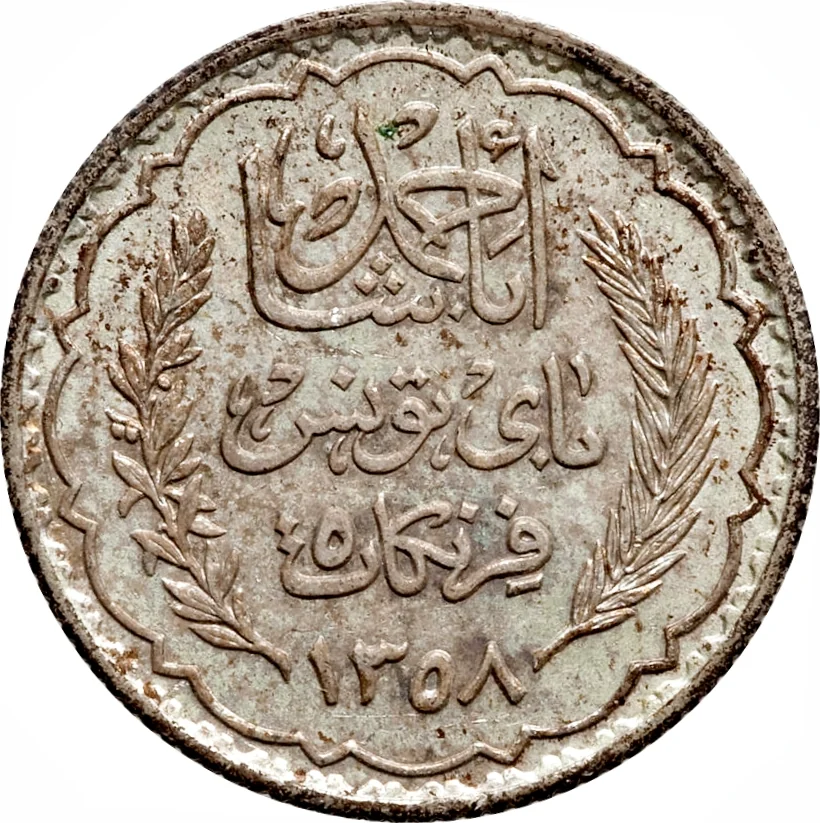
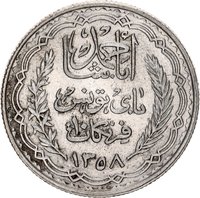
Description:
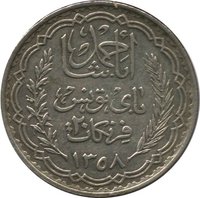
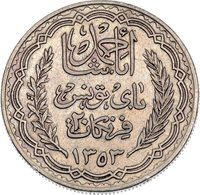
Arabic ruler with value and Hijri date.
Inscription:
أحمد باشا
باى تونس
٥
فرنكات
١٣٥٨
باى تونس
٥
فرنكات
١٣٥٨
Translation:
Ahmad Pasha,
Bey of Tunis,
5
Francs,
1358
Bey of Tunis,
5
Francs,
1358
Language: Arabic
Engraver: Lucien Georges Bazor
Reverse
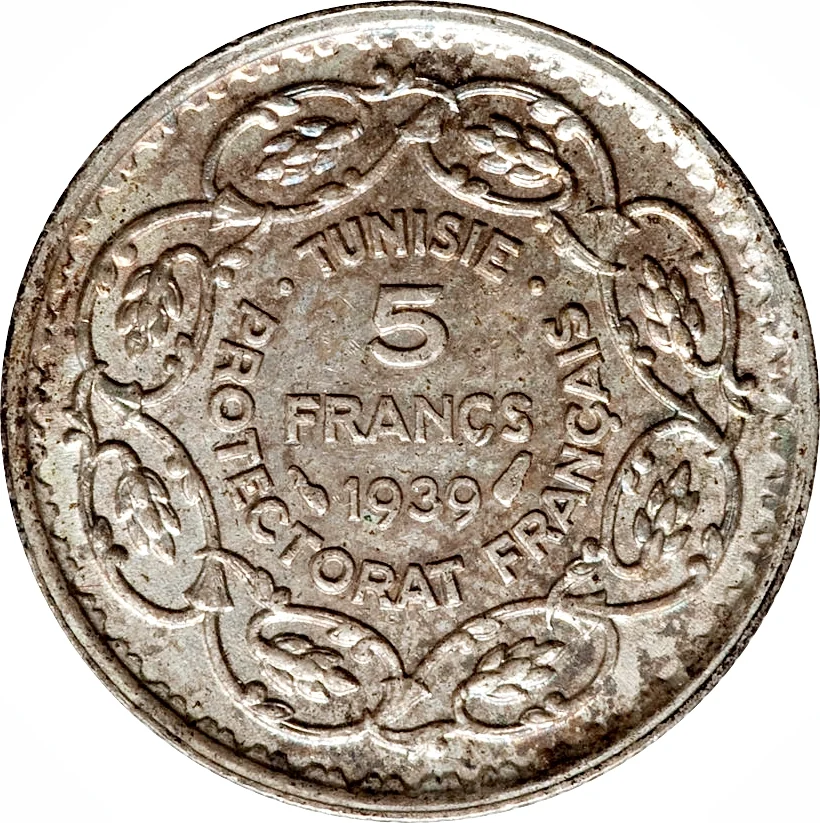
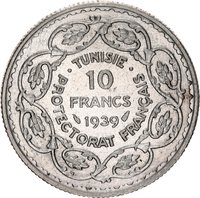
Description:
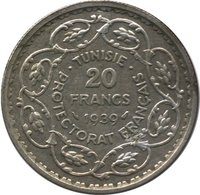
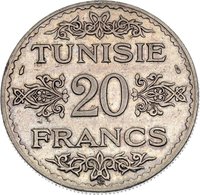
Tunisia: French name, value, and Gregorian date.
Inscription:
TUNISIE
5
FRANCS
1939
· PROTECTORAT FRANÇAIS ·
5
FRANCS
1939
· PROTECTORAT FRANÇAIS ·
Translation:
TUNISIA
5
FRANCS
1939
· FRENCH PROTECTORATE ·
5
FRANCS
1939
· FRENCH PROTECTORATE ·
Script: Latin
Language: French
Engraver: Lucien Georges Bazor
Edge
Reeded
Mints
| Name | Mark |
|---|---|
| Monnaie de Paris | — |
Mintings
| Year | Mint Mark | Mintage | Quality | Collection |
|---|---|---|---|---|
| 1939 | — | 1,600,000 |
Historical background
In 1939, Tunisia's currency situation was fundamentally shaped by its status as a French protectorate, established in 1881. The monetary system was fully integrated into the French franc zone, with the Tunisian franc (franc tunisien) serving as the official currency. It was pegged at par with the French franc, meaning one Tunisian franc equaled one French franc, and its issuance was controlled by the Banque de l'Algérie et de la Tunisie, a private French institution granted the privilege of note-issuing rights for the territory. This arrangement ensured that Tunisia's economy and monetary policy were directly subordinate to the needs and stability of metropolitan France.
The currency in circulation was a colonial hybrid, reflecting the protectorate's administration. Banknotes and coins bore French inscriptions and iconography, often featuring allegorical figures of the French Republic, though some coins also included Arabic text. The system facilitated trade and financial flows with France, which dominated Tunisia's external commerce, but it was designed primarily to benefit French economic interests and colonial settlers. Local populations had little to no influence over monetary policy, which was directed from Paris and Algiers (the bank's headquarters).
On the eve of World War II, this system faced impending strain. The fixed parity with the French franc tied Tunisia's economic fate directly to that of France, which was already experiencing financial uncertainty due to looming conflict. While the currency remained stable and fully convertible within the franc zone in 1939, the outbreak of war would soon test this colonial monetary architecture, leading to disruptions in trade, inflationary pressures, and a tightening of French control over foreign exchange and resources to support the war effort.
The currency in circulation was a colonial hybrid, reflecting the protectorate's administration. Banknotes and coins bore French inscriptions and iconography, often featuring allegorical figures of the French Republic, though some coins also included Arabic text. The system facilitated trade and financial flows with France, which dominated Tunisia's external commerce, but it was designed primarily to benefit French economic interests and colonial settlers. Local populations had little to no influence over monetary policy, which was directed from Paris and Algiers (the bank's headquarters).
On the eve of World War II, this system faced impending strain. The fixed parity with the French franc tied Tunisia's economic fate directly to that of France, which was already experiencing financial uncertainty due to looming conflict. While the currency remained stable and fully convertible within the franc zone in 1939, the outbreak of war would soon test this colonial monetary architecture, leading to disruptions in trade, inflationary pressures, and a tightening of French control over foreign exchange and resources to support the war effort.
🌱 Fairly Common