

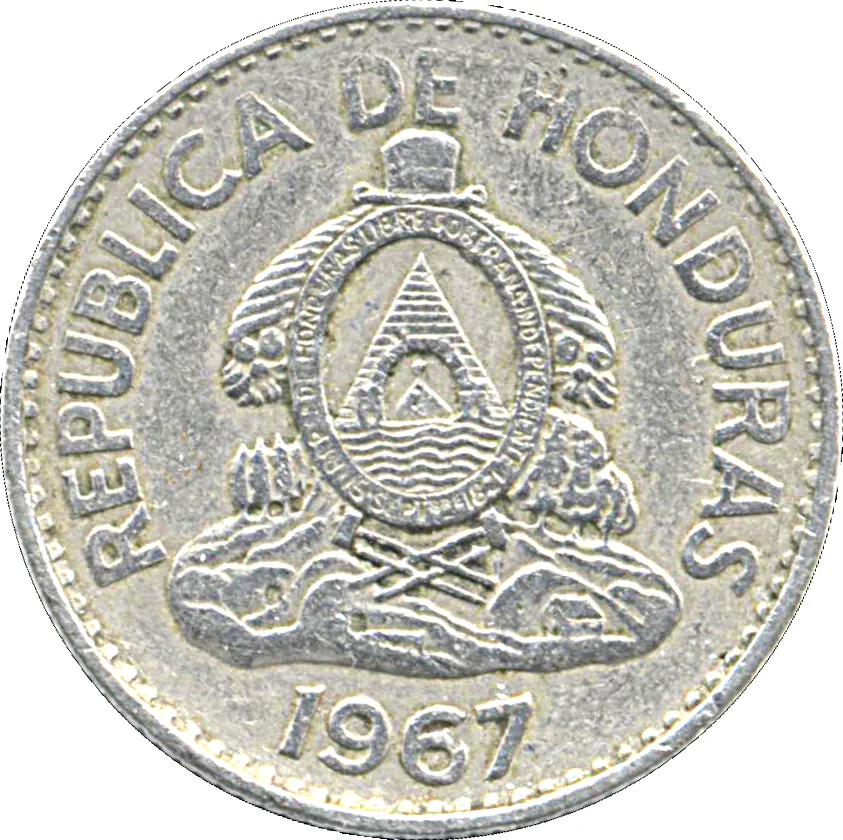
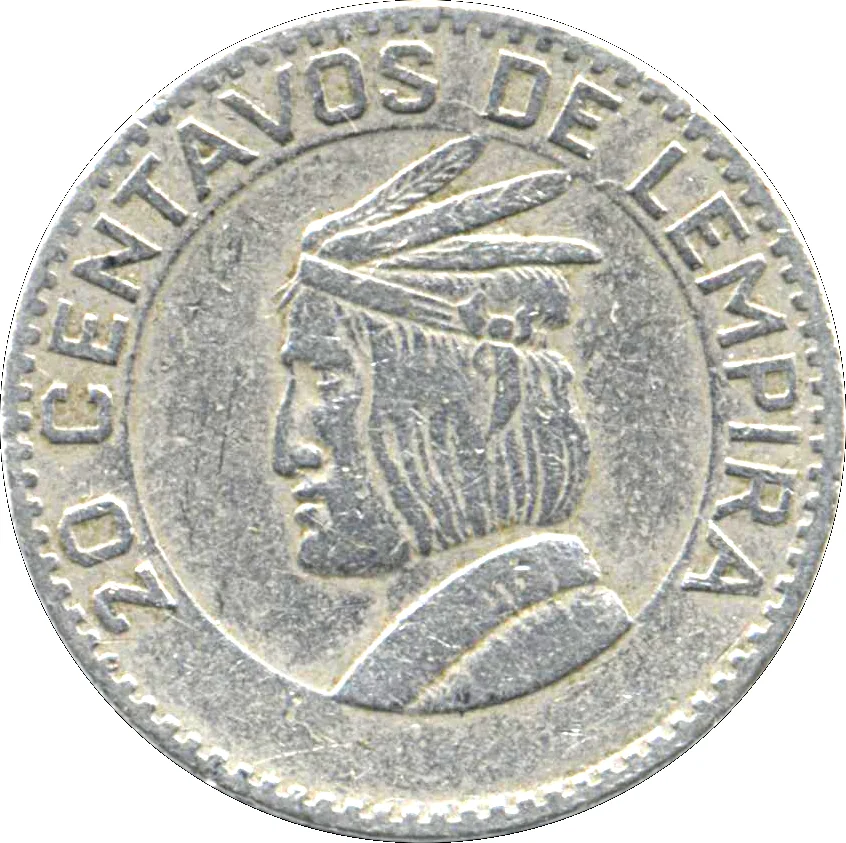
20 centavos – Honduras
Add to wishlist
Honduras
Context
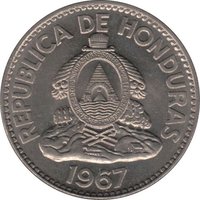
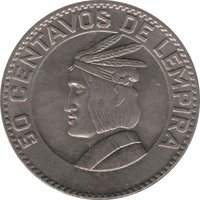
Year: 1967
Issuer: Honduras
Issuing organization: Central Bank of Honduras
Period:
(since 1862)
Currency:
(since 1931)
Total mintage: 12,000,000
Material
Diameter: 17.8 mm
Weight: 2.2 g
Thickness: 1.2 mm
Shape: Round
Composition: Copper-nickel
Technique: Milled
Alignment: Coin alignment
flip
References
KM: #
Numista: #7027
Value
Exchange value: 0.20 HNL
Obverse
Reverse
Edge
Reeded
Categories
| Symbols> Coat of Arms |
Mints
| Name | Mark |
|---|---|
| Staatliche Münze Baden-Württemberg | — |
Mintings
| Year | Mint Mark | Mintage | Quality | Collection |
|---|---|---|---|---|
| 1967 | — | 12,000,000 |
Historical background
In 1967, Honduras operated under a fixed exchange rate system, with its currency, the lempira, pegged to the United States dollar at the long-standing rate of 2 lempiras = 1 US dollar. This parity, established in 1926, was managed by the Central Bank of Honduras (founded in 1950) and provided a crucial anchor for monetary stability and international trade. The country's economy was predominantly agrarian, heavily reliant on exports of bananas, coffee, and later, sugar and beef. The fixed rate facilitated predictable conditions for the powerful foreign fruit companies and domestic exporters, but it also tied Honduras's monetary policy directly to that of the United States, limiting independent tools to manage its economy.
Economically, the period was one of relative stability but underlying vulnerability. The Central American Common Market (CACM), established in the early 1960s, spurred a brief period of industrial growth and increased regional trade. However, Honduras's balance of payments was often strained. While the fixed rate conveyed confidence, it masked pressures from a narrow export base, periodic budget deficits, and a growing need for imported manufactured goods. The nation's financial system remained underdeveloped, with limited credit available for domestic diversification beyond the traditional agro-export sector.
Politically, the currency's stability in 1967 occurred under the military government of President Oswaldo López Arellano, who had taken power in a 1963 coup. His administration prioritized infrastructure projects and maintained close ties with the U.S., which supported the dollar peg. There was no active currency crisis in 1967, but the rigid system left Honduras exposed to external shocks. The major test would come just a few years later, in 1974, when the combination of plummeting coffee prices, the devastation of Hurricane Fifi, and rising oil costs would force the first devaluation of the lempira in nearly 50 years, revealing the structural weaknesses inherent in the 1967 status quo.
Economically, the period was one of relative stability but underlying vulnerability. The Central American Common Market (CACM), established in the early 1960s, spurred a brief period of industrial growth and increased regional trade. However, Honduras's balance of payments was often strained. While the fixed rate conveyed confidence, it masked pressures from a narrow export base, periodic budget deficits, and a growing need for imported manufactured goods. The nation's financial system remained underdeveloped, with limited credit available for domestic diversification beyond the traditional agro-export sector.
Politically, the currency's stability in 1967 occurred under the military government of President Oswaldo López Arellano, who had taken power in a 1963 coup. His administration prioritized infrastructure projects and maintained close ties with the U.S., which supported the dollar peg. There was no active currency crisis in 1967, but the rigid system left Honduras exposed to external shocks. The major test would come just a few years later, in 1974, when the combination of plummeting coffee prices, the devastation of Hurricane Fifi, and rising oil costs would force the first devaluation of the lempira in nearly 50 years, revealing the structural weaknesses inherent in the 1967 status quo.
🌱 Common