

50 centavos – Honduras
Add to wishlist
Honduras
Context
Years: 1978–1990
Issuer: Honduras
Issuing organization: Central Bank of Honduras
Period:
(since 1862)
Currency:
(since 1931)
Total mintage: 17,000,000
Material
References
KM: #
Numista: #7026
Value
Exchange value: 0.50 HNL
Obverse
Description:
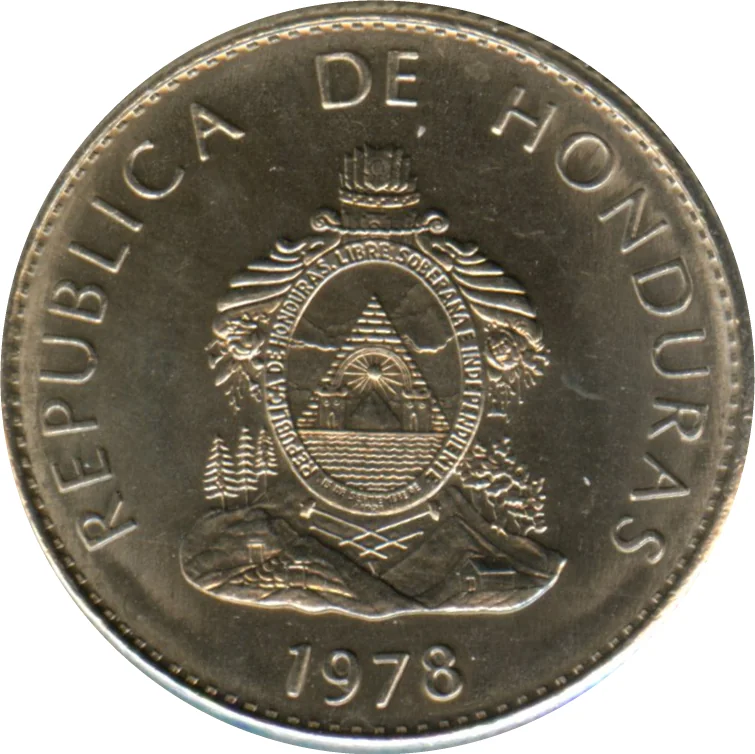
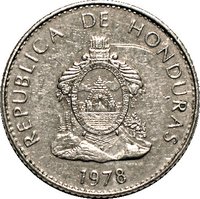
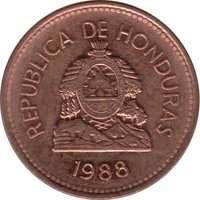
The Honduran coat of arms features an oval with a volcano between two towers, backed by a sun and rainbow, encircled by the words "Republica de Honduras Libre, Soberana, E Independiente." It is topped with cornucopias and arrows, and below are oak and pine trees with mining tools.
Inscription:
REPUBLICA DE HONDURAS
REPUBLICA DE HONDURAS, LIBRE, SOBERANA E INDEPENDIENTE
15 DE SEPTIEMBRE DE
1821
1978
REPUBLICA DE HONDURAS, LIBRE, SOBERANA E INDEPENDIENTE
15 DE SEPTIEMBRE DE
1821
1978
Translation:
REPUBLIC OF HONDURAS
REPUBLIC OF HONDURAS, FREE, SOVEREIGN AND INDEPENDENT
15 SEPTEMBER
1821
1978
REPUBLIC OF HONDURAS, FREE, SOVEREIGN AND INDEPENDENT
15 SEPTEMBER
1821
1978
Script: Latin
Language: Spanish
Reverse
Edge
Reeded
Categories
| Symbols> Coat of Arms |
Mints
| Name | Mark |
|---|---|
| Royal Canadian Mint of Winnipeg | — |
| Royal Mint | — |
| VDM Metals / Vereinigte Deutsche Metallwerke | — |
Mintings
| Year | Mint Mark | Mintage | Quality | Collection |
|---|---|---|---|---|
| 1978 | — | 12,000,000 | ||
| 1990 | — | 5,000,000 |
Historical background
In 1978, Honduras operated under a fixed exchange rate system, with the Honduran lempira (HNL) pegged to the United States dollar at the long-standing rate of 2 Lempiras = 1 USD. This stability, however, was more formal than substantive, masking underlying economic vulnerabilities. The country's economy was heavily dependent on agricultural exports—primarily bananas, coffee, and sugar—making it susceptible to volatile global commodity prices and natural disasters. Furthermore, Honduras was part of the Central American Common Market (CACM), but regional political tensions and economic disparities were straining this framework, affecting trade balances.
The fixed peg was maintained through strict capital controls and the management of the Central Bank of Honduras (BCH), but pressure was mounting. Public sector spending was rising, fueled in part by the military-led government's policies and reconstruction costs following Hurricane Fifi in 1974, which had devastated key export sectors. This contributed to a growing fiscal deficit and increasing external debt. While inflation was relatively moderate compared to global trends of the era, it began to erode the competitiveness of Honduran exports, as the fixed exchange rate could not adjust to reflect the country's changing economic reality.
Consequently, 1978 existed in a tense calm before a significant monetary shift. The rigid peg provided short-term stability for importers and foreign debt servicing but discouraged diversification and strained foreign reserves. These accumulating pressures—fiscal imbalances, external debt, and terms of trade shocks—set the stage for the major devaluation that would follow in the early 1980s. Thus, the currency situation in 1978 was characterized by an outwardly stable but increasingly unsustainable regime, presaging the economic adjustments and turbulence of the coming decade.
The fixed peg was maintained through strict capital controls and the management of the Central Bank of Honduras (BCH), but pressure was mounting. Public sector spending was rising, fueled in part by the military-led government's policies and reconstruction costs following Hurricane Fifi in 1974, which had devastated key export sectors. This contributed to a growing fiscal deficit and increasing external debt. While inflation was relatively moderate compared to global trends of the era, it began to erode the competitiveness of Honduran exports, as the fixed exchange rate could not adjust to reflect the country's changing economic reality.
Consequently, 1978 existed in a tense calm before a significant monetary shift. The rigid peg provided short-term stability for importers and foreign debt servicing but discouraged diversification and strained foreign reserves. These accumulating pressures—fiscal imbalances, external debt, and terms of trade shocks—set the stage for the major devaluation that would follow in the early 1980s. Thus, the currency situation in 1978 was characterized by an outwardly stable but increasingly unsustainable regime, presaging the economic adjustments and turbulence of the coming decade.
🌱 Common