

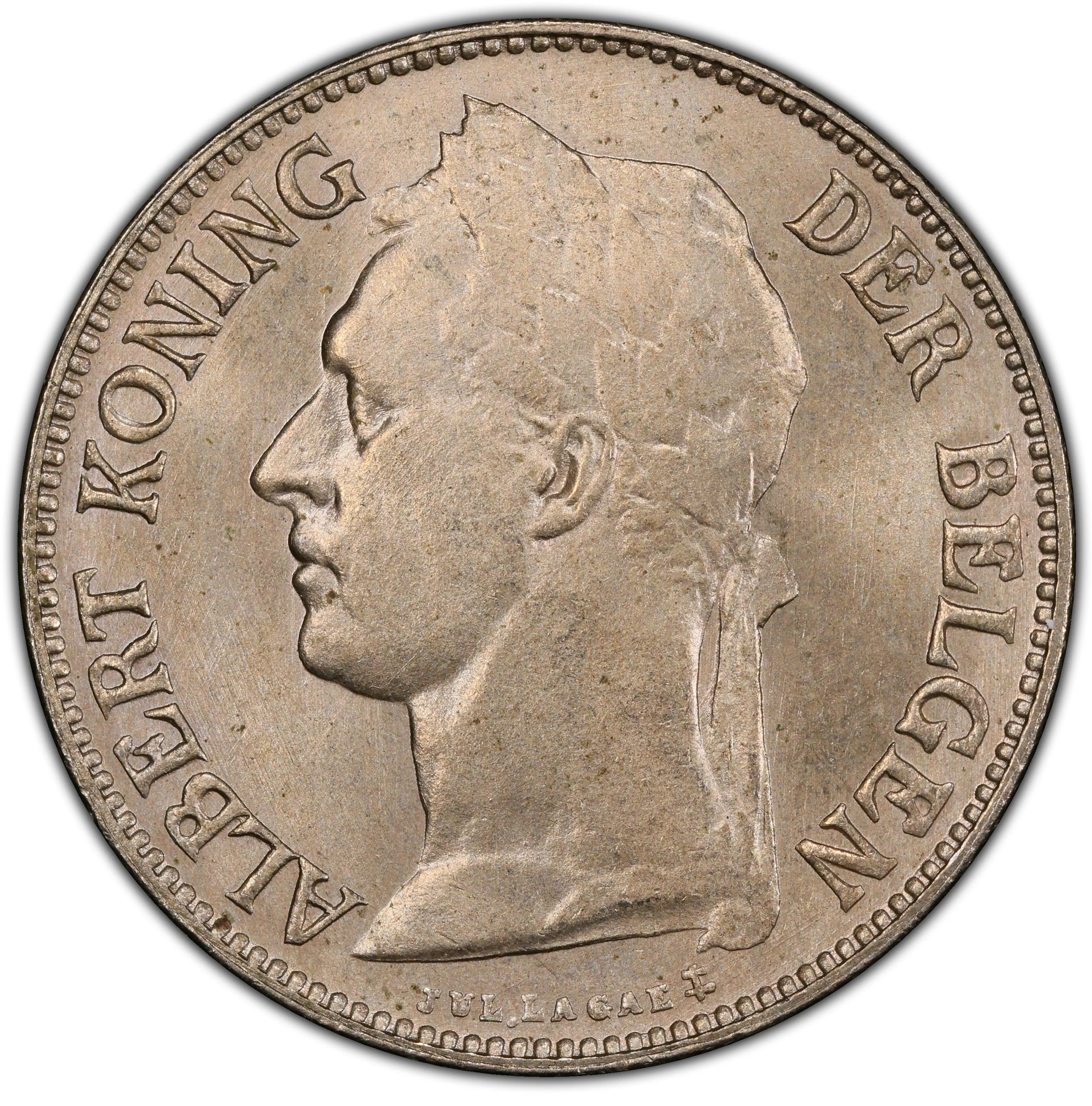
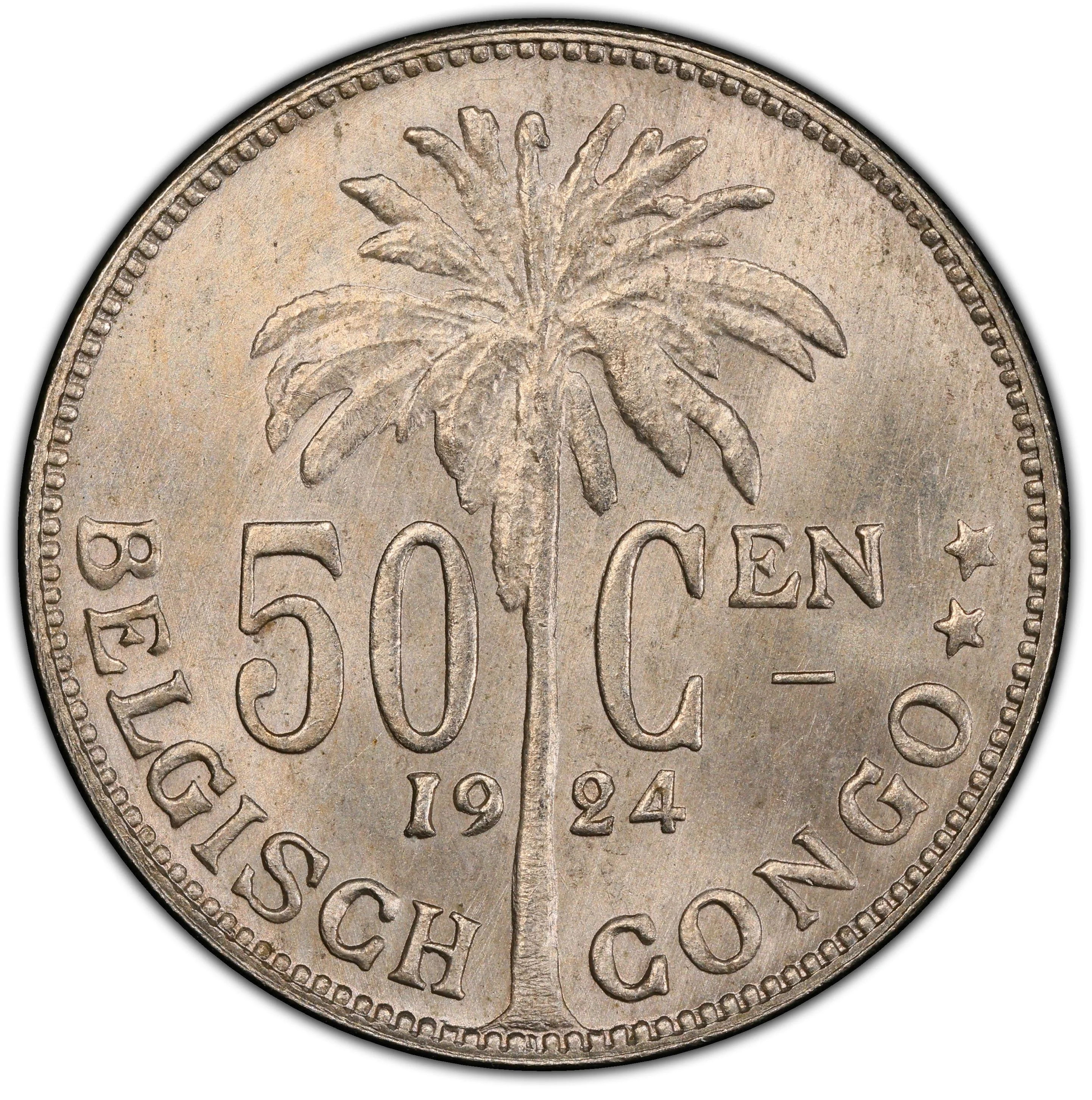
50 Centimes – Belgian Congo
Context
Years: 1921–1929
Country: Rwanda and Urundi Belgian Congo
Issuer: Belgian Congo
Ruler: Albert I
Currency:
(1908—1960)
Demonetized: Yes
Total mintage: 72,000,000
Material
Diameter: 24 mm
Weight: 6.5 g
Thickness: 2 mm
Shape: Round
Composition: Copper-nickel
Technique: Milled
Alignment: Coin alignment
flip
References
KM: #Click to copy to clipboard23
Numista: #7010
Obverse
Description:
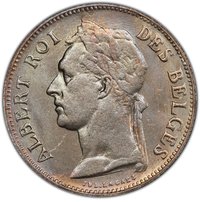
Albert I, laureate, left-facing portrait.
Inscription:
ALBERT KONING DER BELGEN
Jul. Lagae
Jul. Lagae
Translation:
Albert King of the Belgians
Jul. Lagae
Jul. Lagae
Script: Latin
Engraver: Jules Lagae
Reverse
Description:
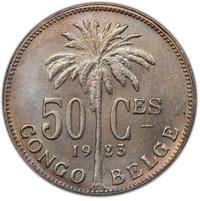
Oil palm divides denomination and date, Dutch legend
Inscription:
50 CEN
1924
BELGISCH CONGO **
1924
BELGISCH CONGO **
Script: Latin
Engraver: Jules Lagae
Edge
Reeded
Mints
| Name | Mark |
|---|---|
| Royal Mint of Belgium | — |
Mintings
| Year | Mint Mark | Mintage | Quality | Collection |
|---|---|---|---|---|
| 1921 | — | 4,000,000 | ||
| 1922 | — | 5,592,000 | ||
| 1923 | — | 7,208,000 | ||
| 1924 | — | 7,000,000 | ||
| 1925 | — | 10,600,000 | ||
| 1926 | — | 25,200,000 | ||
| 1927 | — | 4,800,000 | ||
| 1928 | — | 7,484,000 | ||
| 1929 | — | 116,000 |
Historical background
In 1921, the currency situation in the Belgian Congo was defined by its transition from a franc tied to gold to one tied to the Belgian franc, within a complex colonial monetary hierarchy. Since its creation in 1887, the Congolese franc (CF) was issued by the Banque du Congo Belge and was initially on a gold standard, theoretically independent. However, in practice, its value was pegged at parity with the Belgian franc. This link was formalized in 1921 when the Congolese franc was officially anchored to the metropolitan currency, making the colony's monetary system a satellite of Belgium's. This move ensured stability for Belgian investors and trade but fully subordinated the colony's financial health to decisions made in Brussels.
The year 1921 fell within a period of post-World War I economic adjustment. While Belgium itself had abandoned the gold standard during the war and experienced inflation, the formalization of the peg in 1921 sought to re-establish predictable exchange conditions. The currency in circulation was a mixture of notes issued by the Banque du Congo Belge and coins minted specifically for the colony, all denominated in francs and centimes. This system facilitated the extraction of resources, as companies like the giant Société Générale de Belgique could operate with financial certainty, integrating the Congo's vast mineral and agricultural wealth into the Belgian economy.
For the Congolese population, however, this currency regime was part of a coercive economic structure. The introduction and imposition of a cash economy, through mechanisms like hut taxes payable in francs, forced labourers into the wage economy to work on plantations, in mines, or for the state. Thus, the stable currency of 1921 was not a neutral tool but an instrument of colonial policy, designed to monetize the local economy for the benefit of European enterprises and administrative control, while deeply disrupting traditional subsistence and trade patterns.
The year 1921 fell within a period of post-World War I economic adjustment. While Belgium itself had abandoned the gold standard during the war and experienced inflation, the formalization of the peg in 1921 sought to re-establish predictable exchange conditions. The currency in circulation was a mixture of notes issued by the Banque du Congo Belge and coins minted specifically for the colony, all denominated in francs and centimes. This system facilitated the extraction of resources, as companies like the giant Société Générale de Belgique could operate with financial certainty, integrating the Congo's vast mineral and agricultural wealth into the Belgian economy.
For the Congolese population, however, this currency regime was part of a coercive economic structure. The introduction and imposition of a cash economy, through mechanisms like hut taxes payable in francs, forced labourers into the wage economy to work on plantations, in mines, or for the state. Thus, the stable currency of 1921 was not a neutral tool but an instrument of colonial policy, designed to monetize the local economy for the benefit of European enterprises and administrative control, while deeply disrupting traditional subsistence and trade patterns.
🌱 Common