

50 Paise – India
Circulating commemorative coins
Commemoration: 50th Year of Independence
India

Material
Diameter: 22 mm
Weight: 3.79 g
Thickness: 1.45 mm
Shape: Round
Composition: Stainless steel
Technique: Milled
Alignment: Medal alignment
flip
References
KM: #Click to copy to clipboard70
Numista: #7009
Value
Exchange value: 0.50 INR = $0.01
Inflation-adjusted value: 2.89 INR
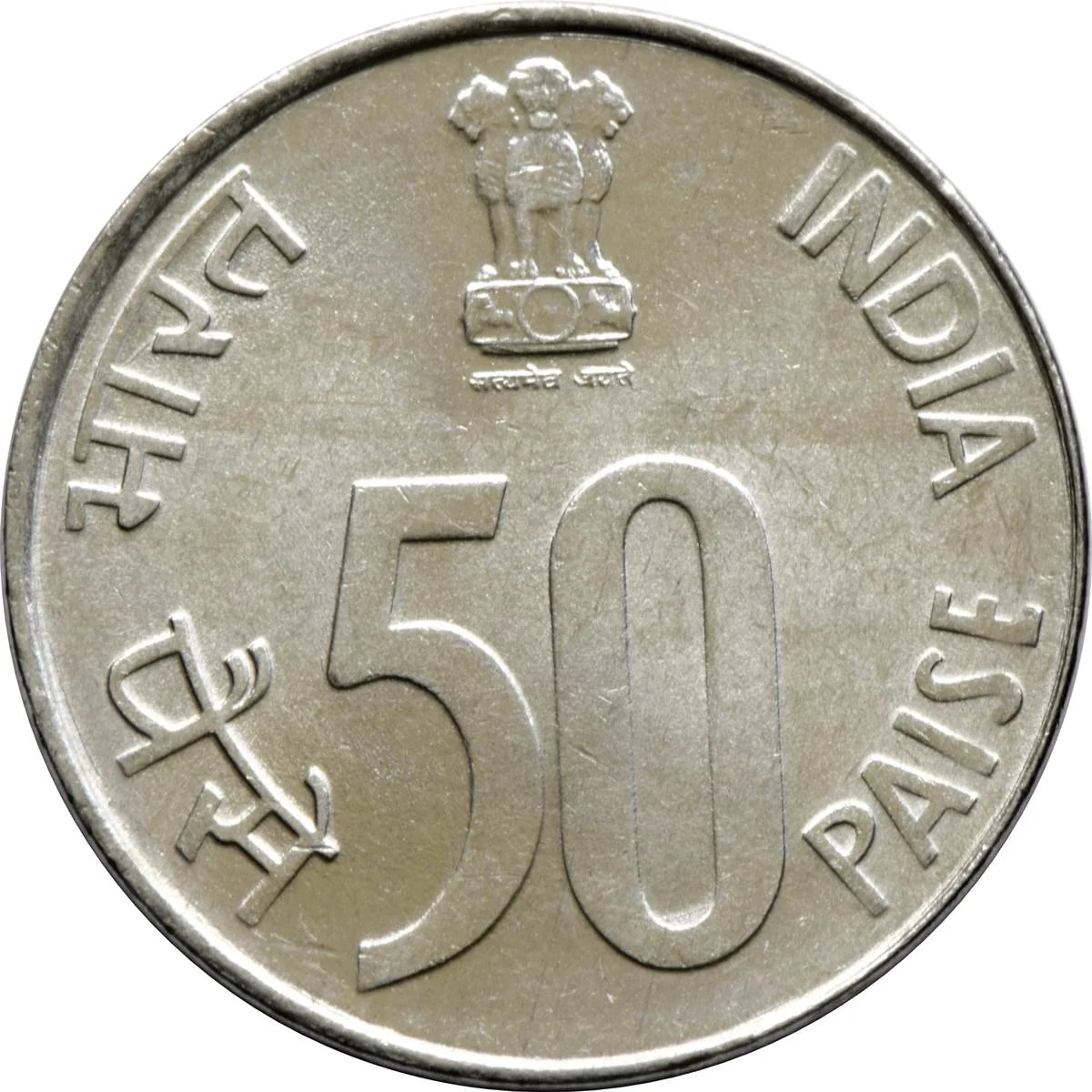
Obverse
Reverse
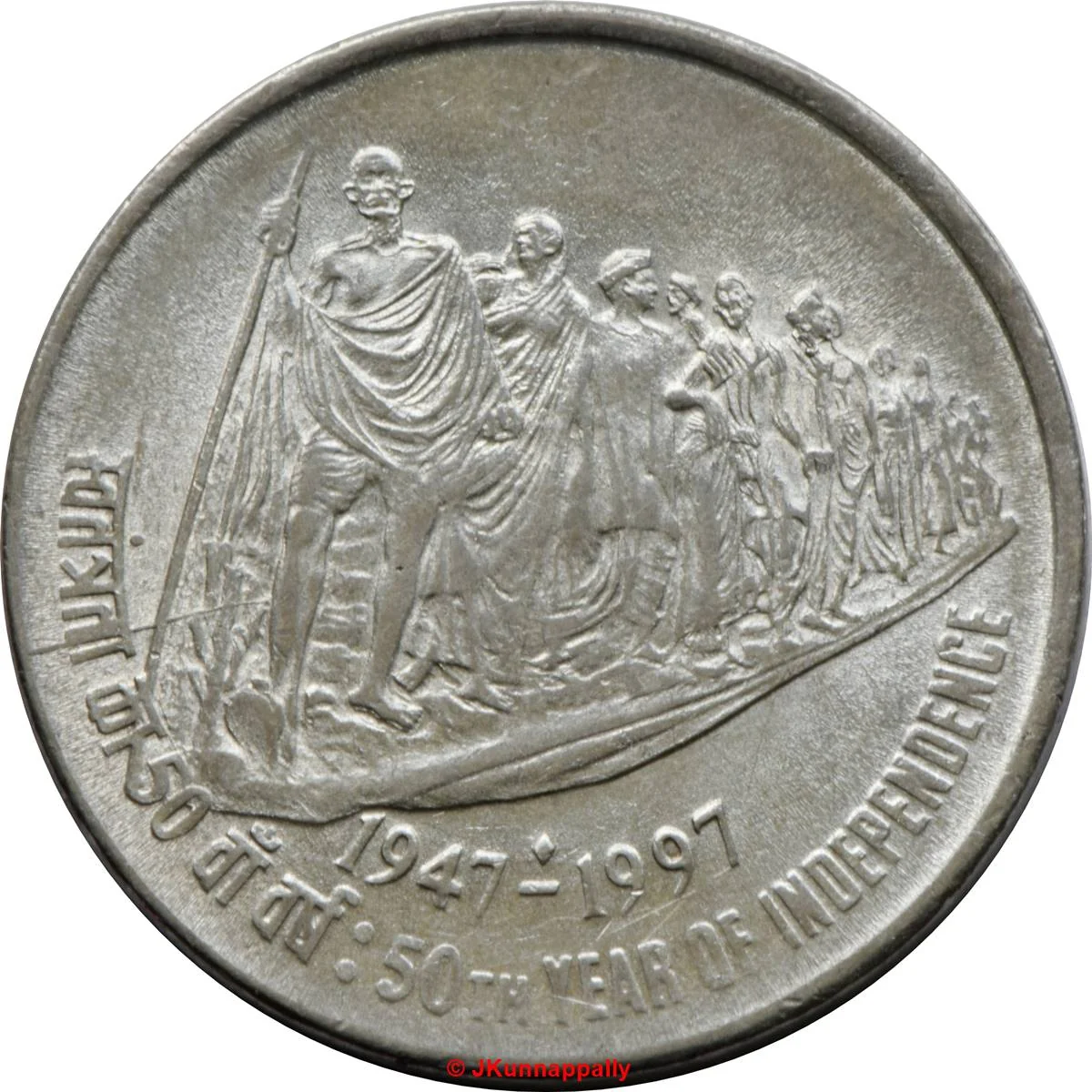
Description:
Gandhi with staff, leading people. Mintmarks: ♦ (Mumbai), none (Calcutta), * (Hyderabad), M (Mumbai proofs), ° (Noida).
Inscription:
1947 - 1997
स्वतंत्रता का 50 वाँ वर्ष :
50TH YEAR OF INDEPENDENCE
स्वतंत्रता का 50 वाँ वर्ष :
50TH YEAR OF INDEPENDENCE
Translation:
1947 - 1997
50th Year of Independence:
50TH YEAR OF INDEPENDENCE
50th Year of Independence:
50TH YEAR OF INDEPENDENCE
Edge
Plain
Categories
| Event> Independence |
Mintings
| Year | Mint Mark | Mintage | Quality | Collection |
|---|---|---|---|---|
| 1997 | — | — | ||
| 1997 | * | — | ||
| 1997 | ° | — | ||
| 1997 | ♦ | — | ||
| 1997 | M | — | Proof |
Historical background
In 1997, India's currency situation was defined by a period of relative stability and cautious liberalization following the profound crisis of 1991. The Indian Rupee (INR), which had been made partially convertible on the current account in 1993, was still under a managed float regime, with the Reserve Bank of India (RBI) actively intervening to curb excessive volatility. The exchange rate was broadly stable against the US Dollar, supported by strong capital inflows from foreign institutional investors (FIIs) attracted by a reforming economy and robust export growth. This environment stood in stark contrast to the turmoil experienced by several Southeast Asian nations during the 1997 Asian Financial Crisis, from which India remained largely insulated due to its relatively closed capital account.
The key policy framework was the "Liberalised Exchange Rate Management System" (LERMS), a dual-exchange rate system that had evolved into a unified market-determined rate. While the current account (for trade in goods and services) was convertible, strict controls remained on the capital account, preventing the kind of rapid, speculative "hot money" outflows that devastated other regional economies. This conservative approach, combined with comfortable foreign exchange reserves that had rebuilt to over $25 billion from a perilous low in 1991, provided a crucial buffer against external shocks. The government and RBI prioritized maintaining macroeconomic stability, using reserves to smooth rupee fluctuations rather than defending a rigid peg.
However, the year was not without pressure. The contagion effect from East Asia, coupled with domestic political uncertainty, led to some rupee depreciation in the latter half of 1997. The RBI had to intermittently sell dollars to stabilize the currency, and there was heightened scrutiny on the sustainability of the current account deficit. Overall, 1997 represented a year of successful navigation for India's currency management, proving the resilience of the post-1991 reforms. It reinforced the official consensus for a gradualist approach to capital account convertibility, setting the stage for future, measured liberalization in the years to come.
The key policy framework was the "Liberalised Exchange Rate Management System" (LERMS), a dual-exchange rate system that had evolved into a unified market-determined rate. While the current account (for trade in goods and services) was convertible, strict controls remained on the capital account, preventing the kind of rapid, speculative "hot money" outflows that devastated other regional economies. This conservative approach, combined with comfortable foreign exchange reserves that had rebuilt to over $25 billion from a perilous low in 1991, provided a crucial buffer against external shocks. The government and RBI prioritized maintaining macroeconomic stability, using reserves to smooth rupee fluctuations rather than defending a rigid peg.
However, the year was not without pressure. The contagion effect from East Asia, coupled with domestic political uncertainty, led to some rupee depreciation in the latter half of 1997. The RBI had to intermittently sell dollars to stabilize the currency, and there was heightened scrutiny on the sustainability of the current account deficit. Overall, 1997 represented a year of successful navigation for India's currency management, proving the resilience of the post-1991 reforms. It reinforced the official consensus for a gradualist approach to capital account convertibility, setting the stage for future, measured liberalization in the years to come.
🌱 Very Common