

100 Rubles – Russian Federation
Non-circulating coins
Series: Russian Ballet
Russia
Context
Year: 1999
Country: Russia 
Issuer: Russian Federation
Period:
(since 1991)
Currency:
(since 1998)
Total mintage: 1,000
Material

References
Value
Exchange value: 100 RUB
Bullion value: $2814.75
Inflation-adjusted value: 2319.12 RUB
Obverse
Description:
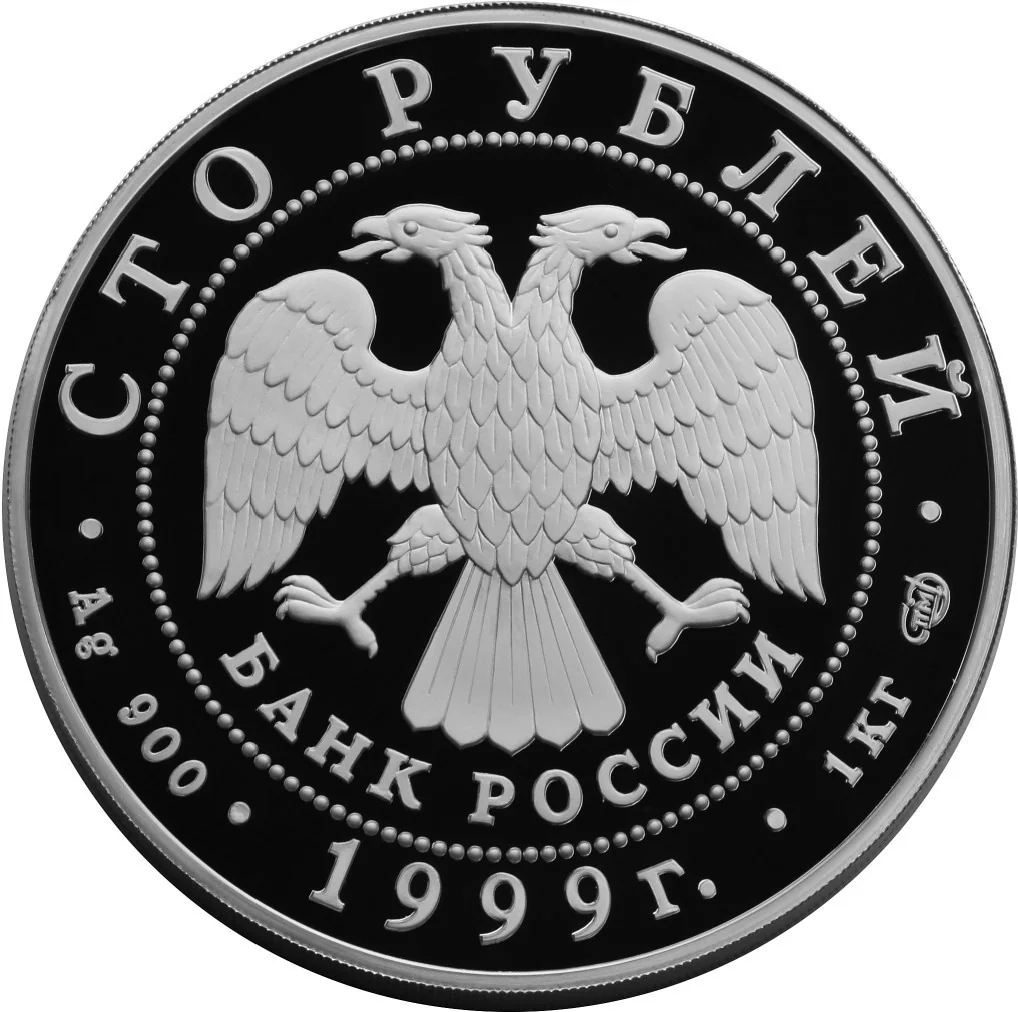
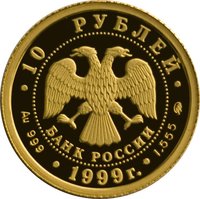
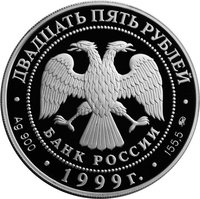
Centered is the Bank of Russia emblem (I. Bilibin's double-headed eagle), below it the semicircular inscription "БАНК РОССИИ" within a dotted circle. The rim inscriptions: top — "СТО РУБЛЕЙ", bottom — "1999". Left of the eagle are the metal and fineness marks, right — the fine metal content and mint mark.
Inscription:
СТО РУБЛЕЙ
БАНК РОССИИ
• Ag 900 • 1999г. • 1кг СПМД •
БАНК РОССИИ
• Ag 900 • 1999г. • 1кг СПМД •
Translation:
ONE HUNDRED RUBLES
BANK OF RUSSIA
• Ag 900 • 1999 • 1kg SPMD •
BANK OF RUSSIA
• Ag 900 • 1999 • 1kg SPMD •
Language: Russian
Designer and engraver: Alexander Vasilyevich Baklanov
Reverse
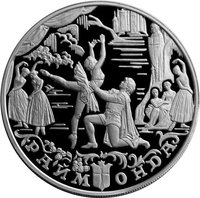
Description:
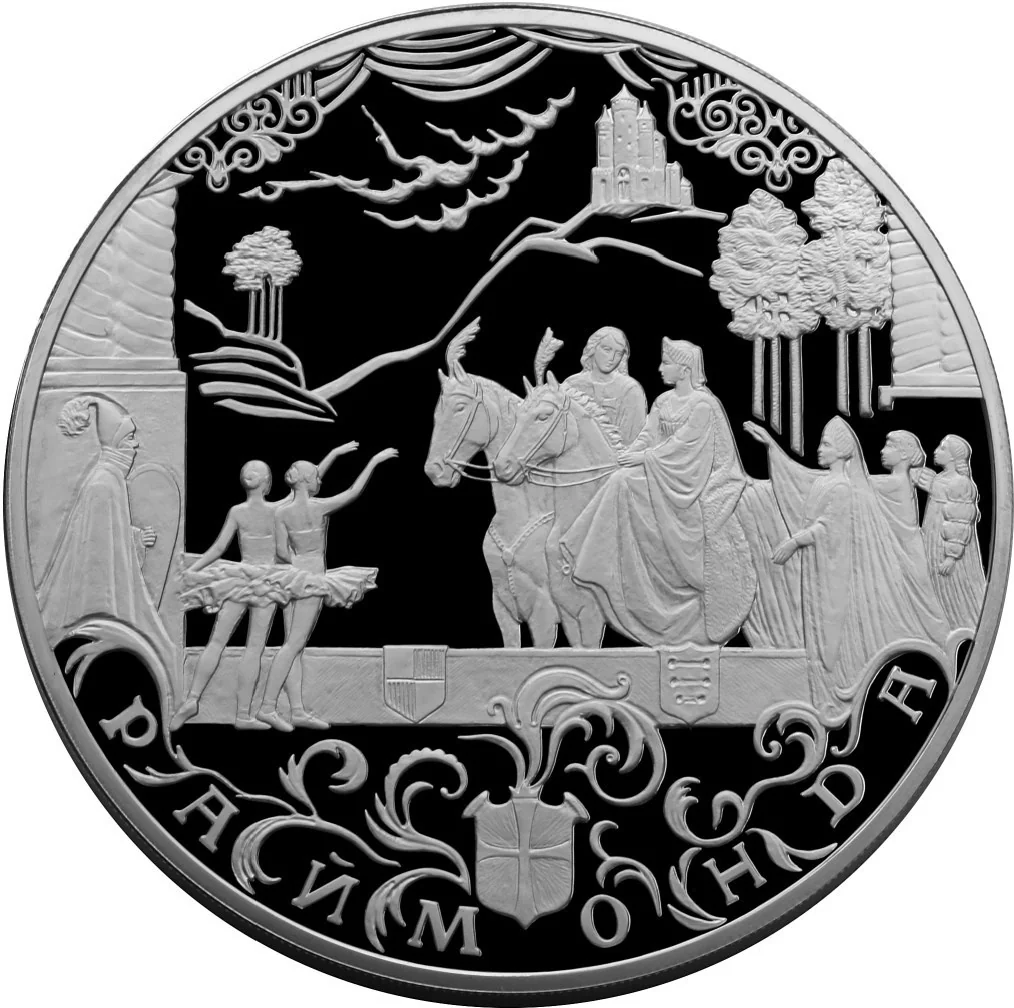
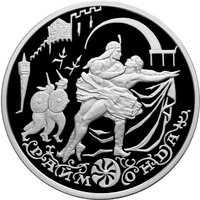
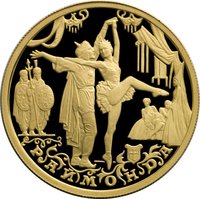
Final scene: the newlyweds depart for the groom's homeland.
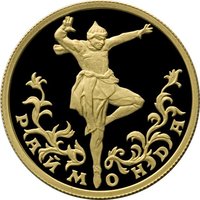
Inscription: «РАЙМОНДА» (RAYMONDA).
Inscription: «РАЙМОНДА» (RAYMONDA).
Inscription:
РАЙМОНДА
Translation:
RAYMONDA
Script: Cyrillic
Language: Russian
Designer and engraver: Alexandra Arsenyevna Dolgopolova
Edge
360 corrugations
Mints
| Name | Mark |
|---|---|
| Saint Petersburg | (СПМД) |
Mintings
| Year | Mint Mark | Mintage | Quality | Collection |
|---|---|---|---|---|
| 1999 | СПМД | 1,000 | Proof |
Historical background
By 1999, the Russian Federation was in a state of severe economic crisis following the 1998 Russian financial collapse (the "Ruble Crisis"). The government had been forced to default on its domestic debt, devalue the ruble, and declare a moratorium on payments to foreign creditors. This shattered confidence in the financial system, leading to a banking crisis, soaring inflation, and a dramatic drop in living standards. The ruble, which had been artificially maintained within a narrow band, lost over 70% of its value against the US dollar in the second half of 1998, plunging from roughly 6 RUB/USD to about 24 RUB/USD by early 1999.
The currency situation in 1999 was characterized by a managed float, but one heavily influenced by strict capital controls imposed in the wake of the default. These controls restricted foreign currency transactions and gave the Central Bank of Russia (CBR) greater power to stabilize the exchange rate. Crucially, the economic landscape began to shift due to a sharp rise in global oil prices. As a major oil exporter, Russia started to see a significant influx of dollar revenues, which boosted foreign reserves and provided the CBR with the means to intervene in support of the ruble, preventing further freefall.
Consequently, 1999 became a year of painful stabilization and unexpected macroeconomic adjustment. The weak ruble made imports expensive but spurred a surge in domestic industrial production, as Russian goods became more competitive. This import substitution, combined with the oil windfall, allowed the government to run a budget surplus and begin rebuilding reserves. By the end of 1999, the ruble had stabilized at around 27 RUB/USD, inflation was being brought down from its 1998 peak, and the economy returned to growth. Thus, the year marked the beginning of a recovery, setting the stage for the economic resurgence of the early 2000s, albeit with the currency's stability now critically tied to commodity exports.
The currency situation in 1999 was characterized by a managed float, but one heavily influenced by strict capital controls imposed in the wake of the default. These controls restricted foreign currency transactions and gave the Central Bank of Russia (CBR) greater power to stabilize the exchange rate. Crucially, the economic landscape began to shift due to a sharp rise in global oil prices. As a major oil exporter, Russia started to see a significant influx of dollar revenues, which boosted foreign reserves and provided the CBR with the means to intervene in support of the ruble, preventing further freefall.
Consequently, 1999 became a year of painful stabilization and unexpected macroeconomic adjustment. The weak ruble made imports expensive but spurred a surge in domestic industrial production, as Russian goods became more competitive. This import substitution, combined with the oil windfall, allowed the government to run a budget surplus and begin rebuilding reserves. By the end of 1999, the ruble had stabilized at around 27 RUB/USD, inflation was being brought down from its 1998 peak, and the economy returned to growth. Thus, the year marked the beginning of a recovery, setting the stage for the economic resurgence of the early 2000s, albeit with the currency's stability now critically tied to commodity exports.
Series: Russian Ballet





✨ Legendary