

1 krone – Greenland
Add to wishlist
Denmark
Context
Years: 1960–1964
Country: Denmark
Issuer: Greenland
Ruler: Frederick IX
Currency:
(since 1873)
Demonetization: 1 July 1967
Total mintage: 218,500
Material
References
KM: #
Numista: #6964
Value
Exchange value: 1 DKK
Inflation-adjusted value: 15.67 DKK
Obverse
Description:
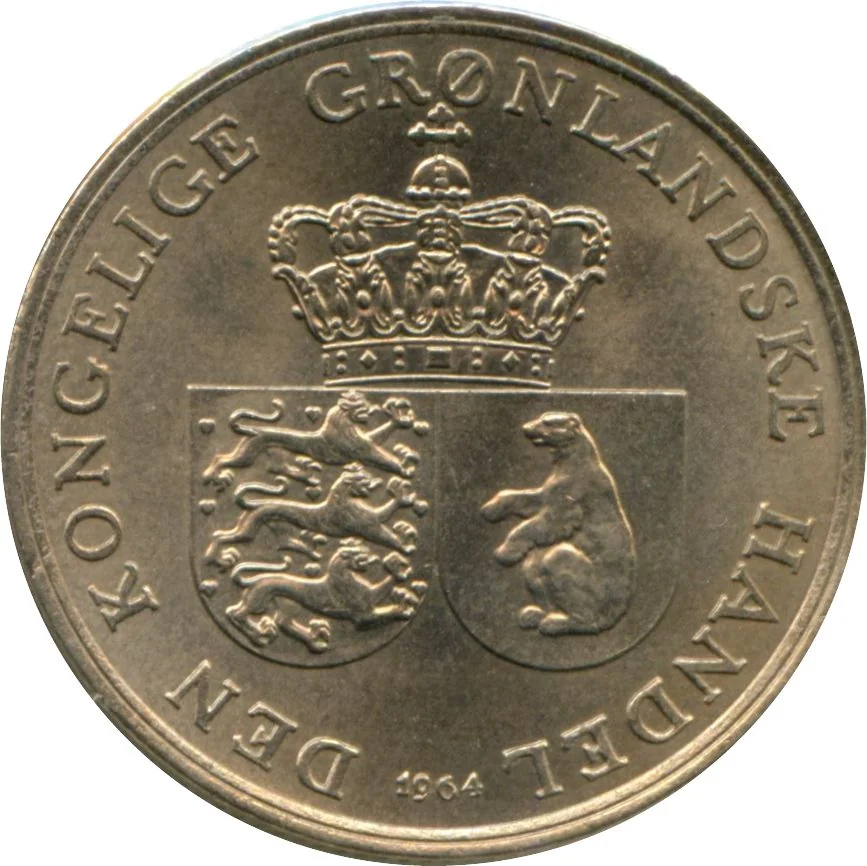
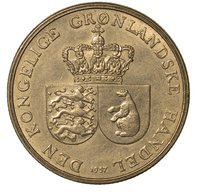
Danish and Greenlandic coats of arms, date beneath.
Inscription:
DEN KONGELIGE GRØNLANDSKE HANDEL
1964
1964
Translation:
The Royal Greenland Trade
1964
1964
Script: Latin
Language: Danish
Engravers: Harald Salomon, Alfred Frederik Christiansen
Reverse
Description:
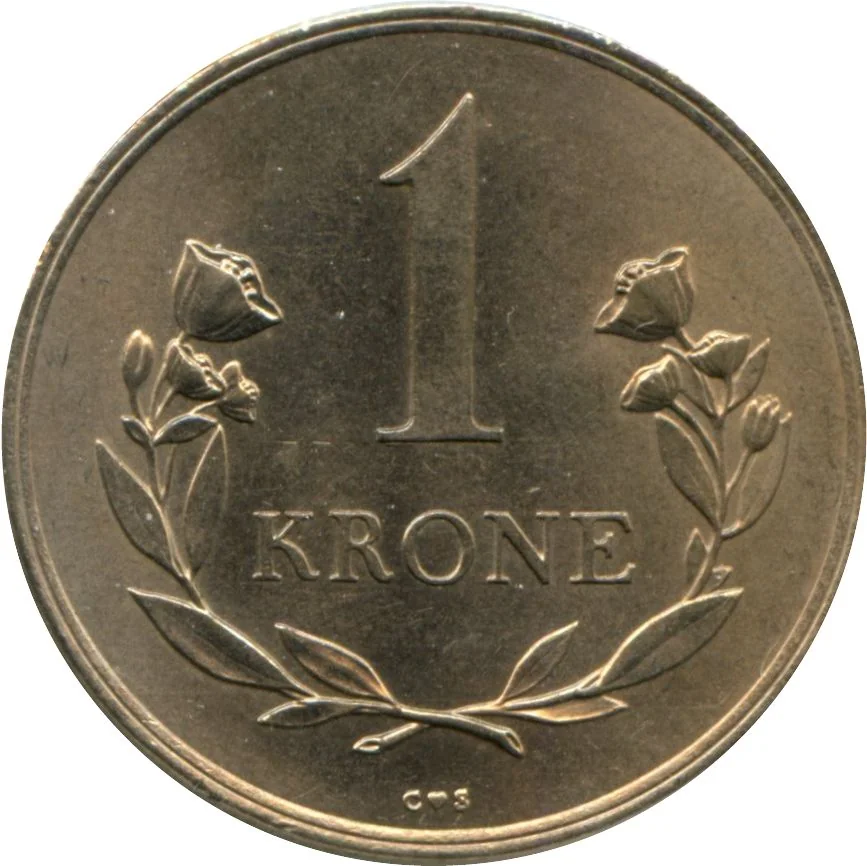
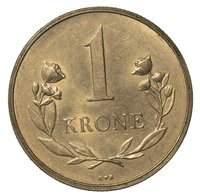
Dwarf fireweed, Greenland's national flower.
Inscription:
1
KRONE
KRONE
Script: Latin
Engravers: Harald Salomon, Alfred Frederik Christiansen
Edge
Reeded
Mints
| Name | Mark |
|---|---|
| Royal Danish Mint | — |
Mintings
| Year | Mint Mark | Mintage | Quality | Collection |
|---|---|---|---|---|
| 1960 | C♥S | 108,500 | ||
| 1964 | C♥S | 110,000 |
Historical background
In 1960, Greenland’s currency situation was fundamentally an extension of Denmark’s monetary system, as the island was an integrated county of the Danish realm. The official and sole legal tender was the Danish krone (DKK), issued by Denmark's central bank, Danmarks Nationalbank. There was no separate Greenlandic currency, and monetary policy was entirely set in Copenhagen, aligning Greenland’s economy closely with that of Denmark and, by extension, the Bretton Woods system of fixed exchange rates.
This arrangement reflected Greenland’s transitional post-war economy. The traditional seal-hunting and fishing subsistence economy was being actively transformed by a state-led modernization drive, heavily funded by Danish investment. The krone facilitated this integration, enabling trade, funding large infrastructure projects, and paying the wages of a growing public sector. However, the monetary union also meant Greenland had no independent tools to manage economic shocks specific to its remote, Arctic conditions.
While functionally seamless, the currency situation underscored a broader dependency. Greenland’s economy was small, vulnerable, and cash-based in many settlements, with its viability heavily reliant on Danish subsidies and administrative control. The use of the Danish krone in 1960 was thus more than a financial technicality; it was a symbol of the centralized colonial relationship that would soon be challenged, leading to the Home Rule negotiations of the following decade.
This arrangement reflected Greenland’s transitional post-war economy. The traditional seal-hunting and fishing subsistence economy was being actively transformed by a state-led modernization drive, heavily funded by Danish investment. The krone facilitated this integration, enabling trade, funding large infrastructure projects, and paying the wages of a growing public sector. However, the monetary union also meant Greenland had no independent tools to manage economic shocks specific to its remote, Arctic conditions.
While functionally seamless, the currency situation underscored a broader dependency. Greenland’s economy was small, vulnerable, and cash-based in many settlements, with its viability heavily reliant on Danish subsidies and administrative control. The use of the Danish krone in 1960 was thus more than a financial technicality; it was a symbol of the centralized colonial relationship that would soon be challenged, leading to the Home Rule negotiations of the following decade.
🌱 Common