

25 øre – Greenland
Add to wishlist
Denmark
Context
Year: 1926
Country: Denmark
Issuer: Greenland
Ruler: Christian X
Currency:
(since 1873)
Demonetized: Yes
Total mintage: 310,000
Material
Diameter: 25 mm
Weight: 6.9 g
Thickness: 1.8 mm
Shape: Round
Composition: Copper-nickel
Technique: Milled
Alignment: Medal alignment
flip
References
KM: #
Numista: #6960
Value
Exchange value: 0.25 DKK
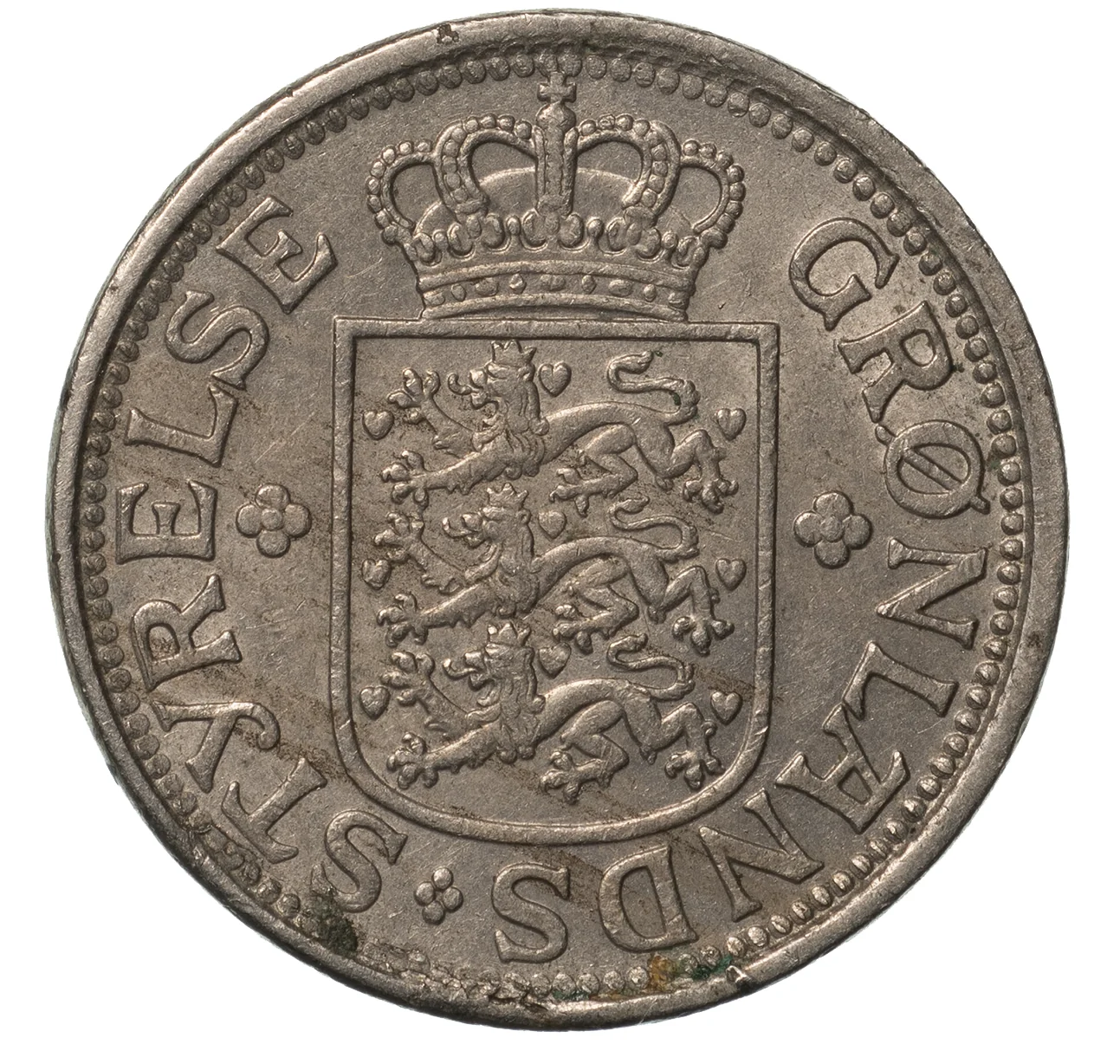
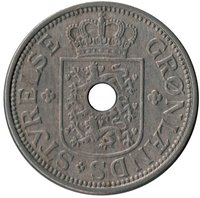
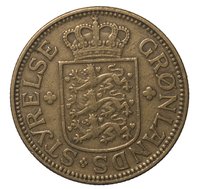
Obverse
Description:
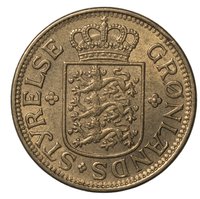
Shield with three lions, encircled by text.
Inscription:
GRØNLANDS STYRELSE
Translation:
Greenland's Administration
Script: Latin
Language: Danish
Engravers: Gunnar Jensen, Hans Christian Nielsen
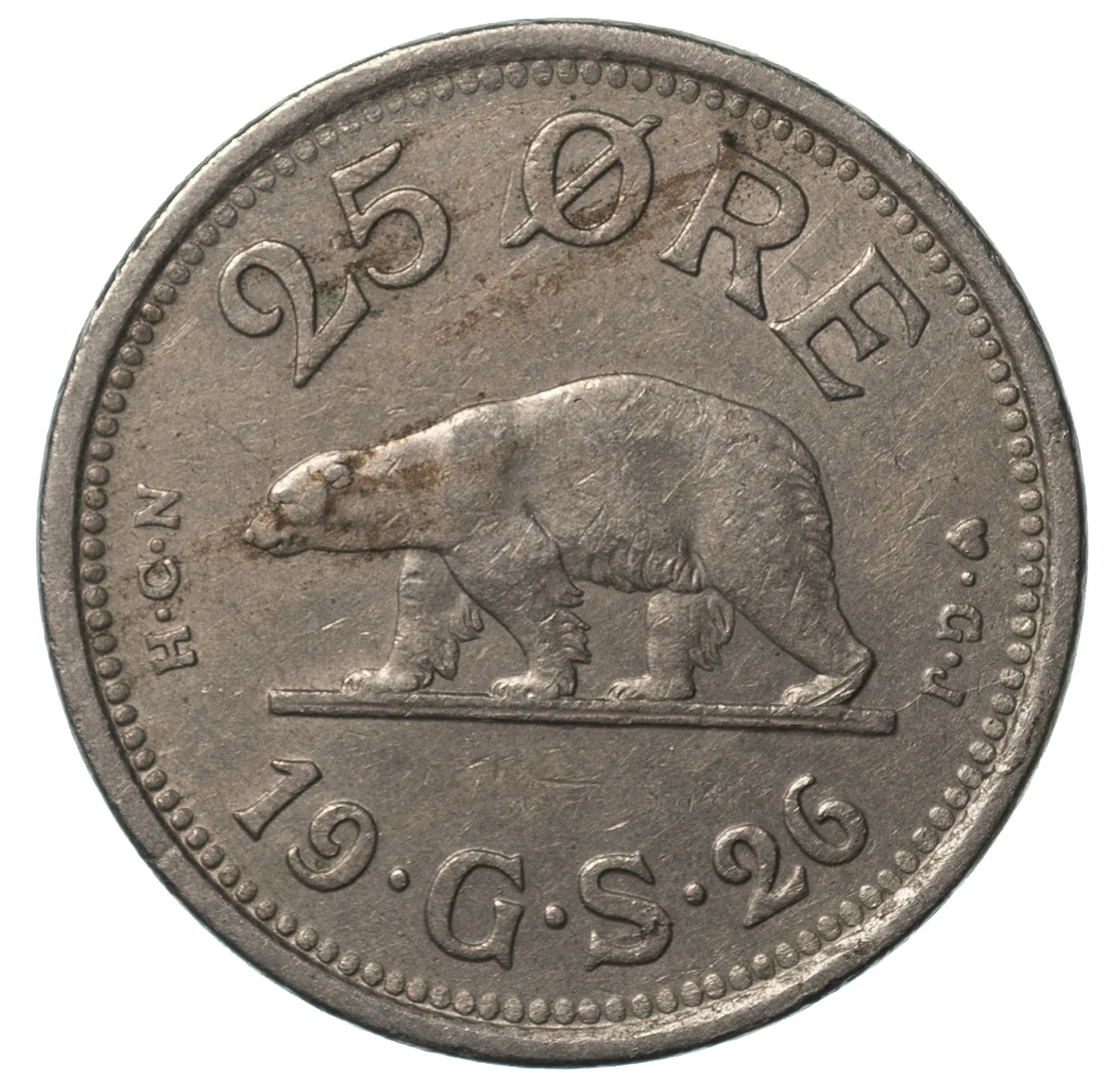
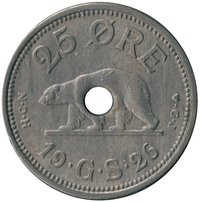
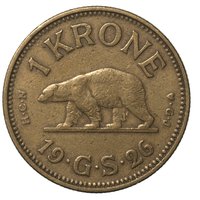
Reverse
Description:
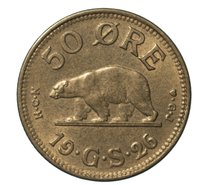
Polar bear walking left. Mintmark right. Value above, date and initials below.
Inscription:
H·C·N 25 ØRE ♥·G·J
19·G·S·26
19·G·S·26
Translation:
25 ØRE H·C·N ♥ G·J
19 G·S·26
19 G·S·26
Script: Latin
Engraver: Gunnar Jensen
Edge
Plain
Mints
| Name | Mark |
|---|---|
| Royal Danish Mint | — |
Mintings
| Year | Mint Mark | Mintage | Quality | Collection |
|---|---|---|---|---|
| 1926 | HCN;♥GJ | 310,000 |
Historical background
In 1926, Greenland remained under Danish colonial administration, and its currency situation was a direct extension of Denmark's monetary system. The official legal tender was the Danish krone (DKK), which had been formally introduced following the full colonization of the island in the early 19th century. There was no separate Greenlandic currency; banknotes and coins circulating on the island were identical to those used in Denmark, issued by the Danish central bank and the state treasury. This arrangement underscored Greenland's integrated, yet subordinate, economic relationship with the colonial power.
The monetary economy, however, coexisted with and was constrained by local subsistence practices. The cash-based system was primarily active in and around the few colonial trading stations (like Godthåb and Egedesminde) administered by the Royal Greenland Trading Department (KGH). Here, Danish kroner were used for wages and for purchasing imported goods. For much of the Greenlandic population, particularly in remote hunting and fishing communities, barter and subsistence living remained prevalent. The KGH itself often operated on a credit and barter system with local hunters, exchanging goods for seal skins and other products, thereby limiting the physical need for widespread cash circulation.
This period fell within a long era of economic stability for the Danish krone, which was on the gold standard until 1931. Consequently, Greenland's currency was effectively pegged to gold through its link to the Danish monetary system. There were no significant currency debates or crises specific to Greenland in 1926; the monetary situation was a quiet, administrative fact of colonial life. The focus for both Danish authorities and Greenlandic residents was less on currency mechanics and more on the broader challenges of livelihood, trade, and the strict monopoly control of the KGH over all external and most internal economic activity.
The monetary economy, however, coexisted with and was constrained by local subsistence practices. The cash-based system was primarily active in and around the few colonial trading stations (like Godthåb and Egedesminde) administered by the Royal Greenland Trading Department (KGH). Here, Danish kroner were used for wages and for purchasing imported goods. For much of the Greenlandic population, particularly in remote hunting and fishing communities, barter and subsistence living remained prevalent. The KGH itself often operated on a credit and barter system with local hunters, exchanging goods for seal skins and other products, thereby limiting the physical need for widespread cash circulation.
This period fell within a long era of economic stability for the Danish krone, which was on the gold standard until 1931. Consequently, Greenland's currency was effectively pegged to gold through its link to the Danish monetary system. There were no significant currency debates or crises specific to Greenland in 1926; the monetary situation was a quiet, administrative fact of colonial life. The focus for both Danish authorities and Greenlandic residents was less on currency mechanics and more on the broader challenges of livelihood, trade, and the strict monopoly control of the KGH over all external and most internal economic activity.
🌱 Common