

2 shu – Japan
Add to wishlist
Japan
Context
Material
Weight: 0.75 g
Thickness: 0.75 mm
Shape: Irregular rectangular
Composition: Electrum Silve
Technique: Hammered
Alignment: Medal alignment
flip
References
Numista: #69472
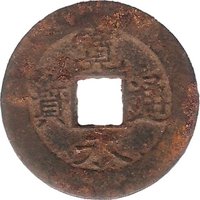
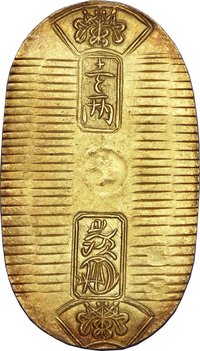
Obverse
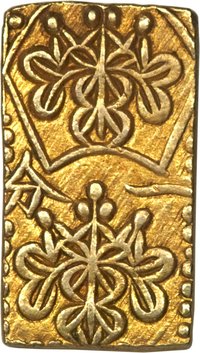
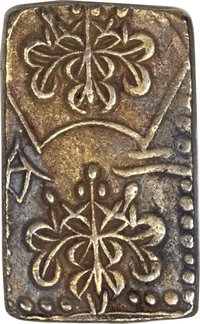
Description:
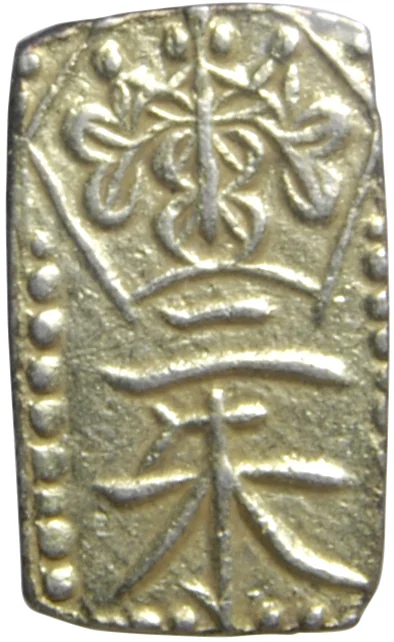
Kiri crest top, centered value within dotted border.
Inscription:
二
朱
朱
Translation:
Two Zhu
Scripts: Chinese (traditional, regular script)
Language: Classical Chinese
Engraver: Shozaburo Mitsutsugu
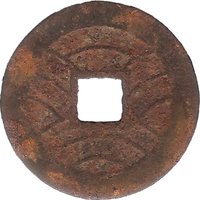
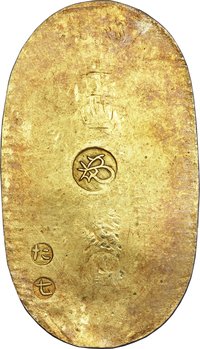
Reverse
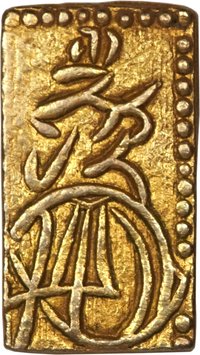
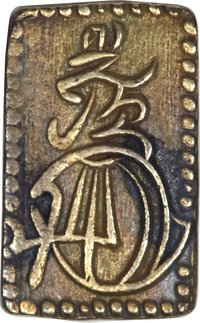
Description:
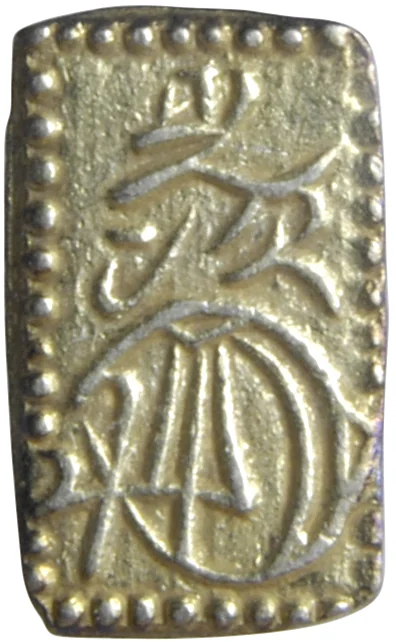
Mint Official and signature in dotted outline.
Inscription:
光
次
次
Translation:
Guangci
Scripts: Chinese (traditional, grass script)
Language: Chinese
Engraver: Shozaburo Mitsutsugu
Edge
Mints
| Name | Mark |
|---|---|
| Kinza, Edo | — |
Mintings
| Year | Mint Mark | Mintage | Quality | Collection |
|---|---|---|---|---|
| — | — | 25,120,000 |
Historical background
In 1860, Japan's currency system was a complex and unstable patchwork, reflecting the country's fractured political state on the eve of the Meiji Restoration. The Tokugawa shogunate issued its own coinage—gold koban, silver momme, and copper mon—but its authority was waning. Nearly 250 semi-autonomous feudal domains (han) also exercised the right to mint their own local currencies, known as hansatsu (domain notes). These paper notes and often debased clan coins circulated primarily within their own territories, creating a bewildering array of exchange rates and hindering national trade. Furthermore, the gold-silver exchange ratio set by the shogunate was artificially low compared to international markets, creating an arbitrage opportunity that foreign merchants, newly arrived after the forced "Opening of Japan" in the 1850s, exploited to drain the country of its gold.
This monetary chaos was exacerbated by severe fiscal pressures. The shogunate and domains faced massive debts, partly due to the mandated alternate attendance (sankin-kōtai) system and the costs of modernizing defenses against the perceived Western threat. To raise revenue, both the central government and domains increasingly resorted to debasement, issuing coins with lower precious metal content and printing more hansatsu without sufficient reserves. This led to widespread inflation, eroding the purchasing power of the samurai class living on fixed stipends and causing distress among commoners. The system was inherently unsustainable, as it lacked central coordination and was vulnerable to external economic shocks.
Thus, the currency situation in 1860 was a critical symptom of the Tokugawa regime's decline. The fragmented and inflationary monetary environment stifled economic unification and highlighted the need for a strong central authority. Resolving this currency crisis would become an immediate and paramount task for the Meiji government after 1868, leading to the abolition of the han system, the demonetization of hansatsu, and the establishment of a unified, modern yen based on the gold standard—a foundational step in Japan's rapid transformation into a modern nation-state.
This monetary chaos was exacerbated by severe fiscal pressures. The shogunate and domains faced massive debts, partly due to the mandated alternate attendance (sankin-kōtai) system and the costs of modernizing defenses against the perceived Western threat. To raise revenue, both the central government and domains increasingly resorted to debasement, issuing coins with lower precious metal content and printing more hansatsu without sufficient reserves. This led to widespread inflation, eroding the purchasing power of the samurai class living on fixed stipends and causing distress among commoners. The system was inherently unsustainable, as it lacked central coordination and was vulnerable to external economic shocks.
Thus, the currency situation in 1860 was a critical symptom of the Tokugawa regime's decline. The fragmented and inflationary monetary environment stifled economic unification and highlighted the need for a strong central authority. Resolving this currency crisis would become an immediate and paramount task for the Meiji government after 1868, leading to the abolition of the han system, the demonetization of hansatsu, and the establishment of a unified, modern yen based on the gold standard—a foundational step in Japan's rapid transformation into a modern nation-state.
Series: 1860 Japan circulation coins
⭐ Somewhat Rare