

5 milliemes – Libya
Add to wishlist
Libya
Context
Year: 1965
Islamic (Hijri) Year:: 1385
Issuer: Libya
Ruler: Idris I
Currency:
(1951—1971)
Demonetized: Yes
Total mintage: 8,500,000
Material
Diameter: 20 mm
Weight: 2.5 g
Thickness: 1.3 mm
Shape: Scalloped
Composition: Nickel brass
Magnetic: No
Technique: Milled
Alignment: Medal alignment
flip
References
KM: #
Numista: #6907
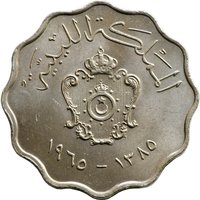
Obverse
Description:
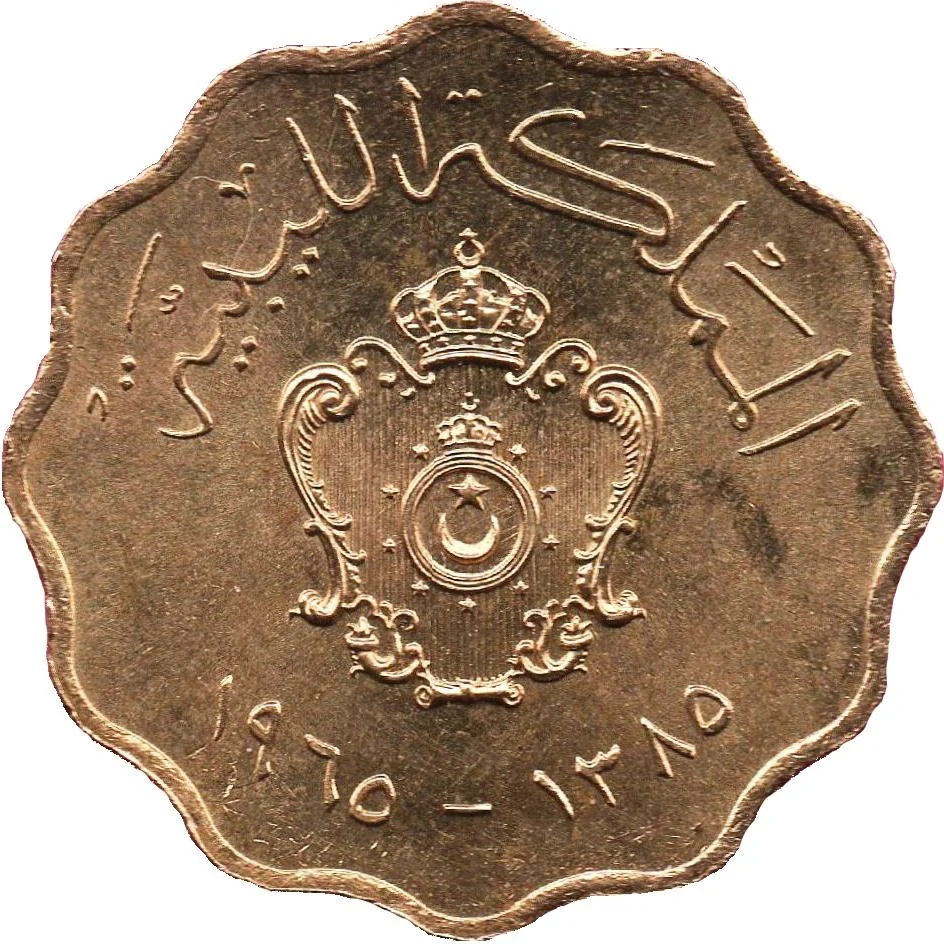
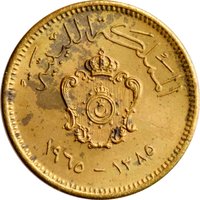
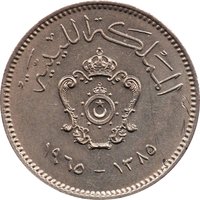
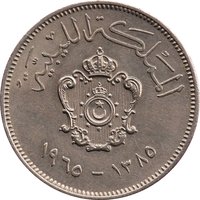
Libyan coat of arms crowned with Arabic legend above and dual Hejira/Gregorian dates below.
Inscription:
المملكة الليبية
١٣٨٥ - ١٩٦٥
١٣٨٥ - ١٩٦٥
Translation:
The Libyan Kingdom
1385 - 1965
1385 - 1965
Language: Arabic
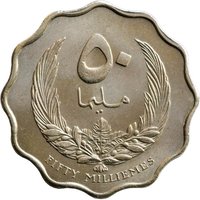
Reverse
Description:
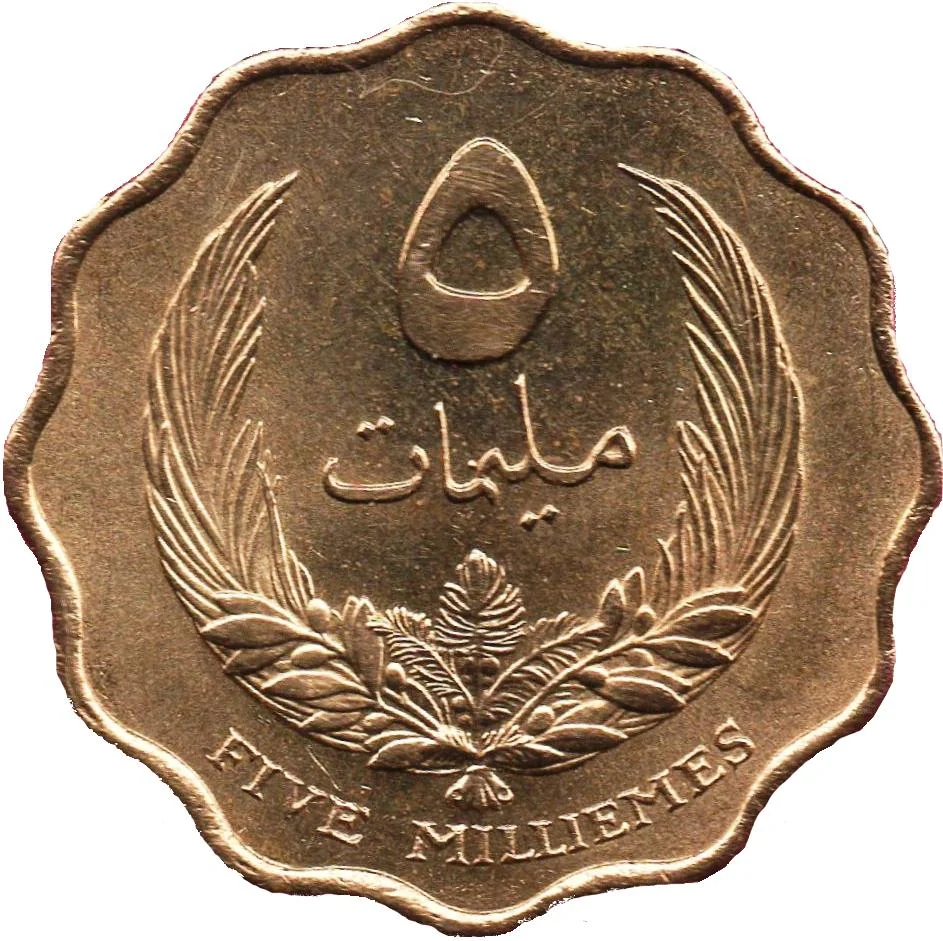
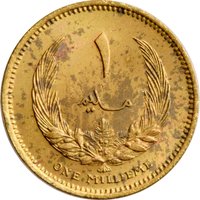
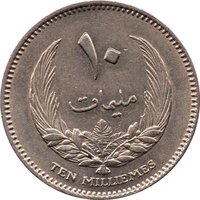
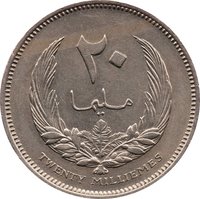
Palm wreath above, English denomination below.
Inscription:
٥
مليمات
FIVE MILLIEMES
مليمات
FIVE MILLIEMES
Translation:
Five Milliemes
Language: Arabic
Edge
Plain
Mints
| Name | Mark |
|---|---|
| Royal Mint (Tower Hill) | — |
Mintings
| Year | Mint Mark | Mintage | Quality | Collection |
|---|---|---|---|---|
| 1965 | — | 8,500,000 |
Historical background
In 1965, Libya’s currency situation was defined by stability and a direct link to the international monetary system, a legacy of its colonial past and recent oil wealth. The official currency was the Libyan pound (£L), introduced in 1951 to replace the Algerian franc and Egyptian pound used in different regions of the newly independent United Kingdom of Libya. It was pegged to sterling at par (£L1 = £1 sterling), a reflection of the country's strong political and economic ties with the United Kingdom and the significant influence of the British military presence and aid.
This peg provided monetary stability during a period of profound economic transformation. The discovery and rapid export of oil, beginning in 1961, had swiftly altered Libya's fiscal reality. Government revenues surged, moving the nation from a recipient of foreign aid to a state with growing financial reserves. The fixed exchange rate facilitated international trade and investment in the burgeoning oil sector, as it minimized currency risk for foreign companies. The Libyan pound itself was issued by the National Bank of Libya, which acted as a central bank, managing the currency board-style system that backed the circulating money with foreign reserves, primarily sterling.
Consequently, the primary monetary challenges of the mid-1960s were not of devaluation or inflation, but of managing sudden wealth and planning for long-term development. The currency's strength and stability were underpinned by hydrocarbon exports, but the economy faced the classic "Dutch disease" symptoms of a growing disparity between a booming oil enclave and traditional agricultural sectors. The government, under King Idris I, began channeling oil revenues into infrastructure and development projects, setting the stage for future state-led expansion while the currency regime itself remained a cornerstone of macroeconomic order until major changes would follow the 1969 revolution.
This peg provided monetary stability during a period of profound economic transformation. The discovery and rapid export of oil, beginning in 1961, had swiftly altered Libya's fiscal reality. Government revenues surged, moving the nation from a recipient of foreign aid to a state with growing financial reserves. The fixed exchange rate facilitated international trade and investment in the burgeoning oil sector, as it minimized currency risk for foreign companies. The Libyan pound itself was issued by the National Bank of Libya, which acted as a central bank, managing the currency board-style system that backed the circulating money with foreign reserves, primarily sterling.
Consequently, the primary monetary challenges of the mid-1960s were not of devaluation or inflation, but of managing sudden wealth and planning for long-term development. The currency's strength and stability were underpinned by hydrocarbon exports, but the economy faced the classic "Dutch disease" symptoms of a growing disparity between a booming oil enclave and traditional agricultural sectors. The government, under King Idris I, began channeling oil revenues into infrastructure and development projects, setting the stage for future state-led expansion while the currency regime itself remained a cornerstone of macroeconomic order until major changes would follow the 1969 revolution.
Series: 1965 Libya circulation coins
🌱 Very Common