

5 Öre – Sweden
Sweden
Context
Years: 1981–1984
Issuer: Sweden 
Ruler: Carl XVI Gustaf
Currency:
(since 1873)
Demonetization: 30 June 1985
Total mintage: 90,073,051
Material

References
KM: #Click to copy to clipboard849a
Numista: #6861
Value
Exchange value: 0.05 SEK = $0.01
Inflation-adjusted value: 0.21 SEK
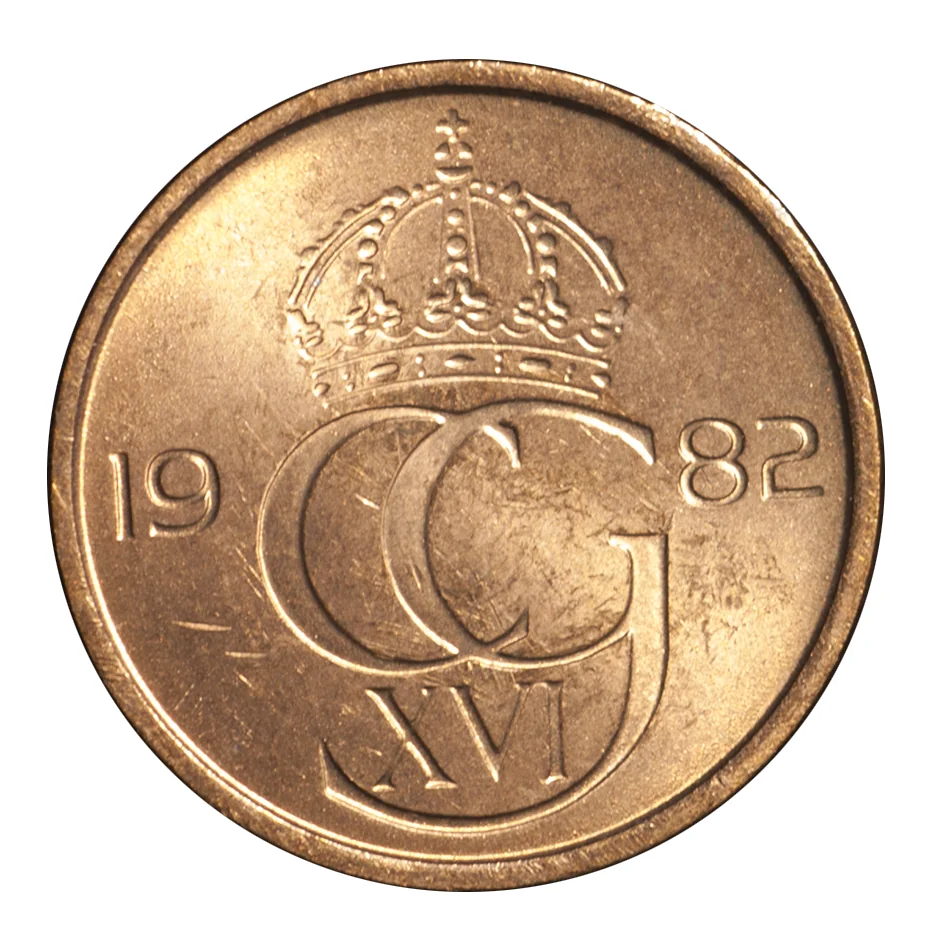
Obverse
Description:
Carl XVI Gustaf monogram divides date.
Inscription:
19 CG 83
XVI
XVI
Script: Latin
Engraver: Lars Englund
Reverse
Description:
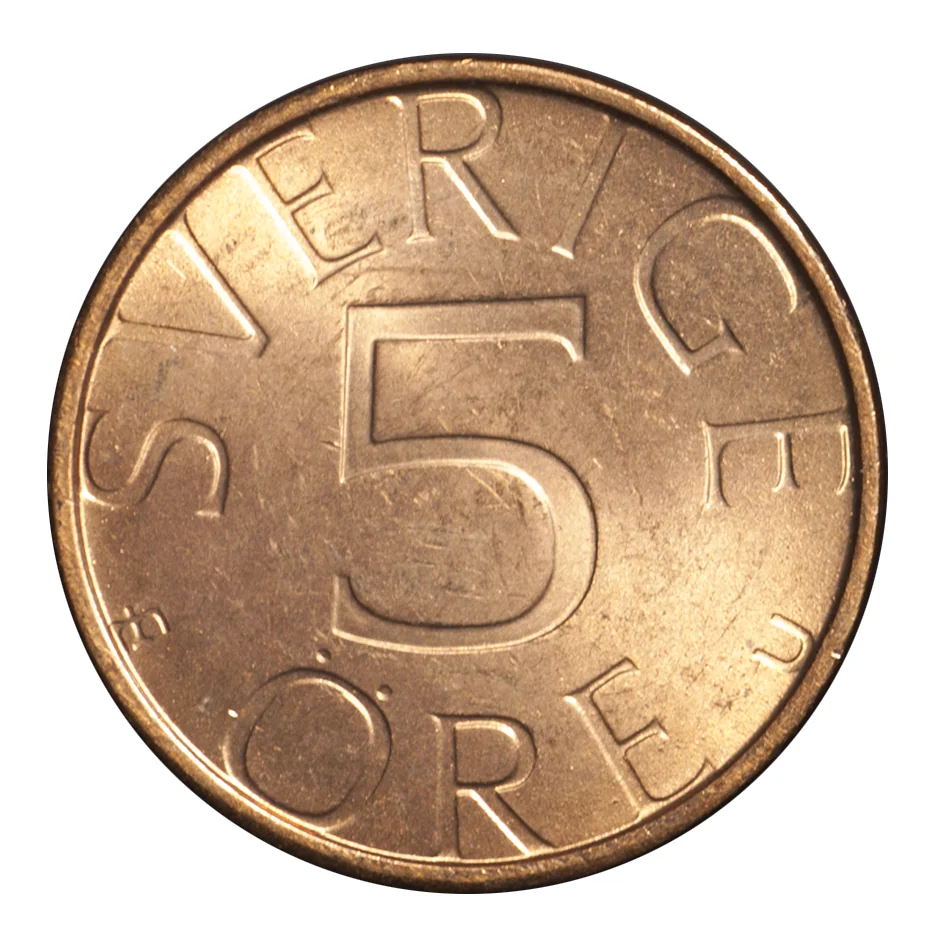
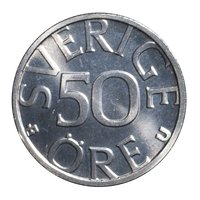
The reverse features the numeral 5, with "SVERIGE" above and "ÖRE" below. The mintmark is left of ÖRE, and the initial of the Riksbank Governor's surname is to the right.
Inscription:
SVERIGE
5 ÖRE
E U
5 ÖRE
E U
Translation:
Sweden
5 Öre
E U
5 Öre
E U
Script: Latin
Language: Swedish
Engraver: Lars Englund
Edge
Plain
Mints
| Name | Mark |
|---|---|
| Myntverket | — |
Mintings
| Year | Mint Mark | Mintage | Quality | Collection |
|---|---|---|---|---|
| 1981 | — | 65,338 | ||
| 1982 | — | 40,402,880 | ||
| 1983 | — | 36,236,537 | ||
| 1984 | — | 13,368,296 |
Historical background
In 1981, Sweden found itself in the midst of a prolonged currency crisis, a defining feature of its economic landscape in the late 1970s and early 1980s. The root cause was a combination of high inflation, large current account deficits, and a loss of international competitiveness, exacerbated by the global oil shocks. Successive devaluations of the Swedish krona—in 1976, 1977, and 1981—were employed as a central policy tool to try to restore the trade balance by making exports cheaper and imports more expensive. However, these were largely defensive reactions to speculative pressure rather than part of a coherent long-term strategy.
The situation was complicated by Sweden's unique economic model, which prioritized full employment and a strong welfare state over price stability. This led to a policy conflict: to defend the fixed exchange rate (pegged to a trade-weighted currency basket), the Riksbank needed to maintain high interest rates, but this clashed with the government's desire to stimulate the domestic economy and protect jobs. Consequently, a system of pervasive financial regulation, including strict credit controls and barriers on international capital movements, was used to try to manage the pressure on the krona. This created a distorted financial environment and did little to address underlying inflationary pressures.
By the end of 1981, the situation remained tense and unsustainable. The third devaluation of the decade in September 1981, a sharp 10% devaluation of the krona, provided only temporary relief. It underscored the failure of repeated devaluations to solve Sweden's structural economic problems and highlighted the growing constraints of the fixed exchange rate regime in an era of increasing global capital mobility. This period set the stage for the profound financial deregulation and policy shifts that would follow in the mid-1980s, ultimately leading to the disastrous financial crisis of the early 1990s.
The situation was complicated by Sweden's unique economic model, which prioritized full employment and a strong welfare state over price stability. This led to a policy conflict: to defend the fixed exchange rate (pegged to a trade-weighted currency basket), the Riksbank needed to maintain high interest rates, but this clashed with the government's desire to stimulate the domestic economy and protect jobs. Consequently, a system of pervasive financial regulation, including strict credit controls and barriers on international capital movements, was used to try to manage the pressure on the krona. This created a distorted financial environment and did little to address underlying inflationary pressures.
By the end of 1981, the situation remained tense and unsustainable. The third devaluation of the decade in September 1981, a sharp 10% devaluation of the krona, provided only temporary relief. It underscored the failure of repeated devaluations to solve Sweden's structural economic problems and highlighted the growing constraints of the fixed exchange rate regime in an era of increasing global capital mobility. This period set the stage for the profound financial deregulation and policy shifts that would follow in the mid-1980s, ultimately leading to the disastrous financial crisis of the early 1990s.

🌱 Very Common