Logo Title
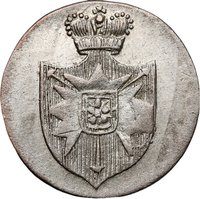
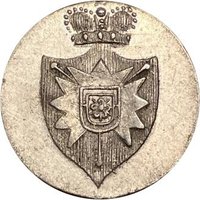
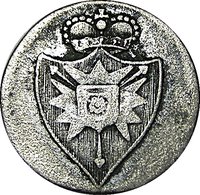
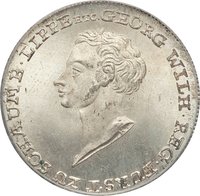
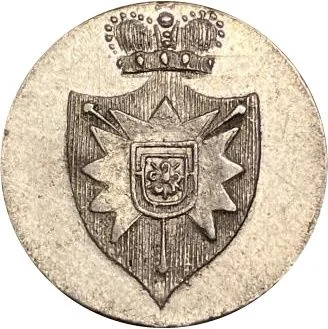
obverse
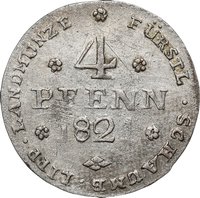
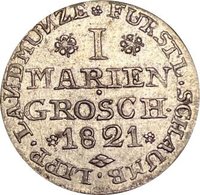
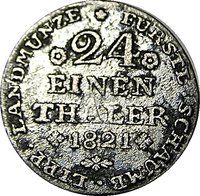
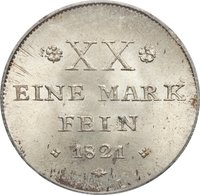
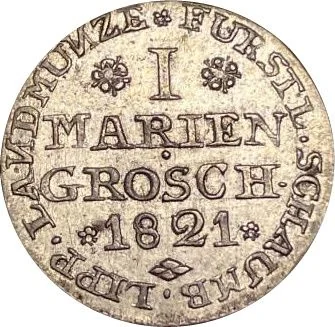
reverse
dbasedman
Context
Years: 1821–1828
Country: Germany Country flag
Currency:
(1807—1865)
Demonetized: Yes
Total mintage: 143,000
Material
Diameter: 16 mm
Weight: 1.55 g
Shape: Round
Composition: Billon (38.8% Silver)
References
KM: #Click to copy to clipboard32
Numista: #68589

Obverse

Description:
Shielded forearms.

Reverse

Description:
Value and date within 4-line inscription, encircled by legend.
Inscription:
LANDMÜNZE FÜRSTL.SCHAUMB.LIPPE

*I*

MARIEN

GROSCH

*1821*

*
Translation:
Principality of Schaumburg-Lippe Regional Coin

*I*

Marien

Groschen

*1821*
Script: Latin
Language: German

Edge

Plain

Mints

NameMark
Braunschweig

Mintings

YearMint MarkMintageQualityCollection
1821143,000
1828

Historical background

In 1821, the currency situation in the Principality of Schaumburg-Lippe was characterized by significant complexity and transition. Like many German states in the post-Napoleonic era, it operated within a fragmented monetary landscape where various coinage systems circulated simultaneously. The principality officially used the Reichsthaler as its accounting unit, divided into 24 Gutegroschen or 288 Pfennige, but in practice, it was heavily influenced by the monetary systems of its larger neighbors, particularly the Kingdom of Hanover and the Electorate of Hesse-Kassel, whose coins were commonly used in daily transactions.

This period was one of active monetary reform, driven by the broader German Confederation's efforts to create standardization. In 1821, Schaumburg-Lippe was in the process of implementing the Konventionsmünzfuß (Convention Standard), a silver-based system agreed upon by several northern German states. This move aimed to bring order by defining the precise silver content of coins, thereby facilitating trade and reducing the confusion caused by the circulation of numerous foreign and older debased coins. The state began issuing its own standardized silver Gutegroschen and Pfennige coins aligned with this convention.

Ultimately, the 1821 situation reflects a small principality navigating between local sovereignty and the practical necessity of regional integration. While seeking to assert its own minting rights and fiscal identity, Schaumburg-Lippe's monetary stability was inextricably linked to adhering to the emerging cooperative frameworks within the German Confederation. This transitional phase laid the groundwork for more comprehensive standardization, which would later culminate in the full adoption of the Prussian Thaler system following Schaumburg-Lippe's entry into the North German Confederation in 1867.

Series: 1821 Principality of Schaumburg-Lippe circulation coins

4 Pfennigs obverse
4 Pfennigs reverse
4 Pfennigs
1821-1828
1 Mariengroschen obverse
1 Mariengroschen reverse
1 Mariengroschen
1821-1828
1 Groschen obverse
1 Groschen reverse
1 Groschen
1821-1826
½ Conventionsthaler obverse
½ Conventionsthaler reverse
½ Conventionsthaler
1821
💎 Extremely Rare