

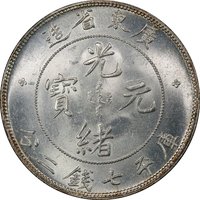
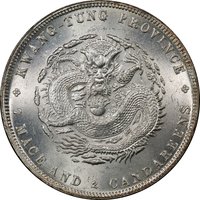
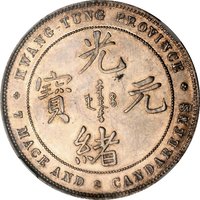
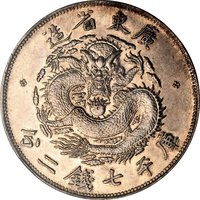
1 cash – Kwangtung Province
Add to wishlist
China
Context
Material
Diameter: 24 mm
Weight: 2.8 g
Thickness: 0.9 mm
Shape: Round with a square hole
Composition: Brass
Magnetic: No
Technique: Milled
Alignment: Medal alignment
flip
References
Y: #
Numista: #6817
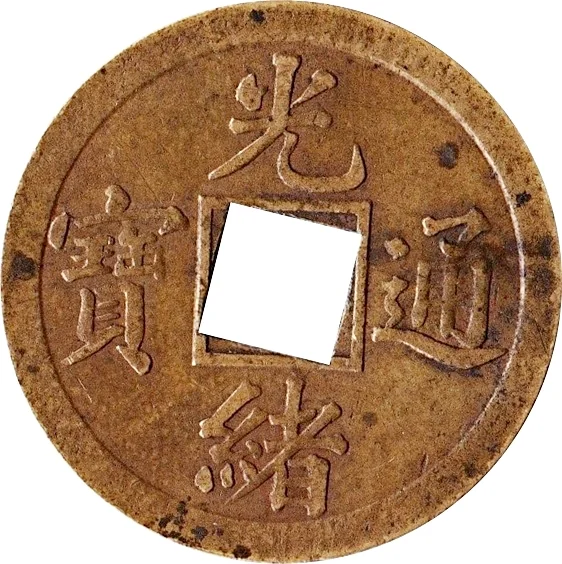
Obverse
Description:
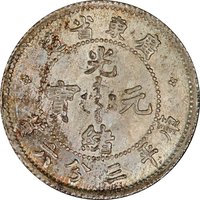
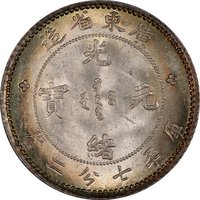
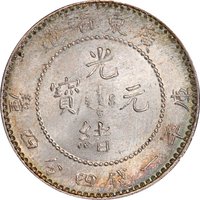
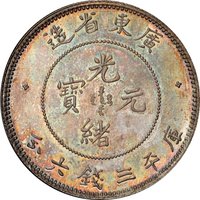
Four Chinese characters read vertically, right to left.
Inscription:
光
寶 通
緒
寶 通
緒
Translation:
Guangxu
Tong Bao
Tong Bao
Scripts: Chinese (traditional, regular script)
Language: Chinese
Reverse
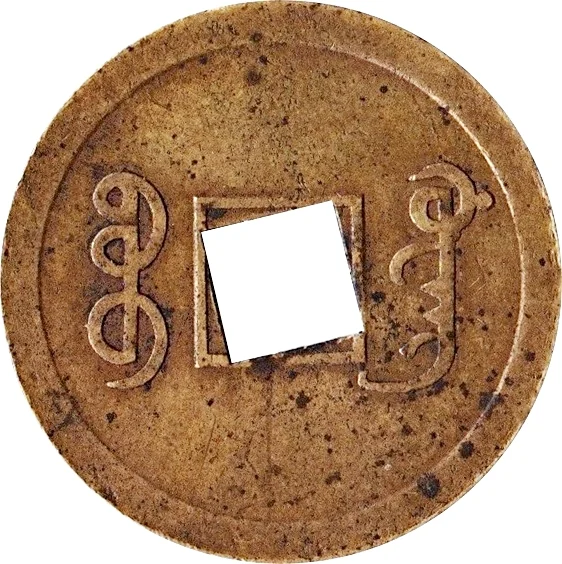
Description:
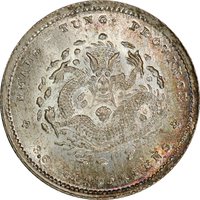
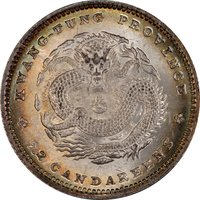
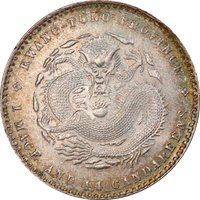
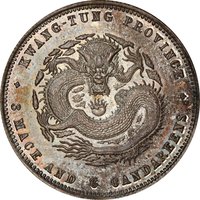
Two Manchu words flank the hole.
Inscription:
ᠪᠣᠣ ᡤᡠᠸᠠᠩ
Translation:
By the grace of Buddha.
Script: Mongolian / Manchu
Language: Manchu
Edge
Plain
Mints
| Name | Mark |
|---|---|
| Guangdong Mint, Guangzhou Branch | — |
Mintings
| Year | Mint Mark | Mintage | Quality | Collection |
|---|---|---|---|---|
| — | — | — |
Historical background
In 1890, Kwangtung (modern Guangdong) Province existed within a complex and fragmented monetary system, typical of late Qing China but intensified by the region's unique economic profile. The official currency was the silver tael, a unit of weight rather than a coin, leading to countless local variants like the Canton Tael used in provincial finance. Concurrently, Spanish and Mexican silver dollars, known as "Carolus" and "Eagle" dollars, circulated widely due to the province's centuries-old foreign trade. These coins were often chopped with merchant marks to verify purity, and their value fluctuated against the tael. The imperial government also minted copper cash coins for daily small transactions, but their exchange rate with silver was unstable, causing hardship for the peasantry.
This multi-currency environment created significant commercial friction and opportunities for arbitrage. The provincial economy, driven by the massive export of tea, silk, and ceramics through Canton (Guangzhou) and the growing port of Hong Kong (a British colony), was deeply integrated into international silver flows. Furthermore, the remittances sent home by Kwangtung's vast diaspora in Southeast Asia and North America, known as qiaoxiang, injected additional foreign silver, complicating the local money supply. This period also saw the early, limited circulation of foreign banknotes from British institutions like the Hongkong and Shanghai Banking Corporation (HSBC), which operated in the treaty ports, introducing yet another layer to the monetary landscape.
The Qing court recognized the disorder caused by this system and had begun discussions about standardization, but in 1890, no unified policy had taken hold in Kwangtung. The province's monetary reality was one of localized calculation and constant exchange, managed by native banks (qianzhuang) and merchant guilds. This situation would soon face greater pressure as the decline in the global price of silver accelerated, and the imperial government moved toward the eventual, though turbulent, creation of a national silver dollar in the late 1890s, a reform that would first take root in commercially advanced regions like Kwangtung.
This multi-currency environment created significant commercial friction and opportunities for arbitrage. The provincial economy, driven by the massive export of tea, silk, and ceramics through Canton (Guangzhou) and the growing port of Hong Kong (a British colony), was deeply integrated into international silver flows. Furthermore, the remittances sent home by Kwangtung's vast diaspora in Southeast Asia and North America, known as qiaoxiang, injected additional foreign silver, complicating the local money supply. This period also saw the early, limited circulation of foreign banknotes from British institutions like the Hongkong and Shanghai Banking Corporation (HSBC), which operated in the treaty ports, introducing yet another layer to the monetary landscape.
The Qing court recognized the disorder caused by this system and had begun discussions about standardization, but in 1890, no unified policy had taken hold in Kwangtung. The province's monetary reality was one of localized calculation and constant exchange, managed by native banks (qianzhuang) and merchant guilds. This situation would soon face greater pressure as the decline in the global price of silver accelerated, and the imperial government moved toward the eventual, though turbulent, creation of a national silver dollar in the late 1890s, a reform that would first take root in commercially advanced regions like Kwangtung.
🌱 Common