

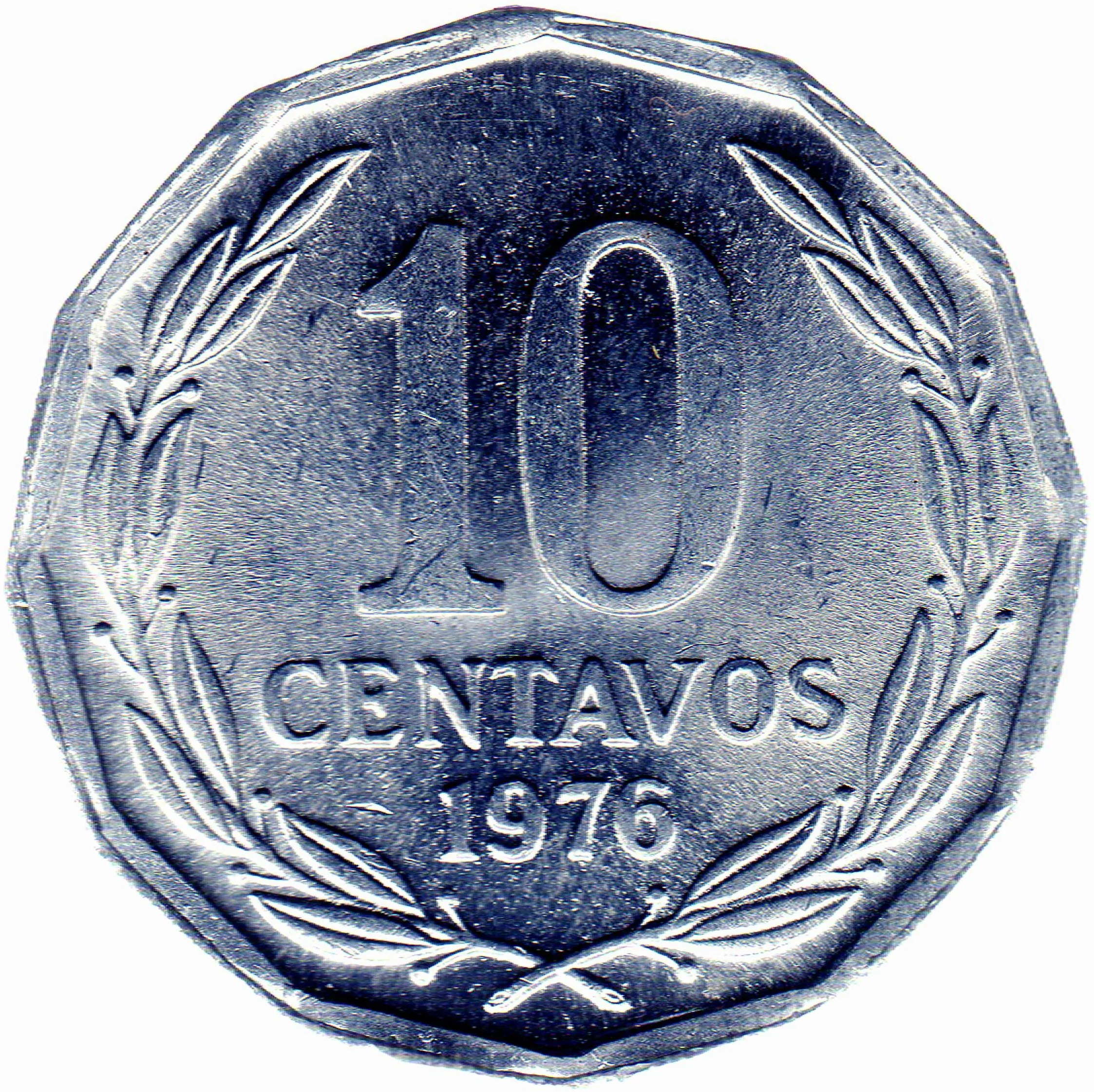
10 centavos – Chile
Add to wishlist
Chile
Context
Material
Diameter: 23 mm
Weight: 2 g
Thickness: 1.8 mm
Shape: Dodecagonal
Composition: 99.5% Aluminium
Magnetic: No
Technique: Milled
Alignment: Coin alignment
flip
References
KM: #
Numista: #6814
Value
Exchange value: 0.10 CLP
Inflation-adjusted value: 57.16 CLP
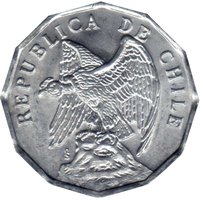
Obverse
Description:
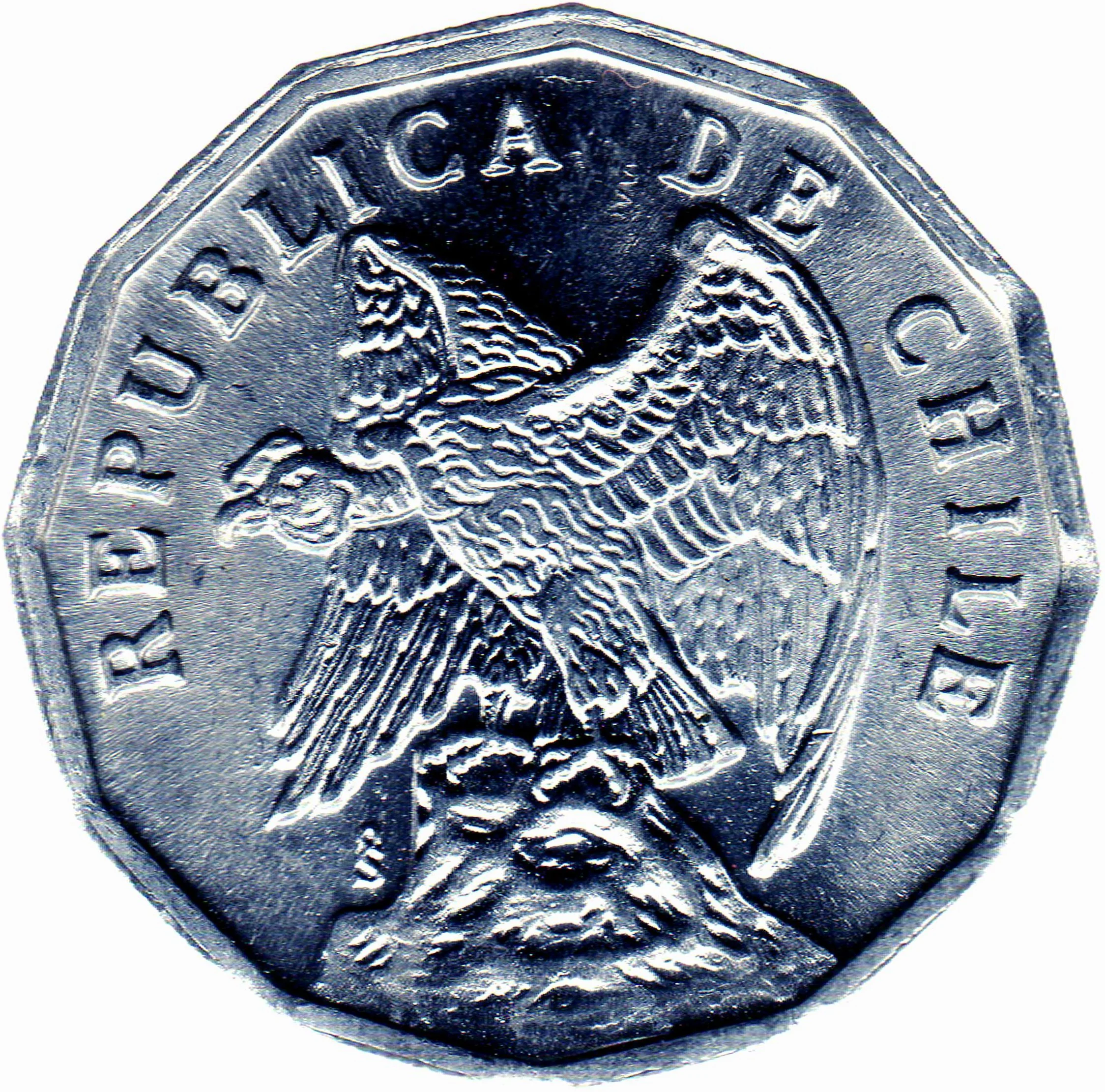
Andean condor perched.
Inscription:
REPUBLICA DE CHILE
So
So
Translation:
REPUBLIC OF CHILE
Script: Latin
Language: Spanish
Engraver: Louis-Oscar Roty
Reverse
Edge
Plain
Mints
| Name | Mark |
|---|---|
| Casa de Moneda de Chile | (So) |
Mintings
| Year | Mint Mark | Mintage | Quality | Collection |
|---|---|---|---|---|
| 1976 | So | 6,600,000 | ||
| 1977 | So | 57,800,000 | ||
| 1978 | So | 58,050,000 | ||
| 1979 | So | 101,950,000 |
Historical background
In 1976, Chile was in the midst of a profound economic transformation under the military dictatorship of General Augusto Pinochet. The government, advised by a group of free-market economists known as the "Chicago Boys," had implemented a radical shock therapy program to combat the hyperinflation and economic chaos inherited from the previous Allende administration. A central pillar of this policy was a fixed exchange rate, established in 1975, which pegged the Chilean peso to the US dollar at a rate of 6.4 to 1. This "tablita cambiaria" was intended to provide stability, anchor inflation expectations, and force fiscal discipline.
However, by 1976, the fixed exchange rate was creating significant distortions. While inflation had fallen dramatically from over 600% in 1973, it remained stubbornly high at around 200%, far exceeding international rates. This meant the peso was becoming severely overvalued in real terms, as domestic prices rose faster than the fixed nominal exchange rate could adjust. The overvaluation made Chilean exports expensive and imports artificially cheap, leading to a growing trade deficit and putting immense pressure on the country's foreign reserves as the Central Bank intervened to maintain the peg.
The situation in 1976 was therefore one of precarious and unsustainable stability. The currency regime was successful in taming hyperinflation and establishing a new economic paradigm, but it was storing up problems for the future. The growing imbalances would eventually force a series of painful devaluations starting in late 1976 and culminating in a major economic crisis in 1982, when the peso was finally floated. Thus, 1976 represents a critical midpoint—a year where the immediate benefits of the fixed exchange rate were still visible, but its fundamental flaws were becoming increasingly apparent to economists and policymakers.
However, by 1976, the fixed exchange rate was creating significant distortions. While inflation had fallen dramatically from over 600% in 1973, it remained stubbornly high at around 200%, far exceeding international rates. This meant the peso was becoming severely overvalued in real terms, as domestic prices rose faster than the fixed nominal exchange rate could adjust. The overvaluation made Chilean exports expensive and imports artificially cheap, leading to a growing trade deficit and putting immense pressure on the country's foreign reserves as the Central Bank intervened to maintain the peg.
The situation in 1976 was therefore one of precarious and unsustainable stability. The currency regime was successful in taming hyperinflation and establishing a new economic paradigm, but it was storing up problems for the future. The growing imbalances would eventually force a series of painful devaluations starting in late 1976 and culminating in a major economic crisis in 1982, when the peso was finally floated. Thus, 1976 represents a critical midpoint—a year where the immediate benefits of the fixed exchange rate were still visible, but its fundamental flaws were becoming increasingly apparent to economists and policymakers.
Series: 1976 Chile circulation coins
🌱 Very Common