

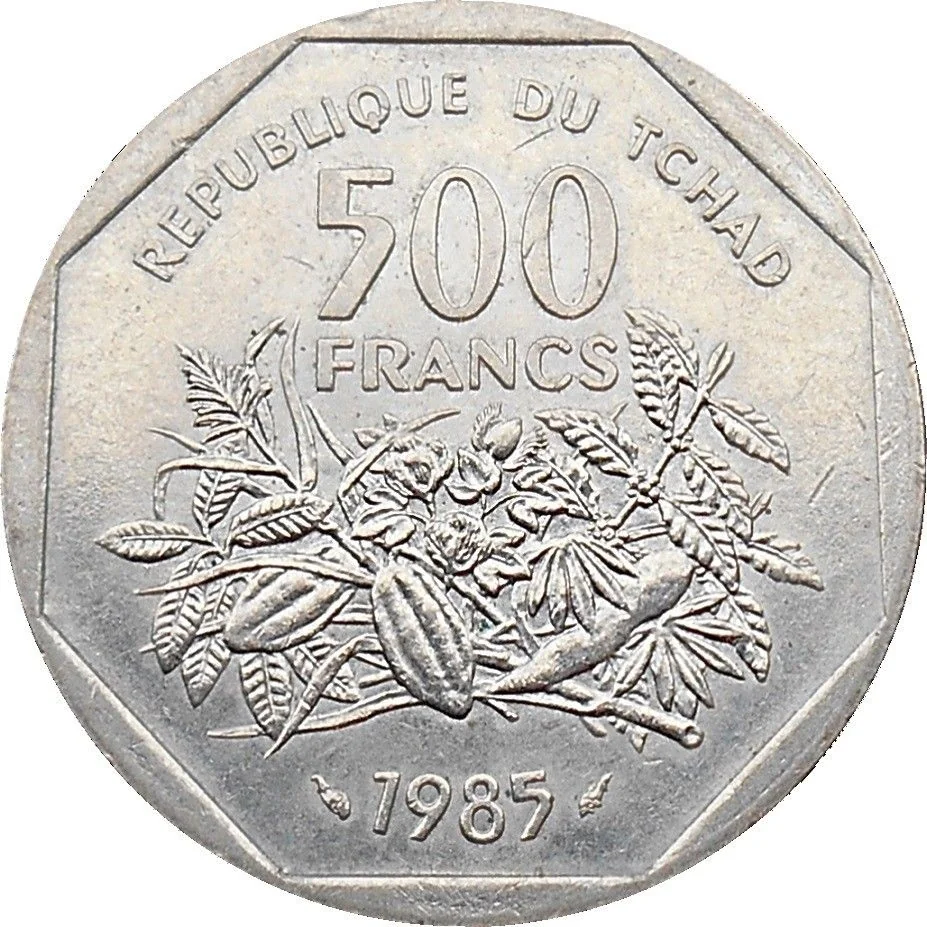
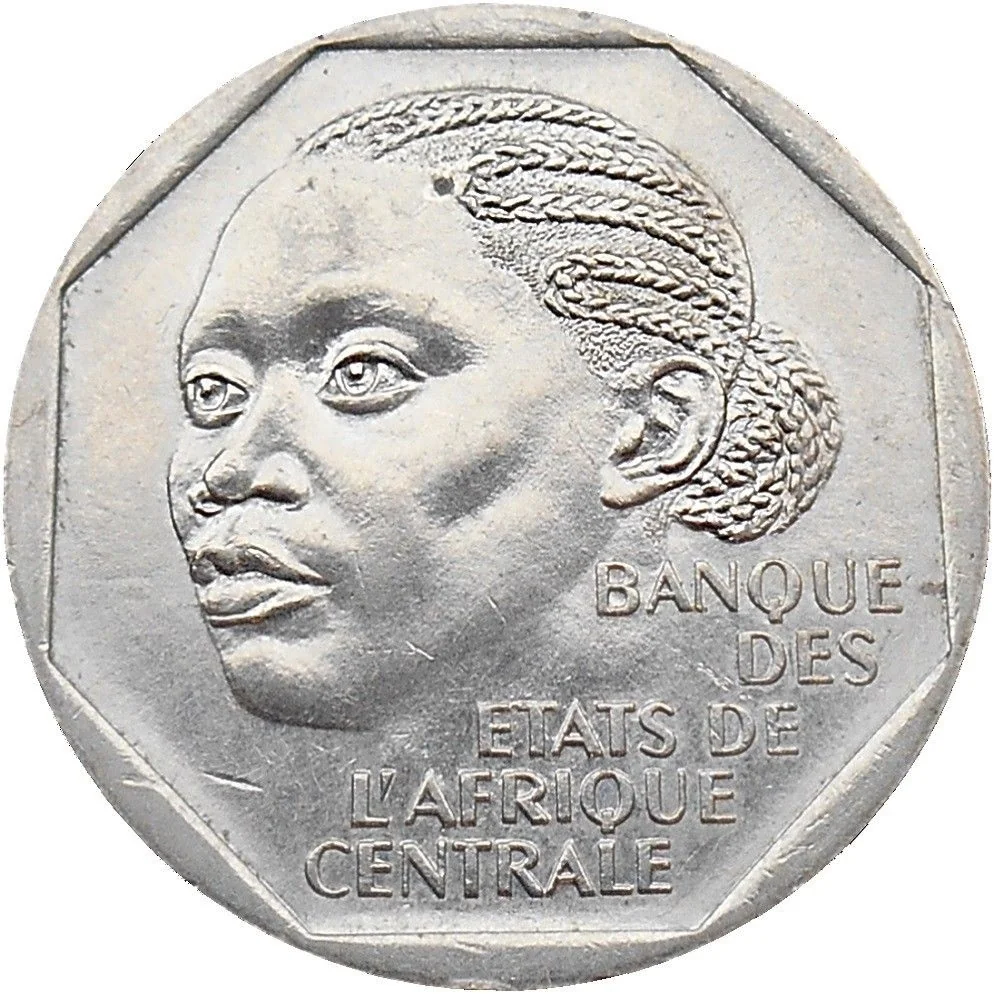
500 francs cfa – Chad
Add to wishlist
Chad
Context
Year: 1985
Issuer: Chad
Issuing organization: Central Bank of Equatorial African States and Cameroon
Period:
(since 1960)
Currency:
(since 1973)
Total mintage: 5,000,000
Material
Diameter: 30 mm
Weight: 11 g
Thickness: 2 mm
Shape: Round
Composition: Copper-nickel
Technique: Milled
Alignment: Coin alignment
flip
References
KM: #
Numista: #6807
Value
Exchange value: 500 XAF
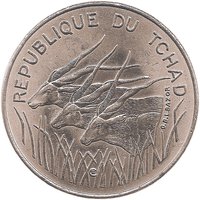
Obverse
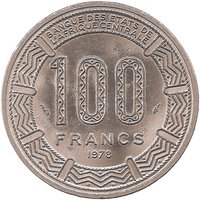
Reverse
Edge
Plain
Mints
| Name | Mark |
|---|---|
| Monnaie de Paris | — |
Mintings
| Year | Mint Mark | Mintage | Quality | Collection |
|---|---|---|---|---|
| 1985 | — | 5,000,000 |
Historical background
In 1985, Chad's currency situation was intrinsically linked to its ongoing civil war and the nation's deep economic fragility. The country was divided, with the northern regions under the control of the GUNT (Transitional Government of National Unity) rebels and the south governed by the French-backed administration of President Hissène Habré in N'Djamena. This political fracture directly impacted the monetary system, as the rebel-held areas operated outside the control of the Banque des États de l'Afrique Centrale (BEAC), the central bank for the six-member Central African CFA franc zone to which Chad belonged. The CFA franc (XAF), pegged to the French franc, remained the official currency, but its effective circulation and authority were severely limited by the conflict.
Economically, Chad was one of the world's least developed nations, with its formal economy crippled by years of warfare. The country's primary export, cotton, was disrupted, and infrastructure was destroyed. While the fixed exchange rate of the CFA franc provided nominal stability in government-held zones, it did not translate to broad economic health. Inflationary pressures were present due to scarcity of goods, and the government's reliance on foreign aid (particularly from France and the United States, who saw Habré as a bulwark against Libyan influence) was essential to maintain any semblance of fiscal operation. The informal economy and barter thrived where the formal monetary system could not.
Thus, the currency "situation" was less about a devaluation or monetary policy shift and more about the severely constrained functionality of the existing system. The CFA franc's stability was an institutional fact in the capital, but its reach was minimal. The real financial picture was characterized by a fragmented territory, a reliance on external financial support for the state, and a vast subsistence and informal economy where national currency competed with alternative means of exchange, all set against a backdrop of profound instability and human suffering.
Economically, Chad was one of the world's least developed nations, with its formal economy crippled by years of warfare. The country's primary export, cotton, was disrupted, and infrastructure was destroyed. While the fixed exchange rate of the CFA franc provided nominal stability in government-held zones, it did not translate to broad economic health. Inflationary pressures were present due to scarcity of goods, and the government's reliance on foreign aid (particularly from France and the United States, who saw Habré as a bulwark against Libyan influence) was essential to maintain any semblance of fiscal operation. The informal economy and barter thrived where the formal monetary system could not.
Thus, the currency "situation" was less about a devaluation or monetary policy shift and more about the severely constrained functionality of the existing system. The CFA franc's stability was an institutional fact in the capital, but its reach was minimal. The real financial picture was characterized by a fragmented territory, a reliance on external financial support for the state, and a vast subsistence and informal economy where national currency competed with alternative means of exchange, all set against a backdrop of profound instability and human suffering.
🌱 Common