

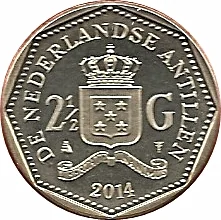
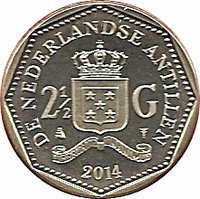
2½ Gulden – Netherlands Antilles
Netherlands
Context
Years: 2014–2016
Country: Netherlands 
Issuer: Netherlands Antilles
Ruler: Willem-Alexander
Currency:
(since 1828)
Demonetization: 31 March 2025
Total mintage: 4,500
Material
References
KM: #Click to copy to clipboard92
Numista: #68063
Value
Exchange value: 2.5 ANG
Inflation-adjusted value: 3.28 ANG
Obverse
Description:
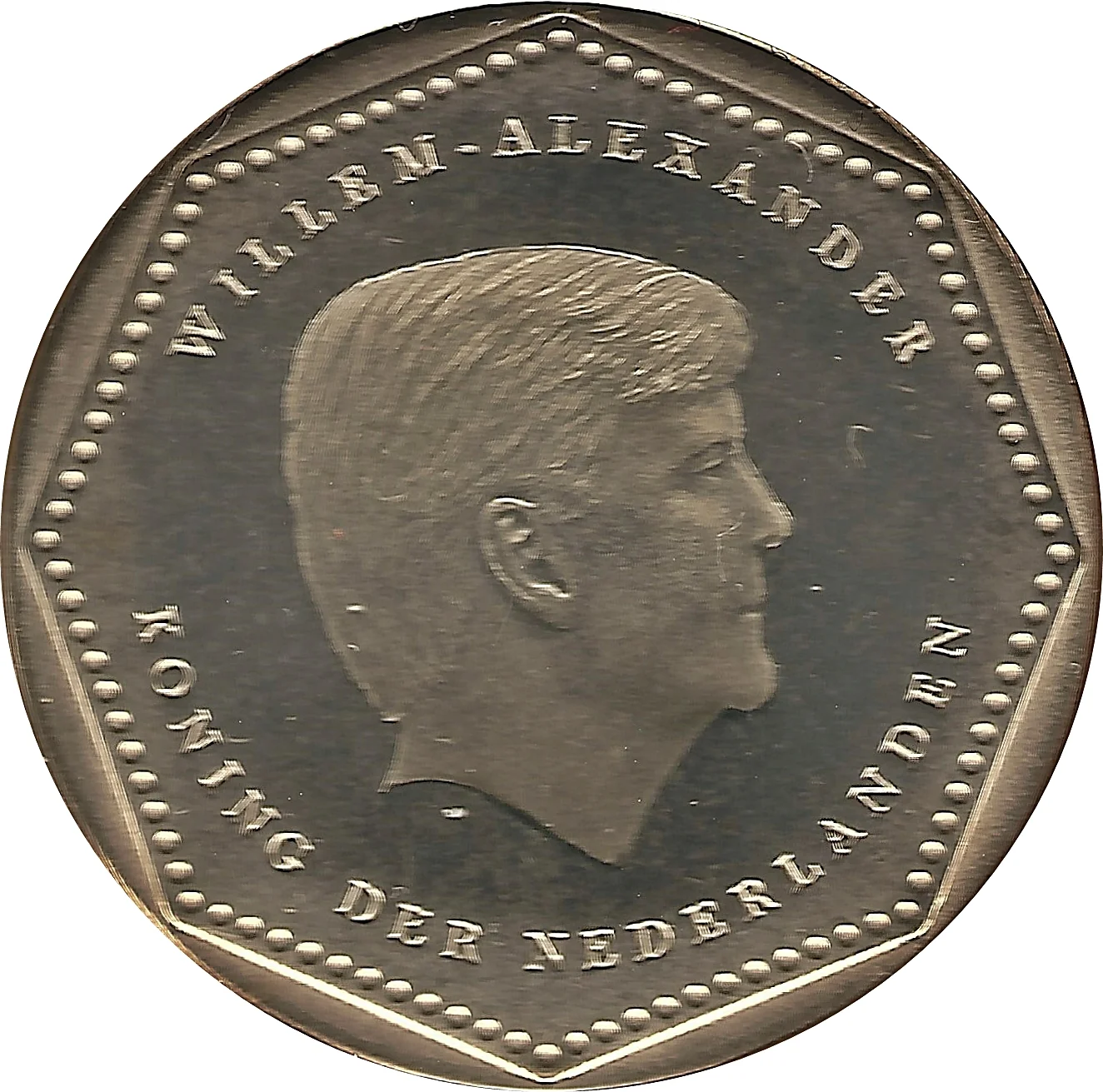
King Willem-Alexander in an octagon.
Inscription:
WILLEM-ALEXANDER
KONING DER NEDERLANDEN
KONING DER NEDERLANDEN
Translation:
WILLEM-ALEXANDER
KING OF THE NETHERLANDS
KING OF THE NETHERLANDS
Script: Latin
Language: Dutch
Designer: Juan Sanchez-Castano
Reverse
Edge
Categories
| Symbol> Crown |
| Symbols> Coat of Arms |
Mints
| Name | Mark |
|---|---|
| Royal Dutch Mint | — |
Mintings
| Year | Mint Mark | Mintage | Quality | Collection |
|---|---|---|---|---|
| 2014 | — | 1,500 | BU | |
| 2015 | — | 1,500 | BU | |
| 2016 | — | 1,500 | BU |
Historical background
In 2014, the currency situation in the Netherlands Antilles was defined by a period of transition and duality, stemming from the political dissolution of the country a few years prior. The Netherlands Antilles as a unified entity was dissolved in October 2010, leading to the creation of two new constituent countries within the Kingdom of the Netherlands: Curaçao and Sint Maarten. However, the currency union established under the former federation remained intact. Consequently, both new countries, along with the three special municipalities of Bonaire, Sint Eustatius, and Saba (collectively known as the BES islands), continued to use the Netherlands Antillean guilder (ANG) as their official currency, which was pegged to the US dollar at a fixed rate of 1.79 ANG to 1 USD.
This arrangement, however, was always intended to be temporary. A key development in 2014 was the active preparation for Curaçao and Sint Maarten to introduce their own new currencies, as mandated by their new constitutional status. The Centrale Bank van Curaçao en Sint Maarten (CBCS), which succeeded the Bank of the Netherlands Antilles, was tasked with overseeing this complex monetary transition. The plan involved replacing the Antillean guilder with the Caribbean guilder for Curaçao and with another, then-unnamed, currency for Sint Maarten, though these changes were subject to significant delays and logistical challenges.
Meanwhile, a different currency reality had already taken hold for the BES islands (Bonaire, Sint Eustatius, and Saba). Since 2011, these islands had adopted the US dollar as their official legal tender, fully replacing the Antillean guilder. Therefore, by 2014, the legacy currency of the Netherlands Antilles was circulating in two countries (Curaçao and Sint Maarten) while having been completely phased out in the three BES municipalities, creating a fragmented monetary landscape across the region that reflected its new political boundaries.
This arrangement, however, was always intended to be temporary. A key development in 2014 was the active preparation for Curaçao and Sint Maarten to introduce their own new currencies, as mandated by their new constitutional status. The Centrale Bank van Curaçao en Sint Maarten (CBCS), which succeeded the Bank of the Netherlands Antilles, was tasked with overseeing this complex monetary transition. The plan involved replacing the Antillean guilder with the Caribbean guilder for Curaçao and with another, then-unnamed, currency for Sint Maarten, though these changes were subject to significant delays and logistical challenges.
Meanwhile, a different currency reality had already taken hold for the BES islands (Bonaire, Sint Eustatius, and Saba). Since 2011, these islands had adopted the US dollar as their official legal tender, fully replacing the Antillean guilder. Therefore, by 2014, the legacy currency of the Netherlands Antilles was circulating in two countries (Curaçao and Sint Maarten) while having been completely phased out in the three BES municipalities, creating a fragmented monetary landscape across the region that reflected its new political boundaries.

⭐ Rare