

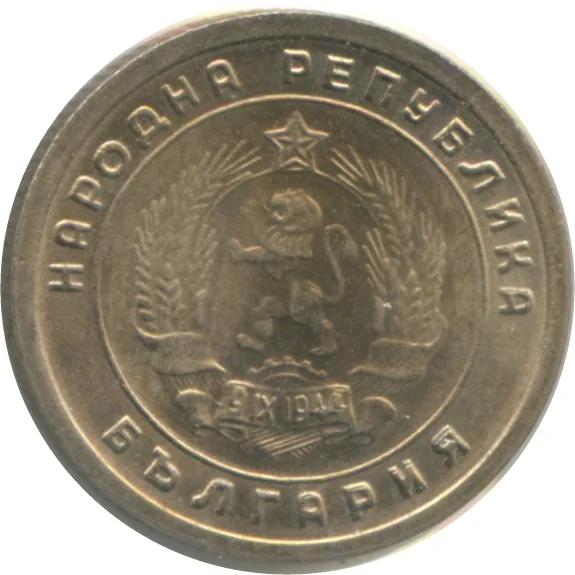
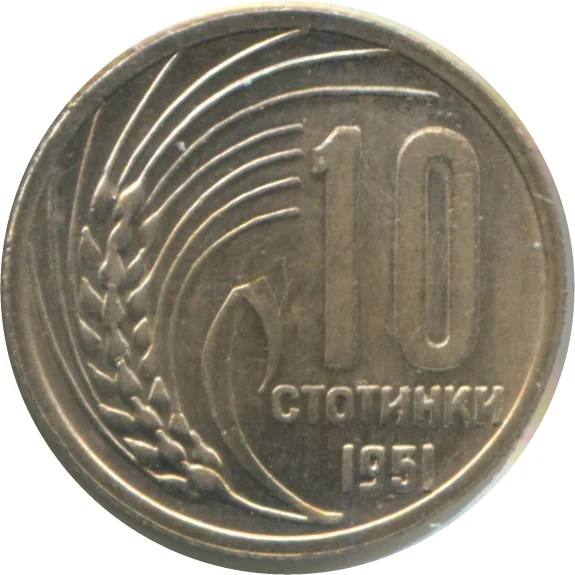
10 stotinki – Bulgaria
Add to wishlist
Bulgaria
Context
Year: 1951
Issuer: Bulgaria
Period:
(1946—1990)
Currency:
(1952—1962)
Demonetization: 1 January 1962
Material
Diameter: 17 mm
Weight: 1.8 g
Thickness: 1 mm
Shape: Round
Composition: Copper-nickel
Technique: Milled
Alignment: Medal alignment
flip
References
KM: #
Numista: #6803
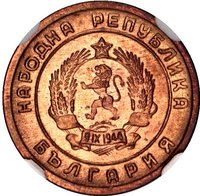
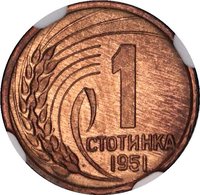
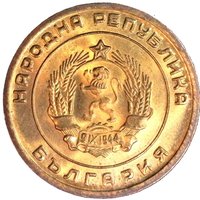
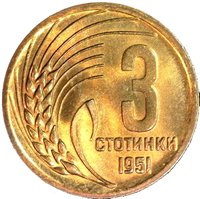
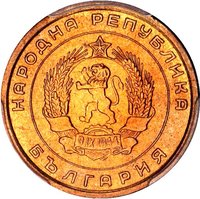
Obverse
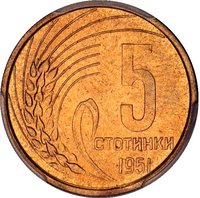
Reverse
Edge
Reeded
Mints
| Name | Mark |
|---|---|
| Saint Petersburg | — |
Mintings
| Year | Mint Mark | Mintage | Quality | Collection |
|---|---|---|---|---|
| 1951 | — | — |
Historical background
In 1951, Bulgaria's currency situation was firmly under the control of the communist regime, which had consolidated power after World War II. The national currency, the lev, was managed as a tool of the centrally planned economy rather than a market instrument. A complex multi-tiered exchange rate system was in place, with separate rates for government accounting, foreign trade with socialist bloc countries, and limited transactions with the West. This system aimed to isolate the domestic economy from global markets, suppress inflation administratively, and direct all financial flows according to the state plan.
The period was characterized by a severe lack of convertible foreign currency (hard currency) like US dollars, as Bulgaria's exports, primarily agricultural goods and some industrial products, generated limited Western currency. What little hard currency existed was hoarded and allocated by the state to priority imports, such as strategic machinery or goods not available within the Eastern Bloc. For ordinary citizens, access to foreign currency was virtually non-existent, and holding it was illegal without authorization, carrying severe penalties.
Internally, while the official currency was stable in terms of printed value, this masked underlying economic distortions. The state used price controls and subsidies on essential goods to maintain an illusion of stability, but this often led to shortages and a vibrant black market where the lev traded for goods and services at a significant de facto devaluation. Thus, in 1951, Bulgaria's currency reflected a closed, state-commanded system designed for control and ideological alignment with the Soviet Union, rather than for economic efficiency or integration with the global financial system.
The period was characterized by a severe lack of convertible foreign currency (hard currency) like US dollars, as Bulgaria's exports, primarily agricultural goods and some industrial products, generated limited Western currency. What little hard currency existed was hoarded and allocated by the state to priority imports, such as strategic machinery or goods not available within the Eastern Bloc. For ordinary citizens, access to foreign currency was virtually non-existent, and holding it was illegal without authorization, carrying severe penalties.
Internally, while the official currency was stable in terms of printed value, this masked underlying economic distortions. The state used price controls and subsidies on essential goods to maintain an illusion of stability, but this often led to shortages and a vibrant black market where the lev traded for goods and services at a significant de facto devaluation. Thus, in 1951, Bulgaria's currency reflected a closed, state-commanded system designed for control and ideological alignment with the Soviet Union, rather than for economic efficiency or integration with the global financial system.
Series: 1951 Bulgaria circulation coins
🌱 Very Common