

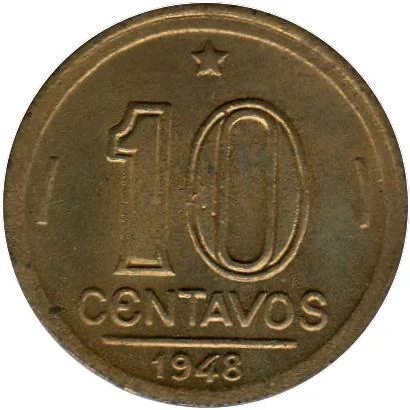
10 centavos – Brazil
Add to wishlist
Brazil
Obverse
Description:
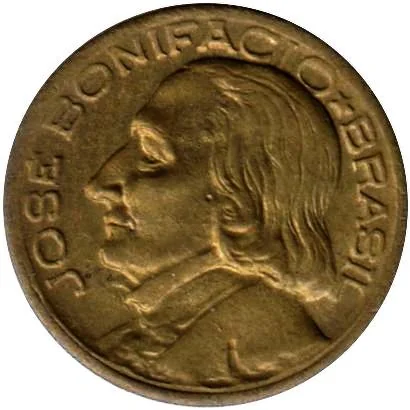
Portrait of José Bonifácio de Andrada e Silva (1763-1838) facing left.
Inscription:
JOSÉ BONIFÁCIO * BRASIL
Translation:
José Bonifácio * Brazil
Script: Latin
Language: Portuguese
Reverse
Edge
Plain
Categories
| Person> Politician |
Mints
| Name | Mark |
|---|---|
| Casa da Moeda do Brasil | — |
Mintings
| Year | Mint Mark | Mintage | Quality | Collection |
|---|---|---|---|---|
| 1947 | — | 20,664,000 | ||
| 1948 | — | 45,041,000 | ||
| 1949 | — | 21,763,000 | ||
| 1950 | — | 16,329,999 | ||
| 1951 | — | 15,561,000 | ||
| 1952 | — | 10,966,000 | ||
| 1953 | — | 25,883,000 | ||
| 1954 | — | 17,031,000 | ||
| 1955 | — | 25,172,000 |
Historical background
In 1947, Brazil's currency situation was characterized by severe inflationary pressures and a complex system of exchange controls, a legacy of the Estado Novo period and the economic disruptions of World War II. The primary currency was the Brazilian cruzeiro (Cr$), introduced in 1942 to replace the old réis. However, the government, under President Eurico Gaspar Dutra, maintained a policy of multiple exchange rates—a system where different types of transactions (e.g., for coffee exports, essential imports, or financial operations) had access to different, artificially set dollar-to-cruzeiro rates. This created a distorted and bureaucratic economic environment.
The core problem was a profound imbalance: high demand for imported goods and machinery for post-war industrialization collided with insufficient U.S. dollar reserves. Brazil's main source of dollars was its coffee exports, but this income could not cover the nation's import appetite. Consequently, the government was forced to draw down the substantial foreign exchange reserves accumulated during the war, which fell from over $700 million in 1945 to under $300 million by 1947. This rapid depletion triggered a balance of payments crisis and forced a tightening of import licenses and exchange controls to conserve hard currency.
The immediate outcome was a significant de facto devaluation and the acceleration of inflation, which reached approximately 7% in 1947—a high figure for the era that signaled deeper structural issues. The Dutra administration's adherence to orthodox, pro-U.S. economic policies prevented a formal maxi-devaluation, but the currency distortions and reliance on controls set the stage for the persistent inflationary struggles and debates over developmentalism that would dominate Brazilian economic policy for the next several decades.
The core problem was a profound imbalance: high demand for imported goods and machinery for post-war industrialization collided with insufficient U.S. dollar reserves. Brazil's main source of dollars was its coffee exports, but this income could not cover the nation's import appetite. Consequently, the government was forced to draw down the substantial foreign exchange reserves accumulated during the war, which fell from over $700 million in 1945 to under $300 million by 1947. This rapid depletion triggered a balance of payments crisis and forced a tightening of import licenses and exchange controls to conserve hard currency.
The immediate outcome was a significant de facto devaluation and the acceleration of inflation, which reached approximately 7% in 1947—a high figure for the era that signaled deeper structural issues. The Dutra administration's adherence to orthodox, pro-U.S. economic policies prevented a formal maxi-devaluation, but the currency distortions and reliance on controls set the stage for the persistent inflationary struggles and debates over developmentalism that would dominate Brazilian economic policy for the next several decades.
🌱 Very Common