

100 Francs – Morocco
Morocco
Context
Year: 1951
Islamic (Hijri) Year: 1370
Issuer: Morocco 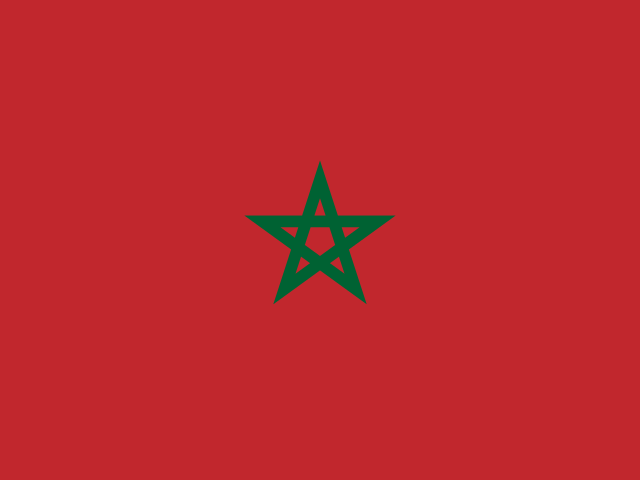
Ruler: Mohammed V
Currency:
(1910—1959)
Demonetized: Yes
Total mintage: 10,000,000
Material
References
Y: #Click to copy to clipboardA54
Numista: #11210
Value
Bullion value: $5.12
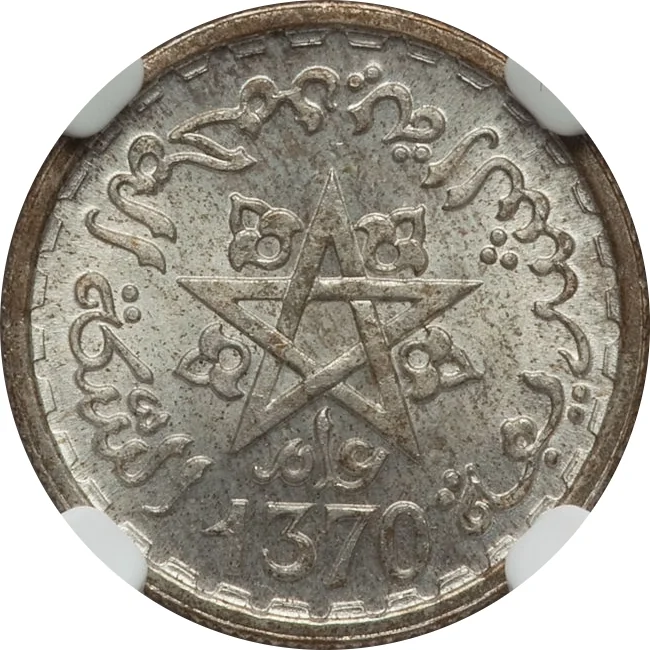
Obverse
Description:
Km 49/50: 100 Francs
Inscription:
السكة المحمدية الشريفة
عام
1370
عام
1370
Translation:
The Noble Muhammadan Coinage
Year
1370
Year
1370
Language: Arabic
Engraver: J. Hainaut
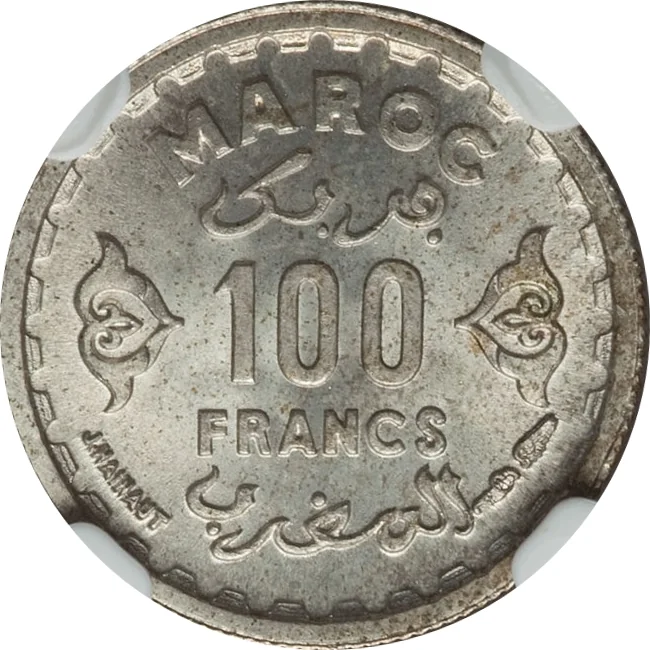
Reverse
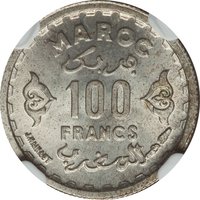
Inscription:
MAROC
فرنك
100
FRANCS
المغرب
J.HAINAUT
فرنك
100
FRANCS
المغرب
J.HAINAUT
Translation:
Morocco
Franc
100
Francs
Morocco
J.HAINAUT
Franc
100
Francs
Morocco
J.HAINAUT
Engraver: J. Hainaut
Edge
Reeded
Mints
| Name | Mark |
|---|---|
| Monnaie de Paris | — |
Mintings
| Year | Mint Mark | Mintage | Quality | Collection |
|---|---|---|---|---|
| 1951 | — | 10,000,000 |
Historical background
In 1951, Morocco's currency situation was a complex reflection of its political status as a French and Spanish protectorate, with the international zone of Tangier adding a third monetary layer. The French franc, issued by Bank Al-Maghrib (a state bank under French control), was the dominant currency in the French zone, circulating alongside a limited issue of Moroccan francs pegged at parity. The Spanish peseta circulated in the northern Spanish protectorate, while the Tangier franc (effectively a hard currency pegged to the French franc but with full convertibility) was used in the International Zone. This fragmentation hindered domestic economic integration and trade.
Economically, the post-World War II period brought inflationary pressures and a growing balance of payments deficit, straining the fixed exchange rate system tied to the French franc. Morocco's economy, heavily oriented towards exporting phosphates and agricultural products to France, was vulnerable to shifts in the French economy and global prices. Furthermore, the colonial monetary system was designed to serve metropolitan interests, channeling Moroccan savings to finance France's post-war reconstruction and limiting Morocco's independent fiscal and monetary policy tools.
This unstable and fragmented currency regime became a point of rising nationalist contention. Moroccan intellectuals and the growing independence movement, the Istiqlal Party, criticized the system as a symbol of economic subjugation and a tool for draining the country's resources. The call for a unified, truly national currency, managed by an independent central bank, became an important element of the broader political demand for sovereignty, which would be realized just a few years later with independence in 1956.
Economically, the post-World War II period brought inflationary pressures and a growing balance of payments deficit, straining the fixed exchange rate system tied to the French franc. Morocco's economy, heavily oriented towards exporting phosphates and agricultural products to France, was vulnerable to shifts in the French economy and global prices. Furthermore, the colonial monetary system was designed to serve metropolitan interests, channeling Moroccan savings to finance France's post-war reconstruction and limiting Morocco's independent fiscal and monetary policy tools.
This unstable and fragmented currency regime became a point of rising nationalist contention. Moroccan intellectuals and the growing independence movement, the Istiqlal Party, criticized the system as a symbol of economic subjugation and a tool for draining the country's resources. The call for a unified, truly national currency, managed by an independent central bank, became an important element of the broader political demand for sovereignty, which would be realized just a few years later with independence in 1956.
💎 Extremely Rare