

½ Mohar – Nepal
Nepal
Context
Years: 1894–1902
Issuer: Nepal 
Ruler: Prithvi Bir Bikram Shah
Currency:
(1546—1932)
Demonetized: Yes
Material
References
KM: #Click to copy to clipboard647
Numista: #67600
Value
Bullion value: $7.56
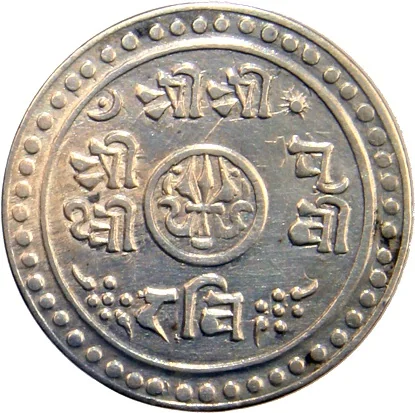
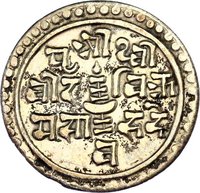
Obverse
Description:
Trishul in a circle. Nagari legend: "Sri Sri Sri Pruthvi Bira Bi."
Inscription:
Sri Sri
Sri Pru
Thvi Bi
Ra Bi
Sri Pru
Thvi Bi
Ra Bi
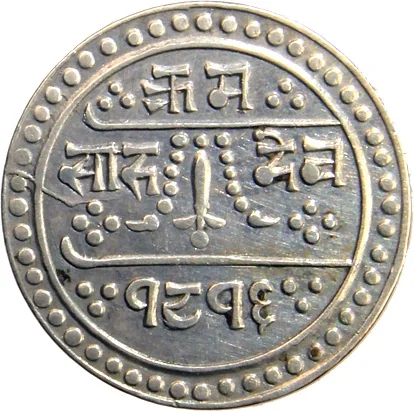
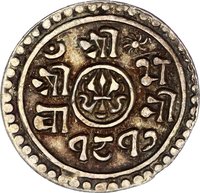
Reverse
Description:
Sword with dotted border, Nagari legend (Krama Shah Deva, 1916).
Inscription:
Kra Ma
Sa Ha De Va
1916
Sa Ha De Va
1916
Edge
Plain
Mintings
| Year | Mint Mark | Mintage | Quality | Collection |
|---|---|---|---|---|
| 1894 | — | — | ||
| 1895 | — | — | ||
| 1902 | — | — |
Historical background
In 1894, Nepal's currency system was a complex and transitional landscape, deeply influenced by its political and economic ties to British India. Officially, the silver Mohar remained the principal coin of the realm, minted by the state under the Shah dynasty. However, the reality was one of monetary duality. The growing integration with the Indian economy, especially through the recruitment of Gurkha soldiers and cross-border trade, had made the Indian Rupee a dominant and preferred medium for larger transactions. This created a de facto bimetallic system where high-value trade was conducted in Indian Rupees, while the Mohar and smaller copper coins served local, everyday commerce.
This period was marked by significant currency manipulation and debasement by the ruling Rana prime ministers, who treated the mint as a source of personal and governmental revenue. Prime Minister Bir Shumsher Jang Bahadur Rana (1885–1901), in power in 1894, was notably engaged in this practice. The government would frequently call in existing coins, remint them with reduced silver content, and profit from the seigniorage. This led to a proliferation of light-weight and substandard Mohars, causing confusion, inflation, and loss of public trust in the domestic currency, further driving the preference for the more stable Indian Rupee.
Consequently, the year 1894 fell within a protracted era of monetary instability that would eventually force a major reform. The chronic debasement and public dissatisfaction culminated, just a few years later, in the historic currency reform of 1903 under Prime Minister Chandra Shumsher. This reform demonetized the old debased coins and introduced a new, standardized silver Nepalese Rupee, pegged at par with the Indian Rupee, finally bringing order to the chaotic monetary system that characterized the late 19th century.
This period was marked by significant currency manipulation and debasement by the ruling Rana prime ministers, who treated the mint as a source of personal and governmental revenue. Prime Minister Bir Shumsher Jang Bahadur Rana (1885–1901), in power in 1894, was notably engaged in this practice. The government would frequently call in existing coins, remint them with reduced silver content, and profit from the seigniorage. This led to a proliferation of light-weight and substandard Mohars, causing confusion, inflation, and loss of public trust in the domestic currency, further driving the preference for the more stable Indian Rupee.
Consequently, the year 1894 fell within a protracted era of monetary instability that would eventually force a major reform. The chronic debasement and public dissatisfaction culminated, just a few years later, in the historic currency reform of 1903 under Prime Minister Chandra Shumsher. This reform demonetized the old debased coins and introduced a new, standardized silver Nepalese Rupee, pegged at par with the Indian Rupee, finally bringing order to the chaotic monetary system that characterized the late 19th century.
💎 Very Rare