

1 Yuan – People's Republic of China
China
Context
Year: 2006
Country: China 
Issuer: People's Republic of China
Period:
(since 1949)
Currency:
(since 1955)
Total mintage: 10,000,000
Material
References
KM: #Click to copy to clipboard1650
Numista: #67550
Value
Exchange value: 1 CNY = $0.15
Inflation-adjusted value: 1.52 CNY
Obverse
Description:
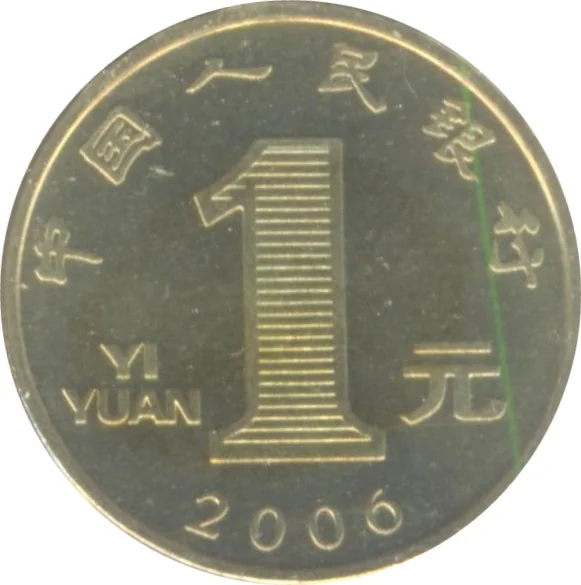
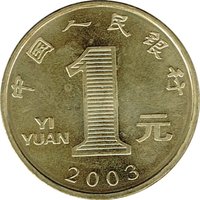
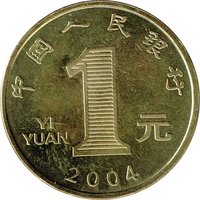
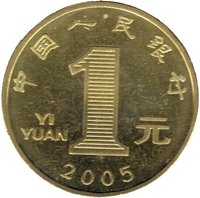
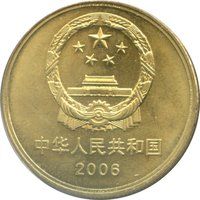
Value, issue year, bank
Inscription:
中国人民银行
YI YUAN 1 元
2006
YI YUAN 1 元
2006
Translation:
The People's Bank of China
One Yuan 1 Yuan
2006
One Yuan 1 Yuan
2006
Scripts: Chinese (simplified), Latin
Language: Chinese
Reverse
Description:
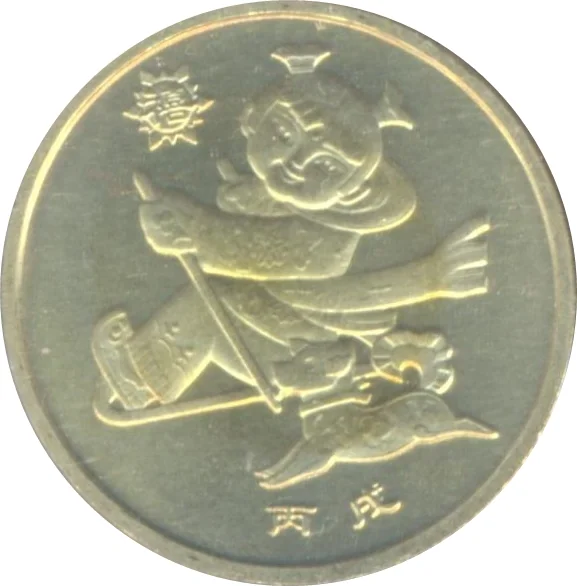
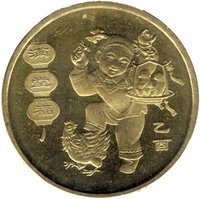
Child sledding with a dog.
Inscription:
禧
丙戌
丙戌
Translation:
Auspicious
Bingxu
Bingxu
Script: Chinese (simplified)
Language: Chinese
Edge
Categories
| Animal> Dog |
| Astrology> Chinese calendar |
Mintings
| Year | Mint Mark | Mintage | Quality | Collection |
|---|---|---|---|---|
| 2006 | — | 10,000,000 |
Historical background
In 2006, the People's Republic of China was navigating a complex currency situation defined by managed reform and mounting international pressure. The cornerstone of this period was the landmark policy shift announced in July 2005, when China moved away from a strict peg to the U.S. dollar and adopted a "managed float" system with reference to a basket of currencies. This revaluation, an initial 2.1% appreciation, was a carefully calibrated response to both domestic economic overheating and persistent foreign (particularly American) calls for a stronger yuan to address global trade imbalances. However, the pace of appreciation throughout 2006 remained gradual and tightly controlled by the People's Bank of China (PBOC), which maintained a narrow daily trading band to prevent volatile capital flows.
Domestically, the currency policy was a key tool for macroeconomic management. A modestly strengthening yuan helped curb imported inflation and made foreign commodities and technology slightly cheaper, supporting industrial upgrading. However, authorities were deeply concerned about the negative impact on China's massive export sector, which was a primary engine for employment and growth. The PBOC faced a significant challenge of "sterilization"—mopping up the vast inflows of foreign exchange from the trade surplus to prevent excessive liquidity from fueling inflation or asset bubbles. This involved issuing central bank bills and raising reserve requirements for commercial banks, operations that were costly but necessary for stability.
Internationally, 2006 saw continued friction, especially with the United States, where lawmakers and manufacturers argued the yuan was still fundamentally undervalued, granting Chinese exports an unfair advantage. While China resisted swift, market-driven appreciation, citing the need for financial system stability and gradual liberalization, its incremental moves were seen as a diplomatic effort to deflect protectionist threats. The year solidified China's dual-track approach: committing to long-term exchange rate flexibility in principle while maintaining decisive state control in practice, ensuring that currency policy served broader strategic goals of development and financial sovereignty above immediate market or foreign political demands.
Domestically, the currency policy was a key tool for macroeconomic management. A modestly strengthening yuan helped curb imported inflation and made foreign commodities and technology slightly cheaper, supporting industrial upgrading. However, authorities were deeply concerned about the negative impact on China's massive export sector, which was a primary engine for employment and growth. The PBOC faced a significant challenge of "sterilization"—mopping up the vast inflows of foreign exchange from the trade surplus to prevent excessive liquidity from fueling inflation or asset bubbles. This involved issuing central bank bills and raising reserve requirements for commercial banks, operations that were costly but necessary for stability.
Internationally, 2006 saw continued friction, especially with the United States, where lawmakers and manufacturers argued the yuan was still fundamentally undervalued, granting Chinese exports an unfair advantage. While China resisted swift, market-driven appreciation, citing the need for financial system stability and gradual liberalization, its incremental moves were seen as a diplomatic effort to deflect protectionist threats. The year solidified China's dual-track approach: committing to long-term exchange rate flexibility in principle while maintaining decisive state control in practice, ensuring that currency policy served broader strategic goals of development and financial sovereignty above immediate market or foreign political demands.
Series: China Lunar Coin



⭐ Somewhat Rare