

10 centimos – Spain
Add to wishlist
Spain
Context
Material
References
KM: #
Numista: #673
Value
Exchange value: 0.10 ESP
Inflation-adjusted value: 5.05 ESP
Obverse
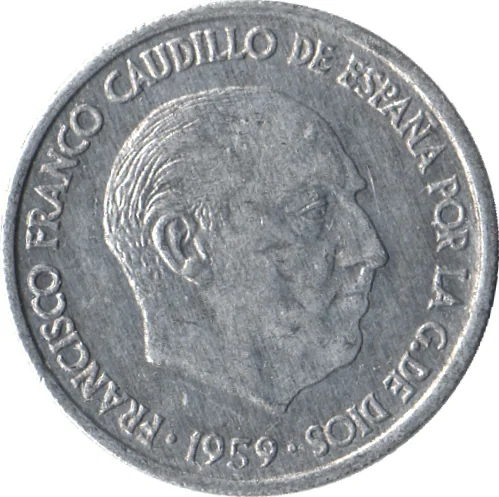
Description:
Franco facing right.
Inscription:
FRANCISCO FRANCO CAUDILLO DE ESPAÑA POR LA G.DE DIOS
1959
1959
Translation:
Francisco Franco, Leader of Spain by the Grace of God
1959
1959
Script: Latin
Language: Spanish
Engraver: Manuel Marín Jimeno
Designer: Mariano Benlliure Gil
Reverse
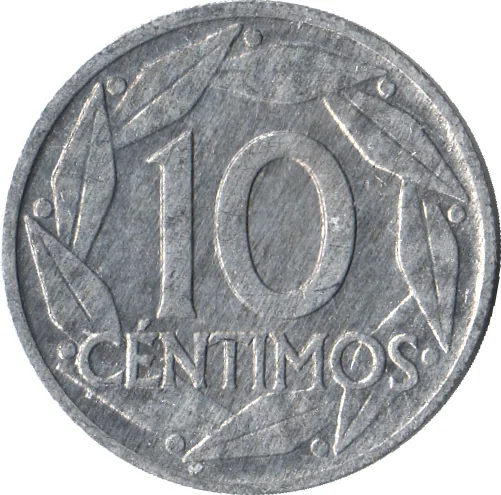
Description:
Face value within a leaf wreath.
Inscription:
10 CÉNTIMOS
Translation:
10 Céntimos
Script: Latin
Language: Spanish
Engraver: Manuel Marín Jimeno
Edge
Reeded
Categories
| Person> Military leader |
| Person> Politician |
| Symbol> Wreath |
Mints
| Name | Mark |
|---|---|
| Royal Mint of Madrid | — |
Mintings
| Year | Mint Mark | Mintage | Quality | Collection |
|---|---|---|---|---|
| 1959 | — | 900,000,000 | ||
| 1959 | — | 101,000 | Proof |
Historical background
By 1959, Spain's economy was in a state of severe crisis, culminating from nearly two decades of the Franco regime's policy of autarky – economic self-sufficiency and isolation. This inward-looking model, characterized by heavy state intervention, import substitution, and strict controls, had led to chronic inefficiencies, rampant inflation, and a critical shortage of foreign currency reserves. The country's industrial and agricultural output was stagnant, living standards were low, and a large balance of payments deficit threatened economic collapse, exposing the complete failure of the autarkic system.
The breaking point was the 1959 Stabilization Plan (Plan de Estabilización), a dramatic policy shift engineered by a new generation of technocrats, often referred to as the "Opus Dei ministers." This plan, developed with crucial advice and conditional loans from the International Monetary Fund and the OECD, marked a decisive turn toward economic liberalization and integration with the West. Its core measures were drastic: a major devaluation of the peseta to boost exports, severe cuts in public spending and credit to curb inflation, and the lifting of many import quotas and foreign investment barriers to attract capital.
The 1959 plan was a watershed moment, effectively ending the era of autarky and setting Spain on a path toward the "Spanish Miracle" of rapid economic growth in the 1960s. The currency devaluation and liberalization unlocked tourism and foreign investment, while the austerity measures, though initially causing a sharp recession, stabilized the peseta and tamed inflation. This painful but necessary restructuring integrated Spain into the global capitalist economy, laying the institutional groundwork for the subsequent industrial boom and the country's eventual economic modernization.
The breaking point was the 1959 Stabilization Plan (Plan de Estabilización), a dramatic policy shift engineered by a new generation of technocrats, often referred to as the "Opus Dei ministers." This plan, developed with crucial advice and conditional loans from the International Monetary Fund and the OECD, marked a decisive turn toward economic liberalization and integration with the West. Its core measures were drastic: a major devaluation of the peseta to boost exports, severe cuts in public spending and credit to curb inflation, and the lifting of many import quotas and foreign investment barriers to attract capital.
The 1959 plan was a watershed moment, effectively ending the era of autarky and setting Spain on a path toward the "Spanish Miracle" of rapid economic growth in the 1960s. The currency devaluation and liberalization unlocked tourism and foreign investment, while the austerity measures, though initially causing a sharp recession, stabilized the peseta and tamed inflation. This painful but necessary restructuring integrated Spain into the global capitalist economy, laying the institutional groundwork for the subsequent industrial boom and the country's eventual economic modernization.
🌱 Very Common