

Spain
Context
Material
References
KM: #Click to copy to clipboard797
Numista: #1885
Value
Exchange value: 100 ESP
Bullion value: $43.21
Inflation-adjusted value: 3314.04 ESP
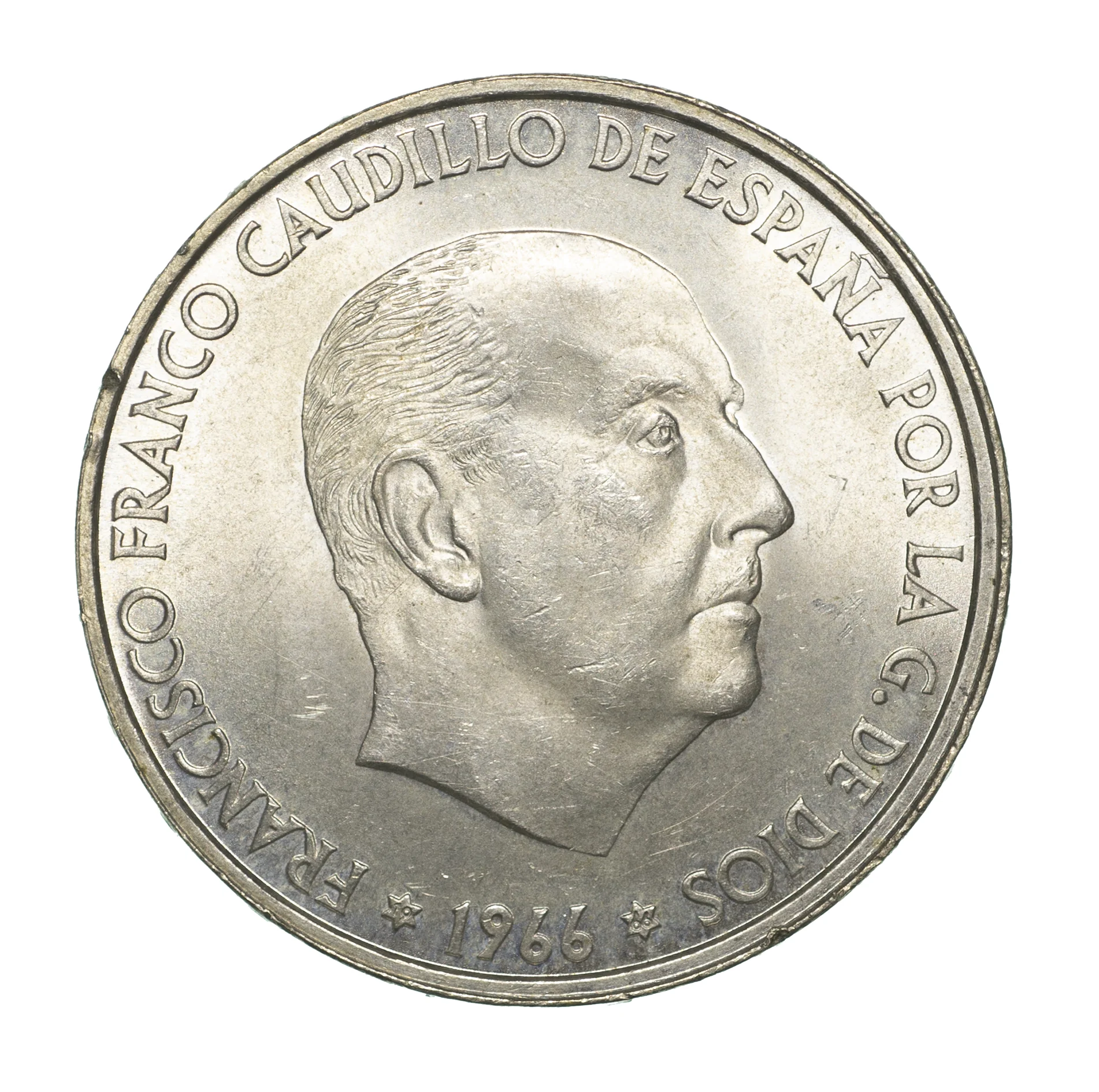
Obverse
Description:
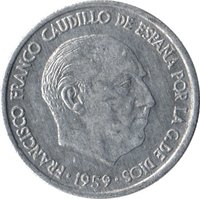
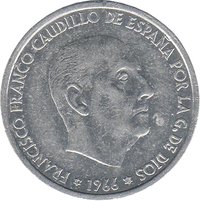
Franco facing right.
Inscription:
FRANCISCO FRANCO CAUDILLO DE ESPAÑA POR LA G. DE DIOS
🟌 1966 🟌
🟌 1966 🟌
Translation:
FRANCISCO FRANCO CAUDILLO OF SPAIN BY THE GRACE OF GOD
🟌 1966 🟌
🟌 1966 🟌
Script: Latin
Language: Spanish
Engraver: Manuel Marín Jimeno
Designer: Juan de Ávalos Taborda
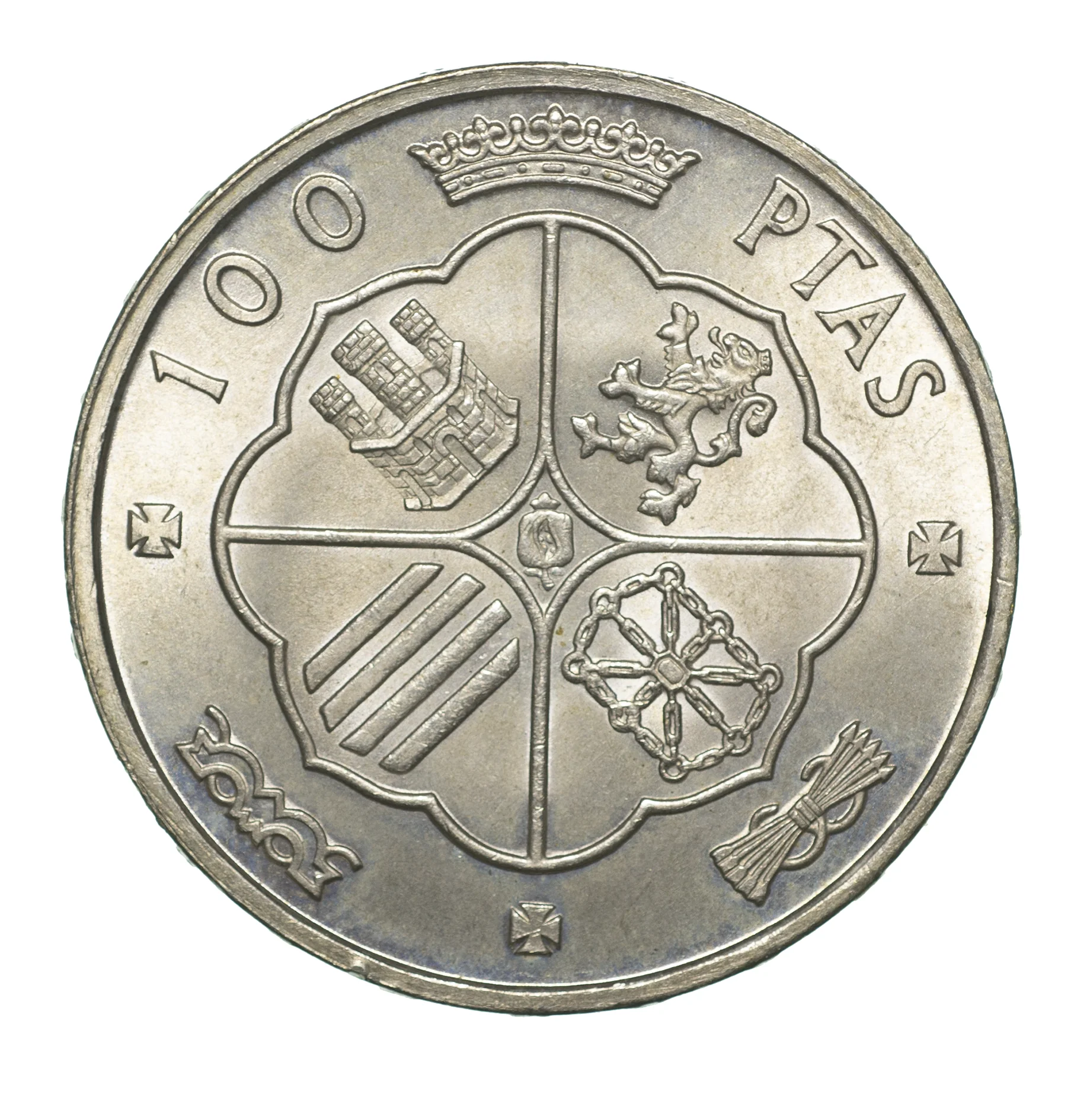
Reverse
Description:
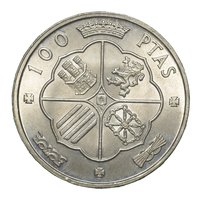
Spanish coat of arms elements (castle, lion, stripes, chains, pomegranate, crown, yoke, arrows) arranged as a flower.
Inscription:
✠ 100 PTAS ✠
✠
✠
Script: Latin
Engraver: Manuel Marín Jimeno
Edge
Embossed lettering
Legend:
🟌 UNA 🟌 🟌 GRANDE 🟌 🟌 LIBRE 🟌
Translation:
One Great Free
Language: Spanish
Categories
| Symbols> Coat of Arms |
| Person> Military leader |
| Person> Politician |
Mints
| Name | Mark |
|---|---|
| Royal Mint of Madrid | (🟌) |
Mintings
| Year | Mint Mark | Mintage | Quality | Collection |
|---|---|---|---|---|
| 1966 | 🟌 | 15,045,000 | ||
| 1967 | — | 15,000,000 | ||
| 1968 | — | 24,000,000 | ||
| 1969 | — | — | ||
| 1970 | — | 995,000 |
Historical background
In 1966, Spain's currency situation was defined by the peseta operating under a tightly controlled and protectionist economic framework established by the Franco dictatorship. The regime maintained a system of multiple exchange rates and strict capital controls, insulating the economy from international market pressures. The official parity was set at 60 pesetas to the US dollar, but this rate was largely symbolic for trade; in practice, a complex web of fixed rates applied to different transaction types (e.g., tourism, essential imports, financial flows). This system aimed to conserve scarce foreign reserves, subsidize key imports, and protect domestic industry, but it also fostered a significant black market for currency where the peseta traded at a substantial discount.
Economically, this period fell within the latter years of Spain's "Spanish Miracle," a phase of rapid industrialization and growth from 1959 to 1974. The 1959 Stabilization Plan had liberalized some aspects of the autarkic model, paving the way for foreign investment and tourism, which became crucial sources of hard currency. However, the currency regime remained fundamentally rigid. The Bank of Spain held exclusive authority over exchange operations, and the peseta was not a convertible currency on international markets. This control allowed the government to manage the balance of payments but created distortions, inefficiencies, and opportunities for arbitrage.
The situation in 1966 was one of underlying tension between a booming, modernizing economy and an increasingly anachronistic financial system. While growth was strong, the rigid exchange controls and multiple rates were seen by technocrats within the regime as obstacles to full integration with the expanding European economy. Pressure for eventual liberalization was building, setting the stage for future reforms. The system would remain largely intact until the 1970s, when economic crises and the political transition to democracy forced a series of devaluations and a move toward a single, more realistic exchange rate.
Economically, this period fell within the latter years of Spain's "Spanish Miracle," a phase of rapid industrialization and growth from 1959 to 1974. The 1959 Stabilization Plan had liberalized some aspects of the autarkic model, paving the way for foreign investment and tourism, which became crucial sources of hard currency. However, the currency regime remained fundamentally rigid. The Bank of Spain held exclusive authority over exchange operations, and the peseta was not a convertible currency on international markets. This control allowed the government to manage the balance of payments but created distortions, inefficiencies, and opportunities for arbitrage.
The situation in 1966 was one of underlying tension between a booming, modernizing economy and an increasingly anachronistic financial system. While growth was strong, the rigid exchange controls and multiple rates were seen by technocrats within the regime as obstacles to full integration with the expanding European economy. Pressure for eventual liberalization was building, setting the stage for future reforms. The system would remain largely intact until the 1970s, when economic crises and the political transition to democracy forced a series of devaluations and a move toward a single, more realistic exchange rate.
🌱 Very Common