

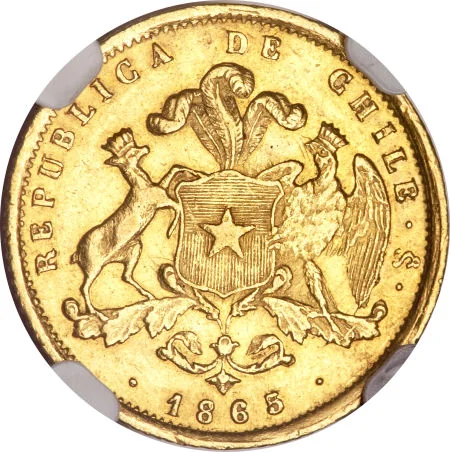
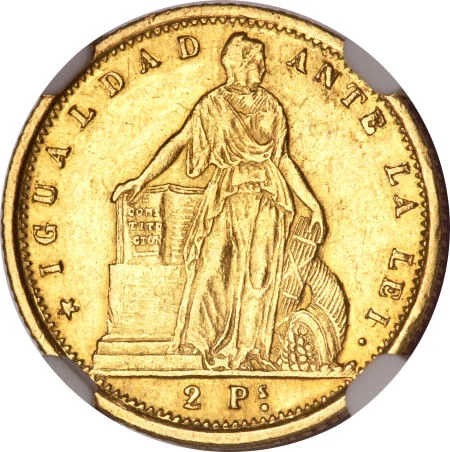
2 Pesos – Chile
Chile
Context

Material
Diameter: 17 mm
Weight: 3.05 g
Gold weight: 2.75 g
Shape: Round
Composition: 90% Gold
Standard: Gold tenth ounce
Magnetic: No
Technique: Milled
Alignment: Coin alignment
flip
References
KM: #Click to copy to clipboard132
Numista: #67169
Value
Bullion value: $457.94
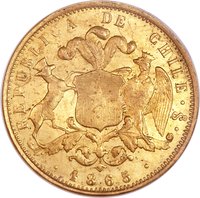
Obverse
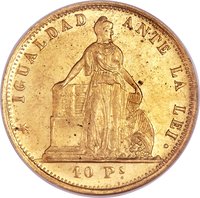
Reverse
Edge
Reeded
Categories
| Symbol> Phrygian cap |
| Symbol> Allegory |
| Symbol> Cornucopia |
Mints
| Name | Mark |
|---|---|
| Casa de Moneda de Chile | (So) |
Mintings
| Year | Mint Mark | Mintage | Quality | Collection |
|---|---|---|---|---|
| 1856 | So | — | ||
| 1857 | So | 207,000 | ||
| 1858 | So | 56,000 | ||
| 1859 | So | 97,000 | ||
| 1860 | So | 78,000 | ||
| 1862 | So | 10,000 | ||
| 1865 | So | — |
Historical background
In 1856, Chile's currency system was a complex and unstable mixture of metallic and paper money, a legacy of the economic policies and mining booms of the early republic. The foundational currency was the peso, defined in silver (peso de plata), but the discovery of rich silver deposits in Chañarcillo (1832) and later gold in California and Australia had flooded the market with precious metals. This influx, while boosting trade, led to significant fluctuations in the relative value of gold and silver, causing practical difficulties for a bimetallic system. Concurrently, the government and private banks, notably the Banco de Valparaíso (established 1849) and the newly chartered Banco de Chile (1855), began issuing paper banknotes (billetes) convertible to metal. This created a dual system where paper circulated alongside gold and silver coinage, often with varying degrees of public trust.
The situation was further complicated by a chronic shortage of small-denomination coinage (moneda menuda) for everyday transactions. To address this, private merchants and mining companies issued their own copper tokens (fichas) as a form of scrip, which circulated widely but erratically, creating a fragmented and unreliable medium for the working class and local commerce. This period also saw the circulation of foreign coins, particularly Peruvian and Bolivian silver, adding another layer of inconsistency to the monetary mass. Consequently, the Chilean economy operated with multiple, unevenly valued currencies, leading to confusion, arbitrage, and frequent disputes over real payment values.
The government of President Manuel Montt (1851-1861) recognized these problems as a major obstacle to national economic integration and modernization. In response, 1856 fell within a critical decade of monetary reform. Efforts were underway to centralize and standardize the system, culminating in the pivotal law of 1857 that established the Caja de Amortización (Amortization Fund). This entity was tasked with managing the public debt and, crucially, guaranteeing the convertibility of banknotes into specie, marking a decisive step toward a more unified and state-backed national currency and setting the stage for the later creation of the Chilean peso as a single, decimalized currency in the 1860s.
The situation was further complicated by a chronic shortage of small-denomination coinage (moneda menuda) for everyday transactions. To address this, private merchants and mining companies issued their own copper tokens (fichas) as a form of scrip, which circulated widely but erratically, creating a fragmented and unreliable medium for the working class and local commerce. This period also saw the circulation of foreign coins, particularly Peruvian and Bolivian silver, adding another layer of inconsistency to the monetary mass. Consequently, the Chilean economy operated with multiple, unevenly valued currencies, leading to confusion, arbitrage, and frequent disputes over real payment values.
The government of President Manuel Montt (1851-1861) recognized these problems as a major obstacle to national economic integration and modernization. In response, 1856 fell within a critical decade of monetary reform. Efforts were underway to centralize and standardize the system, culminating in the pivotal law of 1857 that established the Caja de Amortización (Amortization Fund). This entity was tasked with managing the public debt and, crucially, guaranteeing the convertibility of banknotes into specie, marking a decisive step toward a more unified and state-backed national currency and setting the stage for the later creation of the Chilean peso as a single, decimalized currency in the 1860s.
💎 Extremely Rare