

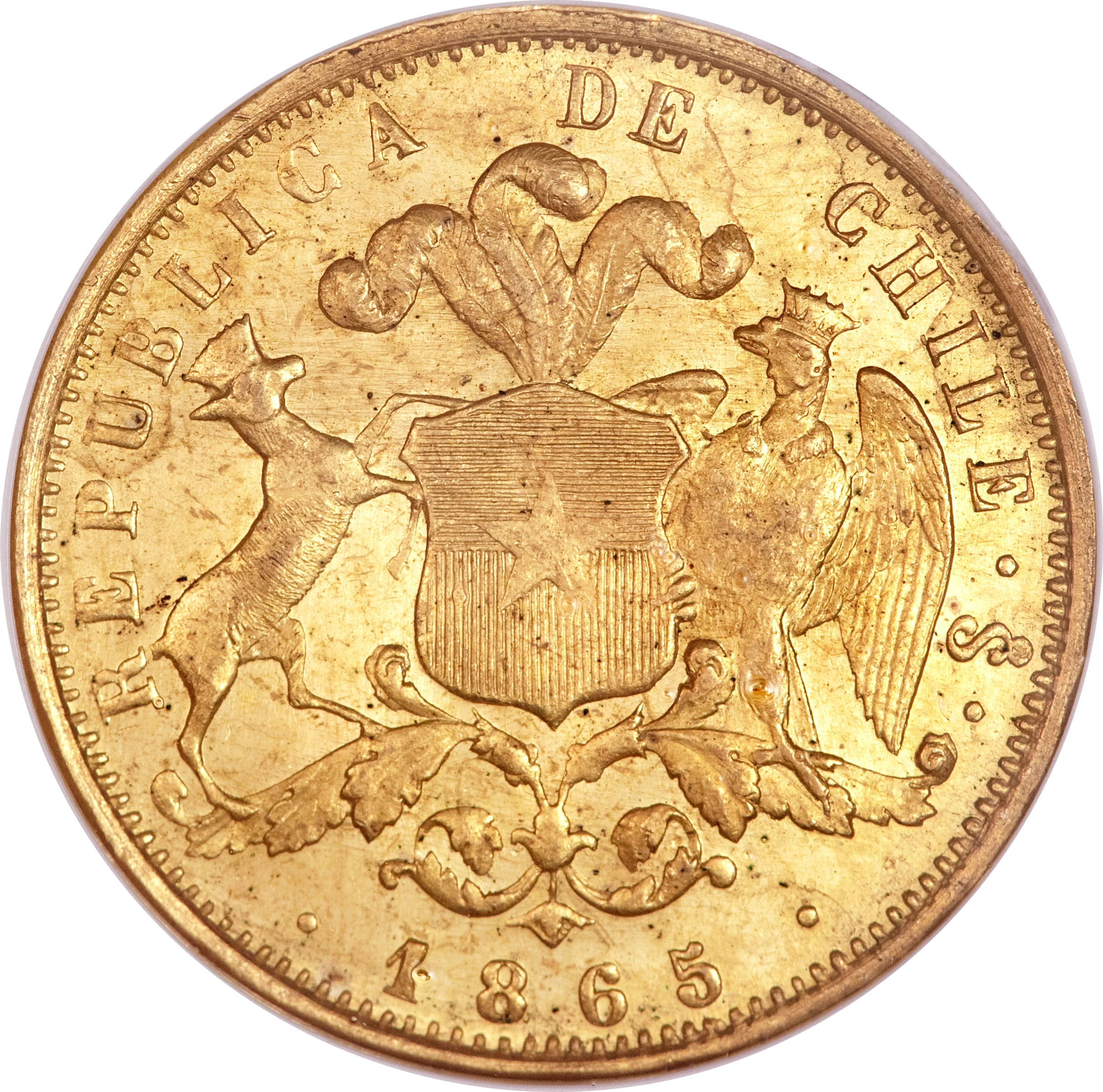
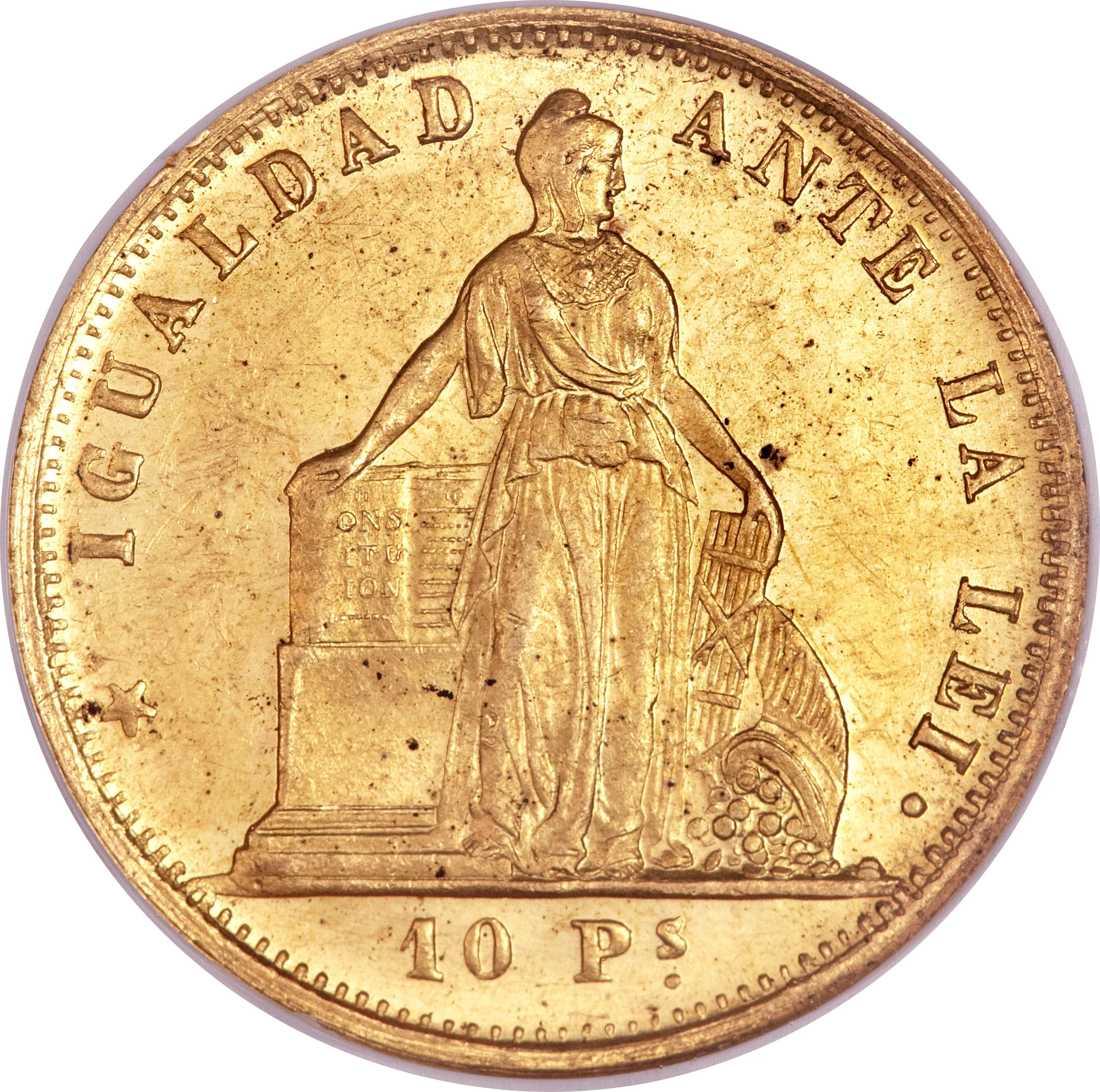

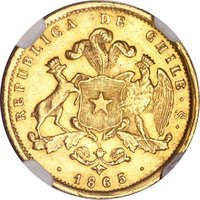
Obverse
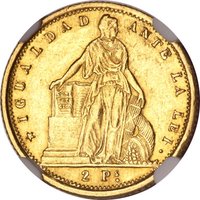
Reverse
Edge
Categories
| Symbol> Cornucopia |
| Symbol> Phrygian cap |
| Symbol> Allegory |
Mints
| Name | Mark |
|---|---|
| Casa de Moneda de Chile | (So) |
Mintings
| Year | Mint Mark | Mintage | Quality | Collection |
|---|---|---|---|---|
| 1854 | So | 195,000 | ||
| 1855 | So | 61,000 | ||
| 1856 | So | 66,000 | ||
| 1857 | So | 20,000 | ||
| 1858 | So | 52,000 | ||
| 1859 | So | 281,000 | ||
| 1860 | So | 31,000 | ||
| 1861 | So | 15,000 | ||
| 1862 | So | 21,000 | ||
| 1863 | So | 25,000 | ||
| 1864 | So | 26,000 | ||
| 1865 | So | 45,000 | ||
| 1866 | So | 66,000 | ||
| 1867 | So | 121,000 |
Historical background
In 1854, Chile's currency situation was characterized by a complex and often chaotic system of multiple coinages in circulation. Following independence, the country had inherited a mix of Spanish colonial coins, alongside currencies from other nations like Bolivia, Peru, and even French francs, which were all accepted in commerce. The primary unit of account was the peso, but its value in real terms was unstable and varied regionally. The state's own minting was limited, and the widespread use of foreign coins, especially those of fluctuating silver content, created significant challenges for trade and public finance, leading to confusion and facilitating fraud.
The government attempted to impose order through laws, notably the 1851 law that officially established a bimetallic system based on the peso of 8 reales and the condor, a high-value gold coin. This law aimed to standardize the national coinage and fix the exchange rate between gold and silver. However, in practice, the system struggled. The fixed legal ratio between the two metals often diverged from the market ratio, leading to Gresham's Law in action: "bad" money (undervalued or debased coin) drove "good" money (full-value coin) out of circulation, as the latter was hoarded or exported. This resulted in a persistent shortage of reliable specie for everyday transactions.
Consequently, by 1854, Chile remained in a transitional and unsatisfactory monetary state. While legislative frameworks for a national currency existed, the tangible reality was one of inconsistency and inflationary pressures. The lack of a uniform, trusted circulating medium hindered economic development and state-building efforts. This unresolved situation would ultimately pave the way for more decisive reforms later in the decade, culminating in the creation of the Caja de Conversión (Conversion Bank) in 1860 and the eventual adoption of a gold standard in the late 19th century.
The government attempted to impose order through laws, notably the 1851 law that officially established a bimetallic system based on the peso of 8 reales and the condor, a high-value gold coin. This law aimed to standardize the national coinage and fix the exchange rate between gold and silver. However, in practice, the system struggled. The fixed legal ratio between the two metals often diverged from the market ratio, leading to Gresham's Law in action: "bad" money (undervalued or debased coin) drove "good" money (full-value coin) out of circulation, as the latter was hoarded or exported. This resulted in a persistent shortage of reliable specie for everyday transactions.
Consequently, by 1854, Chile remained in a transitional and unsatisfactory monetary state. While legislative frameworks for a national currency existed, the tangible reality was one of inconsistency and inflationary pressures. The lack of a uniform, trusted circulating medium hindered economic development and state-building efforts. This unresolved situation would ultimately pave the way for more decisive reforms later in the decade, culminating in the creation of the Caja de Conversión (Conversion Bank) in 1860 and the eventual adoption of a gold standard in the late 19th century.
💎 Extremely Rare